Saturday, August 3, 2019

Concert Review: Peter Asher and Albert Lee at the Dakota Jazz Club

Peter Asher


Albert Lee
On Wednesday night, I saw Peter Asher and Albert Lee at the Dakota Jazz Club in Minneapolis. I’ve seen Peter Asher a couple of times before, and I’ve always enjoyed hearing his music and his stories. Peter was half of the 1960’s British Invasion duo Peter and Gordon, and he later became a top record producer, working with James Taylor and Linda Ronstadt, among many, many others. Peter and Gordon have always been one of my favorite British Invasion groups. I was less familiar with Albert Lee. My Mom had seen Lee at the Dakota before, and she was very impressed with his guitar playing. 

Together, Peter and Albert put on a very fun show. Both of them are big fans of the Everly Brothers, and Albert played guitar with the Everlys for more than twenty years. They opened the show with two Everly Brothers songs, “Bye Bye Love” and “Crying in the Rain.” Of course, the songs provided opportunities for Peter and Albert to weave together the stories of their musical lives. Asher related how he introduced James Taylor to Carole King, and convinced King that she should perform her own songs when she opened for Taylor at the Troubadour in Los Angeles. That story led into the next song, “Handy Man,” Taylor’s cover of the Jimmy Jones hit. Asher encouraged us all to sing along on the “Come-a, come-a” backing vocals, which was fun. 

Asher and Lee then traded off songs performed by the “British Elvis,” Cliff Richard, and the actual Elvis, with Asher singing Cliff’s 1961 hit “A Girl Like You,” and Lee singing “That’s All Right,” Elvis’ first record. Lee also provided excellent guitar solos on “That’s All Right.” Lee then sang “Sweet Little Lisa,” a song he played the guitar solo on for Dave Edmunds’ 1979 LP Repeat When Necessary. (That album featured Rockpile, with the wonderful Nick Lowe on bass.)

Other highlights of the evening included Peter and Gordon’s hit single “I Go to Pieces,” written by Del Shannon, and a lovely version of Buddy Holly’s “Well All Right.” Asher remarked that the style of glasses he wore in the 1960’s was an homage to Holly’s own black framed glasses. 

Lee performed his version of the Green Day hit “Good Riddance (Time of Your Life)” which Lee knew originally only through Glen Campbell’s cover version! The evening ended with a performance of Peter and Gordon’s biggest hit, “A World Without Love,” which topped the charts in both the United States and the UK. Written by Paul McCartney, the song didn’t quite seem to fit with what the Beatles were doing, so Peter persuaded Paul to give the song to Peter and Gordon as their first single. Asher also had to badger McCartney to write a bridge to the song, which Asher says Paul did “in something ridiculous like seven minutes.” And just how did Peter Asher have such access to Paul McCartney? Well, Paul was dating Peter’s sister, the actress Jane Asher, and the Asher’s let Paul live in the third floor of their family home! So it’s because of that connection that Peter Asher became the first person besides John Lennon and Paul McCartney, to hear “I Want to Hold Your Hand,” which was written on the Asher’s piano! 

The encore songs were Peter and Gordon’s last Top Ten hit, the cheeky and silly “Lady Godiva,” and the eternally gorgeous “Let It Be Me,” another song made famous by the Everly Brothers. All in all, it was a fun evening of music and stories from two musicians who have crossed paths with many of rock music’s greatest figures.

Wednesday, July 31, 2019

Book Review: Hope Never Dies: An Obama Biden Mystery, by Andrew Shaffer (2018)

The awesome cover of Hope Never Dies, by  Andrew Shaffer, 2018. Sadly, Joe Biden doesn't drive a t-top 1977 Pontiac Firebird Trans Am in the novel.
Author Andrew Shaffer.


Barack Obama and Joe Biden, best buddies.
Are you sick and tired of the current political situation in the United States? Are you nostalgic for the time when Barack Obama was President, Joe Biden was Vice President, and they would go out for ice cream together? If you answered yes to both those questions, I have the perfect book for you: Hope Never Dies: An Obama Biden Mystery, by Andrew Shaffer. 

In Hope Never Dies, Joe Biden is adjusting to life as a former Vice President when suddenly a longtime Amtrak conductor turns up dead on the railroad tracks. Uncle Joe starts poking around, and eventually gets his friend, former President Barack Obama, involved as well. 

As they did in real life, the fictional Biden and Obama make a good teamBarack is cool and cerebral, Joe is relaxed and shoots from the hip, following his gut. Shaffer writes the book in first person, from Biden’s point of view, and he does a good job at capturing Biden’s stream of consciousness thoughts. As Biden confides to us: “I had something of a reputation for being loose-lipped.” (p.74) 

The plot doesn’t really matter, as it’s all an excuse for us to enjoy seeing Obama and Biden together again, even if it’s only in fictional form. One highlight is Biden waxing poetic about getting to fire up his 2017 Dodge Challenger, with Obama in the passenger’s seat. 

Shaffer has a difficult needle to thread in Hope Never Dies. Should the book feel real, or should it be insanely over the top? Shaffer largely goes for realism, which I think is the better choice. (Although the novel does feature a dream sequence in which Obama is riding a unicorn.) 

Two critiques I have about the book: there are way too many “Joe is a really old guy!” jokes. We know, the guy turned 76 the year Hope Never Dies was released. But he didn’t step in from 1973 on a time-traveling Amtrak train, for crying out loud. (Okay, that sounds like a great idea for a novel: time-traveling Joe Biden! Hoping that the next leap will be the leap home.) He knows that people take selfies! He knows people other than sailors have tattoos! 

My second critique is that there’s just too much material about Biden feeling mopey that Obama hasn’t been hanging out with him enough. It’s just a standard buddy-film trope that gets too much ink here. Hopefully the second Obama Biden Mystery, 2019’s Hope Rides Again, remedies this and just has Barack and Joe being best buds from page one. Because honestly, that’s what we all want. We don’t want Joe moping around about his feelings; we want happy Joe and Barack going out for ice cream.

Monday, July 29, 2019

Book Review: Razor Girl, by Carl Hiaasen (2016)

Paperback cover of Razor Girl, by Carl Hiaasen, 2016.


Author Carl Hiaasen.
Carl Hiaasen has been on my list of “authors I should read” for a while now. I’ve seen his books in stores for years, and they’ve always stuck out, thanks to their eye-catching covers. Years ago I saw Hiaasen interviewed on The Colbert Report and I was struck by his humor. So I finally cracked open a Hiaasen novel this summer. 

Razor Girl, published in 2016, is Hiaasen’s most recent novel, and the second of his books to feature Andrew Yancy as the main character. The cast of Razor Girl is made up of assorted loonies and miscreants, ranging from the titular character Merry Mansfield to Martin Trebeaux, who owns a company that replaces sand on Florida’s beaches, and Buck Nance, the star of a trashy reality TV show. 

There’s no shortage of topics for Hiaasen to satirize in Razor Girl, and his prose keeps the novel humming along smoothly. There are plenty of laughs to be found. One of my own favorite lines was about two transplants to Key West: “At first they were distrusted because of their sobriety and competence, but in time the locals accepted them.” (p.22) 

I’ll forgo a detailed plot summary, since it is quite Byzantine, and just tell you that I enjoyed reading Razor Girl. However, the novel does tend to lose a bit of steam during the last third, as it takes the various strains of the plot a long time to wind down and wrap up. 

My one annoyance with the characters in Razor Girl was how every female character seems to find Andrew Yancy super attractive. I don’t recall Yancy ever being described as especially attractive, but even if he looked like Cary Grant, it’s stretching it to think every woman would be so interested in him. To wit: there’s Yancy’s girlfriend, Dr. Rosa Campesino, although she quickly leaves South Florida for Norway. There’s Merry Mansfield, who starts telling Andrew they will never sleep together as soon as they meet, which, of course, inevitably means that they will sleep together. (I think this rule is related to Anton Chekhov’s saying about not having a loaded gun on stage unless it will be fired.) There’s also Deb, whose fiancée wants to build a home on the empty lot next door to Yancy’s house. Deb loses her engagement ring somewhere on the property, and offers Yancy a blow job if he’ll help her find it. Perhaps offering random strangers oral sex may be de rigueur among neighbors in Key West, but it struck me as a pretty unlikely occurrence.

That being said, I’d still recommend Razor Girl as an entertaining romp, a perfect summer read that will give you some laughs.

Friday, July 12, 2019

Book Review: The Stories of Edith Wharton, Selected and Introduced by Anita Brookner (1988)

The Stories of Edith Wharton, which features the same painting as my edition of Summer, by Edith Wharton. (Photo by Mark C. Taylor)


Edith Wharton, circa 1889.
Edith Wharton is best-known for writing classic novels like The House of Mirth, Ethan Frome, and The Age of Innocence. However, Wharton also published some 85 short stories throughout her career. The Stories of Edith Wharton, a 1988 collection, gathers together 14 of Wharton’s short stories. The stories are presented in chronological order and span her entire career, from her first short story collection, published in 1899, to the last, published in 1937, the year she died. 

The stories in this collection were selected by Anita Brookner, a British art historian who became an acclaimed novelist herselfher 1984 novel Hotel du Lac won the Booker Prize. I didn’t read Brookner’s introduction to the book until I had finished all of the stories, since modern introductions have the terrible habit of often spoiling the plot. (I’m looking at you, Matthew J. Bruccoli’s introduction to The Great Gatsby!) Fortunately, Brookner does not spoil any key plot details in her brief introduction to the book. All 14 of the stories included in this volume show Wharton’s masterful skills at work. 

Wharton was very familiar with the subjects she wrote about. She was born Edith Jones into a wealthy New York City family, who may have inspired the phrase “Keeping up with the Joneses.” Edith was married to Edward “Teddy” Wharton when she was 23 years old. Their marriage was not a very happy one, and eventually Edith divorced Teddy in 1913. 

You might hear the name Edith Wharton and be distracted by visions of Gilded Age New York City and cushy rich people. You might think her writing is all stuffy mansions, tight corsets, and repressed feelings. But that stereotype does Wharton’s writing a disservice. These stories are still relevant, as they show us human behavior, both good and bad, that is universal. There are divorceseven two in the humorous story “The Other Two”and there are affairsof the heart, if not the entire body. Wharton’s writing style still feels modern today, as it is clear and direct, but mixed with a keen eye towards social status and more than a dollop of humor and wit. Here’s the first paragraph from “The Pelican,” the first short story in the collection, from 1898:

“She was very pretty when I first knew her, with the sweet straight nose and short upper-lip of the cameo-brooch divinity, humanized by a dimple that flowered in her cheek whenever anything was said possessing the outward attributes of humor without its intrinsic quality. For the dear lady was providentially deficient in humor: the least hint of the real thing clouded her lovely eye like the hovering shadow of an algebraic problem.” (p.1) 

That’s superb writing, and it paints a vivid picture of the character. Wharton’s keen empathy allowed her to enter other people’s points of view—“The Pelican” and some of the other stories collected here are told in the first person by male narrators. 

Wharton’s sharp wit is on excellent display in the story “The Mission of Jane,” where these two quotes come from:

“Most of his wife’s opinions were heirlooms, and he took a quaint pleasure in tracing their descent. She was proud of their age, and saw no reason for discarding them while they were still serviceable.” (p.33)

“It occurred to him that perhaps she was trying to be funny: he knew that there is nothing more cryptic than the humor of the unhumorous.” (p.34)

“Charm Incorporated” is the funniest story in the book, a light trifle about a man who must constantly take care of his eccentric, but charming, in-laws. The story features this funny and insightful quote:

“Besides, Targett’s imagination was not particularly active, and as he was always sure of a good meal himself, it never much disturbed him to be told that others were not.” (p.272)

Another humorous quote that I quite enjoyed is from the story “The Last Asset”:

“…there was about him a boundless desultoriness which renewed Garnett’s conviction that there is no one on Earth as idle as an American who is not busy.” (p.66)

Wharton is always excellent on the subjects of love and desire, and the following were some of my favorite quotes from these stories:

“…it is not the kiss endured, but the kiss returned, that lives.” (p.92) 

“It was horrible to know too much; there was always blood in the foundations.” (p.117)

“She was sure he felt sorry for her, sorrier perhaps than anyone had ever felt; but he had always paid her the supreme tribute of not showing it.” (p.122)

“Our thoughts met as naturally as our eyes: it was almost as if we loved each other because we liked each other. The quality of a love may be tested by the amount of friendship it contains.” (p.153)

“He supposed afterward that what had happened to him was what people called falling in love.” (p.272)

Wharton wrote a fair number of stories that deal with the supernatural, and two are included in this volume. “Pomegranate Seed” tells the tale of a woman whose husband receives sporadic letters from a mysterious party. “All Souls’” the last story in the book, is quite creepy, and features this great quote at the beginning:

“I read the other day in a book by a fashionable essayist that ghosts went out when electric light came in. What nonsense!” (p.291) 

If you enjoy short fiction, chances are you’ll find something that moves you in The Stories of Edith Wharton.

Thursday, June 27, 2019

Movie Review: Belanger, a Documentary Directed by Dominic Dastoli (2018)


My signed 1981 Topps card of Mark Belanger, and the DVD of Belanger, directed by Dominic Dastoli, 2018.


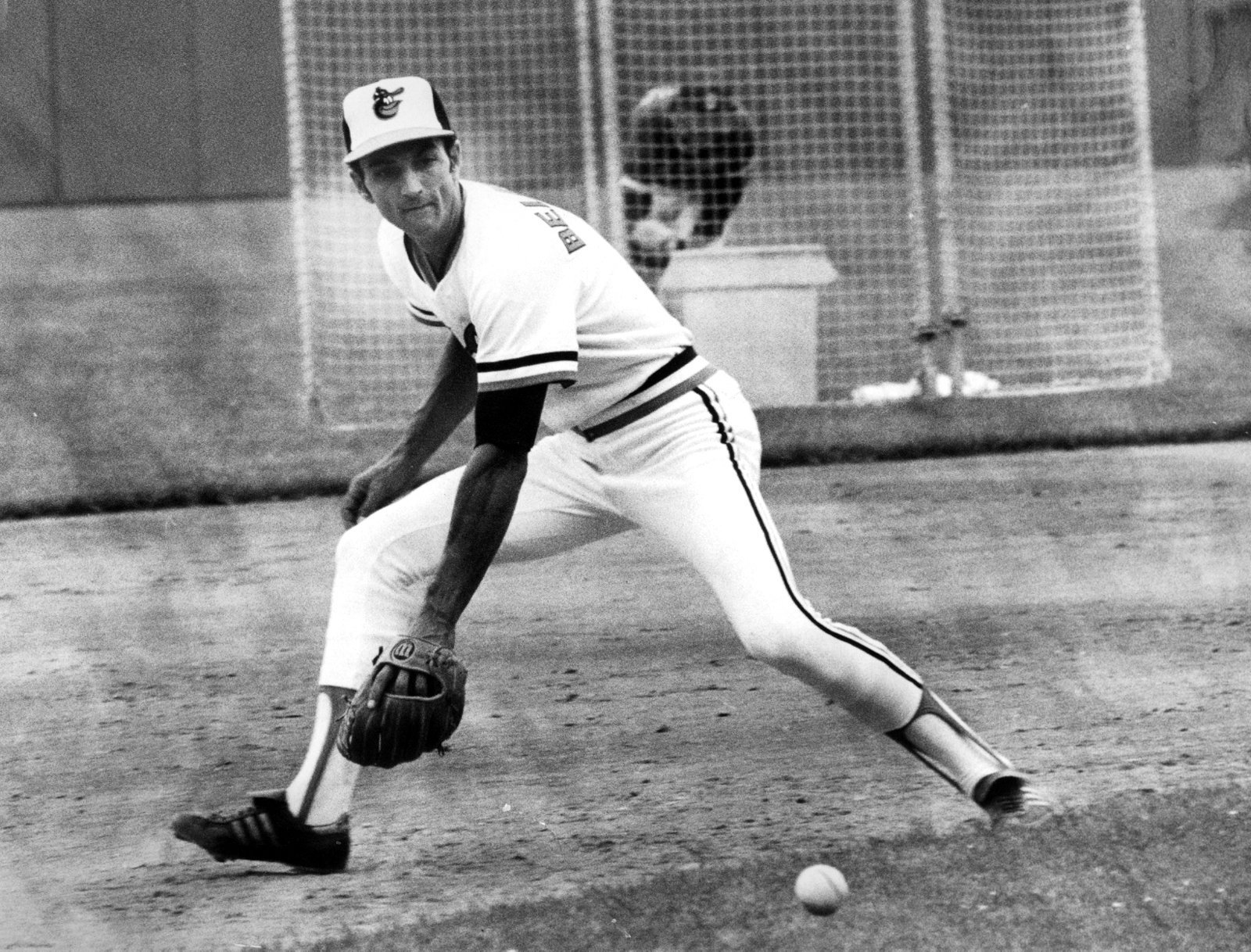
Mark "the Blade" Belanger, about to scoop up another ground ball.
Mark Belanger was the ultimate “good field, no hit” shortstop. Belanger played for the Baltimore Orioles from 1965 until 1981, and one season for the Los Angeles Dodgers in 1982, winning 8 Gold Gloves and accumulating a career batting average of just .228. I’m too young to have seen Belanger play, but because I collected baseball cards from the 1970’s and 1980’s, he was a player I was aware of. I can’t really tell you why I was aware of Mark Belanger when I was a little kid, but my head was full of random details about old baseball players. Sure, I knew superstars from the 1970’s like Reggie Jackson, Willie Stargell, and Jim Palmer, but I also knew random 70’s players like Billy North, John Milner, Mike Lum, and Kurt Bevacqua. I’m sure part of the reason I liked Mark Belanger was because we have the same first name, and he has a cool-sounding last name. What little information I could glean from my early 1980’s Topps cards of Mark Belanger told me two things: 

1. He had played for the Orioles for a really long time
2. He was not a very good hitter
But hitting statistics only told part of Mark Belanger’s story, and for him it was definitely the less interesting part of his story. Sabermetric fielding stats paint a picture of Belanger as one of the finest defensive shortstops ever. Baseball-Reference ranks Belanger second all-time in defensive WAR, just ahead of his longtime infield mate, third baseman Brooks Robinson. In a statistic called Total Zone Runs, which I’m not smart enough to attempt to explain, Belanger ranks as the second best defensive shortstop since 1953, behind Ozzie Smith. Belanger’s 8 Gold Gloves at shortstop still rank as the fourth most at the position. 

I wrote a little about Belanger in my review of Jeff Katz’s book Split Season: 1981. Katz’s book focused on Belanger because he was one of the union player representatives who were most involved in the ongoing negotiations between the players and the owners. It made me more intrigued about Belanger, and in my recent internet sleuthing, I discovered that a documentary about Belanger premiered in 2018. Titled simply Belanger, the film was directed by Dominic Dastoli. Running 70 minutes, the film explores the story of Belanger’s life. It begins with Belanger’s boyhood in Pittsfield, Massachusetts, where he played baseball on a farm field. Belanger achieved high school stardom on both the baseball and basketball fields, and he was courted by college basketball coaches, as well as major league baseball teams. Belanger signed with the Baltimore Orioles just after he graduated from high school in 1962. 

Belanger’s path to the major leagues was blocked by the Orioles’ excellent shortstop, future Hall of Famer Luis Aparicio. Belanger earned September call-ups in 1965 and 1966, but he was not on the roster for the Orioles’ upset of the Dodgers in the 1966 World Series. Once Aparicio was traded to the Chicago White Sox after the 1967 season, Belanger became the Orioles’ regular shortstop. 

Belanger hit for the highest batting average of his career in 1969, when he hit .287, well above the American League’s cumulative batting average of .246. In the film, Boog Powell attributes Belanger’s success with the bat that season to Charley Lau, the Orioles’ hitting coach. Unfortunately, the Orioles let Lau go after the 1969 season. 

Belanger became an integral part of the Orioles’ lineup during their three consecutive trips to World Series, from 1969-1971. These Oriole teams are often mentioned in discussions of the greatest baseball teams ever, as they averaged 106 wins a year. The Orioles lost to the “Miracle Mets” in 1969, and were defeated by the Pittsburgh Pirates in 1971, but they beat the Cincinnati Reds in 1970. Belanger batted just .105 in the 1970 World Series, but he and Brooks Robinson combined to make the left side of the infield impenetrable. 

Belanger features interviews with several of Belanger’s teammates, like Jim Palmer, Rick Dempsey, and Davey Johnson. Brooks Robinson is seen once at the very beginning of the film, and I wish we had heard more from Robinson, as he and Belanger were one of the finest fielding third base and shortstop duos ever. Johnson says of Belanger in the film, “Everything he did was meticulous.” This extended from his fielding work at shortstop to his post-playing days working for the players’ union. Johnson also informs us that Belanger never wore a protective cup when he played! That’s a sign of the confidence Belanger must have had in his own fielding prowess. (Belanger not wearing a cup is confirmed by Tony Kubek in George F. Will's book about baseball, Men at Work.) Rick Dempsey says that he never saw a ground ball go between Belanger’s legs. Even allowing for old baseball player exaggeration, that’s a pretty remarkable statement to make. 

Fortunately, Belanger features enough footage of “the Blade” in action for the viewer to get a sense of how excellent Belanger was in the field. Every motion of Belanger’s was graceful, whether he was ranging left or right, and his powerful and accurate throwing arm fired bullets to first base. One of the plays that I was most impressed by was a catch Belanger made in the 1979 World Series. Willie Stargell hit a pop fly, and Belanger caught it in left fieldhe’s out at normal left field depth, calling off the left fielder to make the catch.

As a kid, I had a book that was called You Are the Manager, or something like that. You’d read about a situation confronting a manager, and then see if the manager did what you thought they should have done. One of the situations in the book was “Who do you play at shortstop for the Orioles in the 1979 World Series?” The choices were slick-fielding but poor hitting Mark Belanger, or poor fielding but good hitting Kiko Garcia. As a kid, I probably went with Garcia because of his bat. Now, I’d stick with Belanger and his stellar defense. Kiko Garcia wasn’t actually that great a hitterin 1979 he hit .247, with 5 home runs. Granted, Belanger hit .167 with zero home runs, but still, it’s not like Garcia was a .300 hitter or a power threat. 

At the very end of the 1981 season, Belanger started to lose playing time to a hotshot young shortstop the Orioles had just called up. His name was Cal Ripken Jr., and he would revolutionize the position of shortstop. There had been good-hitting shortstops before, but very few had combined hitting and fielding excellence the way Ripken did. There’s certainly no shame in losing your job to someone as talented as Cal Ripken Jr. Belanger was a free agent after the 1981 season, and the Orioles made it clear they had no interest in bringing him back. Belanger had also publicly criticized manager Earl Weaver in September, which may have helped to sow the seeds for his departure. The Orioles might also have been sick of having two players who were highly involved in the players’ union, as they also traded outspoken union representative Doug DeCinces during the 1981-82 off-season. 

Belanger ended up signing a one-year contract with the Los Angeles Dodgers. He played sparingly, starting just 12 games for the Dodgers in 1982. He retired at the end of the season. 

Belanger features interviews with family members, and the film presents us with a picture of the man he was off the field as well. When Curt Flood was challenging baseball’s reserve clause, Belanger was one of the few active players to publicly support his case. Belanger’s interest in the players’ union led to him becoming a union representative, and after his retirement, the first former player hired by the players’ union. As Expos pitcher Steve Rogers says in the film, “He spent his life defending.”

Mark Belanger was tall, (6’2”) thin, (175 pounds) and darkly handsome. (He looks better on filmhis baseball cards don’t really do him justice.) He was a devoted father to his two sons, and he took his work seriously, whether it was fielding ground balls or protecting the rights of his fellow baseball players. Unfortunately, Belanger was also a longtime smoker who died from lung cancer at age 54 in 1998. In a sad footnote to the film, Belanger’s son Rob, who speaks eloquently throughout the film about his Dad, died of prostate cancer in 2016 at the age of 47. 

The older I get, the more fascinated I am by baseball players like Mark Belanger. He wasn’t a Hall of Famer, and he only made one All-Star team, but he still made an impact on the sport. Belanger does an excellent job of telling his story.