Wednesday, September 21, 2011

Nemesis, by Philip Roth


I just finished reading Philip Roth’s 2010 novel Nemesis. It’s an excellent book. It’s a short novel, but one that packs a powerful punch. It tells the story of Eugene “Bucky” Cantor, a 23-year-old playground director in Newark, New Jersey, during a polio epidemic in 1944. Bucky, who is a star athlete despite his short stature, is classified 4-F and thus ineligible for the draft because of his bad eyesight. He is sitting on the sidelines while his college buddies are off fighting, and this greatly distresses Bucky. He takes some refuge in the fact that he is running the playground the best way he knows how to, and he is trying to keep the kids happy and healthy while the stifling summer heat and polio take their toll on the Jewish neighborhood of Weequahic. Some of the kids who come to the playground every day are stricken with polio, and one boy dies. This seemingly random tragedy leads Bucky to question his faith in God.

“…he himself hadn’t dared to turn against God for taking his grandfather when the old man reached a timely age to die. But for killing Alan with polio at twelve? For the very existence of polio? How could there be forgiveness-let alone hallelujahs-in the face of such lunatic cruelty?” (p.75)

The city panics as the polio epidemic gets worse. Bucky gets an offer to join his girlfriend, Marcia Steinberg, at a summer camp in the Poconos as a swimming director. He goes back and forth about taking the job, worried that he is abandoning his kids at the playground. He visits Marcia’s father, a doctor, who tells him that he has been doing everything he can for the kids at the playground. Feeling better, Bucky spontaneously asks Dr. Steinberg for Marcia’s hand in marriage. Dr. Steinberg says that he would be thrilled to have Bucky join the family. Bucky decides to leave Newark and take the job in the Poconos. Camp Indian Hill is idyllic, an escape from both the oppressive heat and also the constant threat of polio. Bucky quickly strikes up a rapport with Donald Kaplow, a seventeen-year-old counselor at the camp. Bucky helps Donald with his diving skills. Bucky also has late-night trysts with Marcia, as they paddle out to an island in the middle of the lake and make love. Things couldn’t be better.

Which is, of course, when things start going to hell. Bucky is wracked with guilt over his decision to abandon the playground in Newark. He learns that just a few days after he left the city closed all of the playgrounds. However, this does nothing to assuage his feelings of guilt at having left Newark.

“If only he’d stayed, he would never have had to walk out on his kids and look back for a lifetime at his inexcusable act.” (p.194)

Bucky gets snappish with Marcia when she tells him that she prayed he would be safe from polio. He turns her simple statement into a theological argument, asking her:

“Why didn’t God answer the prayers of Alan Michaels’s parents? They must have prayed. Herbie Steinmark’s parents must have prayed. They’re good people. They’re good Jews. Why didn’t God intervene for them? Why didn’t He save their boys?” (p.170)

Polio finally enters Camp Indian Hill as well, as Donald Kaplow is stricken with it. Bucky is convinced that he is the one who brought polio to Indian Hill, even though there’s absolutely no evidence to support that. The camp doctor tells Bucky he can have a spinal tap performed to see if he has polio, as changes to spinal fluid are indicative of polio. The test comes back positive. Bucky has polio. The novel then fast-forwards a bit, as we learn that Bucky spends more than a year in the hospital, slowly and painfully recovering from his crippling illness, which leaves him with weakened legs.

Nemesis, though it is told from Bucky’s point of view, is actually narrated by Arnie Mesnikoff, who was a child at the playground that Bucky was the director of. Arnie contracted polio in the summer of 1944, and was confined to a wheelchair for a year as he learned how to walk again, with the help of crutches and braces. In 1971 Arnie runs into Bucky in Newark, and they start eating lunch together once a week as Bucky tells him the story of the summer of 1944. Bucky has become a bitter shell of a man, blaming God for his misfortunes. He let Marcia slip away by refusing to let her see him when he was in the hospital. And the one time she did come to see him, he quarreled with her. He says,

“’I didn’t want to ruin her life. She hadn’t fallen in love with a cripple, and she shouldn’t be stuck with one.’” (p.254-55)

Marcia fires back at Bucky,

“’You’re always holding yourself accountable when you’re not. Either it’s terrible God who is accountable, or it’s terrible Bucky Cantor who is accountable, when in fact, accountability belongs to neither. Your attitude toward God-it’s juvenile, it’s just plain silly.” (p.260)

Marcia is exactly right. Bucky presumes that God is responsible for everything bad that happens in the world. But whether or not there is a God does not change the fact that suffering exists. Blaming all of your suffering on God, as Bucky does, does not do anything to change the situation. Whether you think it’s the work of God or simply terrible luck, it’s something that is out of your control. Pain and suffering and unfairness all exist in the world regardless of whether or not there is a God. You have to accept the fact that suffering and misery exist, and Bucky seems unable or unwilling to do this. He is in denial. He’s essentially asking, “Why do bad things happen to good people?” There is no rhyme or reason for why bad things happen to good people. It’s an unfortunate fact of life that terrible things will happen to very good, totally undeserving people.

As Arnie says,

“Sometimes you’re lucky and sometimes you’re not. Any biography is chance, and, beginning at conception, chance-the tyranny of contingency-is everything. Chance is what I believed Mr. Cantor meant when he was decrying what he called God.” (p.243)

Bucky gets a job at the Post Office and settles into a solitary life, bereft of companionship. Arnie was able to overcome his polio in a way that Bucky wasn’t.

“I learned that back there in Weequahic in 1944 I’d lived through a summerlong social tragedy that didn’t have to be a lifelong personal tragedy too.” (p.269)

This is the difference between Bucky and Arnie. Bucky has allowed himself to be destroyed by tragedy, whereas Arnie has moved on with his life. Which begs the question, why do some people survive tragedy and others do not? Life can do terrible things to people. It can deal you a rotten hand from the beginning, or it can buffer you with blows that few people can withstand. And yet there are some people who survive, who keep going in the face of terrible tragedy. It’s probably personality that accounts for why some people can survive tragedy and some people cannot. Surviving tragedy certainly isn’t easy to do, and Arnie admits that it took him some difficult years to arrive at the point we find him in 1971. But if you stay stuck in the past as Bucky does, you run the risk of letting that tragedy define your life. Arnie contrasts Bucky with the most famous victim of polio, the President of the United States in 1944, FDR. Bucky remained mired in the past, obsessing over what he could have done differently. FDR, after contracting polio at age 39 in 1921, became the Governor of New York and the country’s only four-term President. FDR never walked again. He never regained the full use of his legs. But did he consider himself a failure? I don’t think so. He was a man full of optimism, and for him, every day was probably a small victory against a disease that had left him disabled.

Roth’s writing throughout Nemesis is sharp and vivid as he brings Newark in 1944 to life. Roth has an eye for details, and his sentences are very well-crafted, which is why I have used so many quotations from the book. Because Roth lived through the years of polio epidemics, and was about the same age as the kids on the playground in 1944, this subject must have struck a chord with him. Polio is a word from the distant past for someone of my generation, but it must have been a truly frightening childhood fear back in the 1940’s. The only other Philip Roth book I’ve read is the short novel Goodbye, Columbus, which won him the National Book Award in 1960. It’s been more than 10 years since I read Goodbye, Columbus, which means I should probably re-read it. Nemesis is a great book, and I’m looking forward to reading more of Philip Roth.

Thursday, May 26, 2011

Richard Burton and Lana Turner in “The Rains of Ranchipur” (1955)


Because Richard Burton is my favorite actor, and I have committed myself to the goal of seeing as many of his movies as I possibly can, I have seen many terrible movies. “The Rains of Ranchipur” is one of them. Set in India, and released in 1955, it was not a hit at the time. It was a remake of 1939’s “The Rains Came,” starring Tyrone Power and Myrna Loy. So why remake a movie that was only 16 years old? Good question. I have no idea. As far as I can tell from reading about the film, the only reason for making the film was to showcase the disasters of the rains in the glories of CinemaScope. The picture was rushed into post-production, as it was shot during August and September of 1955, and released in December, 1955.
The first thing wrong with “The Rains of Ranchipur,” besides the fact that it’s a rather unnecessary remake, is that Richard Burton plays a Hindu doctor. Yes, really. And he does a pretty bad job; it’s really just watching Richard Burton with a tan. Despite the help of a voice coach, Burton was not able to imitate an Indian accent, so he just gave up. Burton was a very talented actor, but he was certainly not a character actor.
Burton plays Dr. Safti, a doctor in the town of Ranchipur, who is doing all he can to help the sick and the poor in post-independence India. The gorgeous Lana Turner plays Lady Edwina Esketh, who is unhappily married to Lord Esketh, played by the hulking actor Michael Rennie. The Eskeths are in Ranchipur to buy some horses. You know, just making a trip to India to get some horses, doesn’t everyone do that? Probably my favorite part of the movie is a scene at the very beginning. There’s a long scene with Turner and Rennie in a train on the way to Ranchipur, and they simply discuss their empty marriage. It’s a long scene, probably 4 or 5 minutes with no breaks, no cuts, and no edits. I love seeing long scenes unfold in real time. To me it’s always been a hallmark of old movies. There’s no fancy camerawork, you just have to listen and watch, and be pulled in by the story. And I was.
Burton and Turner meet at a party, and there is an immediate spark of attraction between them. But Edwina is a totally spoiled, selfish person, and Dr. Safti is totally selfless. Eventually they acknowledge their feelings for each other and start having an affair. There’s a climactic scene where Lord Esketh and Dr. Safti go tiger hunting, and, as you can probably guess, bad things happen. Esketh gets attacked by the tiger; Safti has to shoot the tiger and in the process wounds Esketh. Dr. Safti then has to nurse Esketh back to health, an awkward situation for the two men. I found Lord Esketh to be an interesting character, he and Edwina have a very complicated relationship, and Lord Esketh comes off as a rather sympathetic character. Rennie does a good job playing a man who is somewhat lost in his own life, blessed with money, but still not happy.
Another plot in the film involves Fred MacMurray, who plays Tom Ransome, a rich alcoholic American who is romantically wasting away. A young girl, Fern Simon, played by Joan Caulfield, starts hanging around Ransome and tries to persuade him to become interested in life again.
And then the rains come, there’s both an earthquake and a flood, and Dr. Safti has to rush off and save lives, leaving Edwina behind. She becomes very ill herself, and Ransome takes care of her while also trying to get to Safti to let him know how sick she is. This is the part of the movie where we get our magnificent CinemaScope disasters, which seem to take too much pleasure in the tragedies we are seeing. Ransome, who is an architect/designer by trade, risks his life to blow up a dam and thus saves Ranchipur from further disaster. (Don’t ask me how blowing up a dam is good, it doesn’t seem to make a lot of sense.) Ransome does not admit to the deed, but Dr. Safti cleverly lets Fern know that it was Ransome. I’m paraphrasing what Safti actually says, but it’s something like, “It must have been someone who had a great deal of knowledge on how dams are built and constructed, to have put the dynamite in exactly the right place. And someone who cares a great deal about the people of Ranchipur.” Anyway, Fern knows that Ransome is once more engaged with life, and they are paired off at the end of the film.
After she recovers, Lady Edwina has decided that she actually does care about some things in life other than herself, and she leaves Dr. Safti, knowing that Ranchipur needs him more than she does. In her first selfless act, she leaves Ranchipur with her husband.
There is an interesting film somewhere in all of this, but it didn’t quite make it to the screen. Dr. Safti is pretty much a saint, and he is not a very interesting character. His only flaw is that he’s attracted to Lana Turner, and I think just about every man would have been attracted to Lana Turner in 1955. There are a lot of things that happen off screen that might have made interesting scenes. Edwina talks at one point about Dr. Safti showing her the slums where the poor people live, but that all happens off-screen. It might have been a good scene to show Edwina’s gradual change of heart. Lana Turner is gorgeous in the movie, and parts of the story are interesting, but it doesn’t add up to a successful film. Apart from the first few minutes of the film, I don’t know that any of the movie was actually filmed in India, which is a shame. And IMDB lists the only filming location as being in Pakistan, so maybe what I thought was India at the beginning isn’t even really India.
The lack of realism in this film leads to the next problem with it. Apart from some of the extras, I don’t think that anyone in the cast is actually Indian. Of course, the unspoken reason for casting someone so totally unsuitable for the part of Dr. Safti is because in 1955 you could not have shown a romance between an Indian man and a white woman on screen. I’m pretty sure that no Indian actors were even considered for the part of Dr. Safti. This racism dates the film quite badly, and the utter ridiculousness of casting someone who was English/Welsh to play someone from India is insulting. The other major Indian character in the movie is the Maharani, the woman who basically runs Ranchipur. She is played by Eugenie Leontovich, who was born in Russia! Hollywood still had a long way to go when it came to portraying people other than Americans and Europeans.
In all of the Richard Burton biographies I consulted for writing this post, (yes, I really do research these movies before I write about them!) they all basically say that Burton and Turner had a pretty frosty relationship. All except for Michael Munn’s 2008 book, “Richard Burton: Prince of Players.” Munn was a close, personal friend of Burton’s, and according to him, Burton says he had a relationship with Turner. In the book, Burton is quoted as saying, “She was not someone I loved. She was just incredibly attractive and remarkably good in bed.” Well, okay, good to know! It’s not that surprising, given the romantic histories of both Burton and Turner, that they might have had an affair. (Between the two of them, they were married 13 times!) They were two remarkably attractive people, and Burton was well-known for trying to bed all of his leading ladies. (I think that Burton’s first wife, Sybil, whom he left for Elizabeth Taylor, deserves some kind of medal for putting up with him for so long!) By all accounts, Burton was supremely bored with the film, and he wrote it off by saying, “It never rains but it ranchipurs.”
It’s interesting to compare the careers of Burton at Turner in 1955, as they made this film. Burton turned 30 in 1955, and he was regarded as a promising young actor. His most successful films to date were 1952’s “My Cousin Rachel,” and “The Robe,” the 1953 religious epic that introduced CinemaScope to audiences. Turner was only 4 years older than Burton, yet she was a movie veteran by 1955, and was past the peak of her popularity, which occurred in the 1940’s. After “The Rains of Ranchipur” Turner still had a couple of hit films, like 1957’s “Peyton Place,” and 1959’s “Imitation of Life,” but after she turned 40 in 1961, her filmography is rather undistinguished. By contrast, nearly all of Burton’s most famous movies were made around the age of 40. Of course, it’s a bit unfair to compare them because Turner and Burton were very different kinds of movie personalities. Turner was discovered by Hollywood because she was gorgeous. She was a movie star who didn’t really need to be a great actress as long as she was still beautiful. Although his good looks undoubtedly helped, Burton was signed by Hollywood because of his raw talent on the London stage. But I still think it’s interesting to contrast how Turner’s career as a leading lady was basically over as she started to age, whereas Burton was still playing leading roles until he died at age 58. I think it’s generally true that it’s easier for male actors to keep playing leading parts as they age, and it’s more difficult for female actors. This gender inequity is still visible in movies today, as there are fewer and fewer parts for actresses once they start to show their age.

Wednesday, May 25, 2011

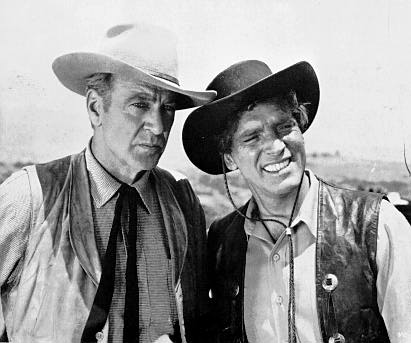
Gary Cooper and Burt Lancaster in "Vera Cruz" (1954)


I recently watched the 1954 western "Vera Cruz," starring Burt Lancaster and Gary Cooper. It's a very good movie, and somewhat ahead of its time. It's also a really fun movie to watch. The plot is really complicated, and it takes place in Mexico after the U.S. Civil War, during the Franco-Mexican War. Gary Cooper plays, well, Gary Cooper, of course. Actually he plays Ben Trane, a former Confederate soldier. (Gary Cooper from the South? Really?) In these post-Civil War westerns, why does everyone play a former Confederate? Aren't there any former Union soldiers doing anything interesting? Of course Trane was one of those nice Confederates who was just protecting his family farm, or whatever, and just happened to fight for the side supporting slavery. Lancaster plays Joe Erin, an American living in Mexico. After Trane and Erin meet, they team up to become mercenaries and make some easy money. They eventually meet Emperor Maximilian I, who hires them to escort a countess to the port of Veracruz. From that point on, there are crosses and double-crosses, as the plot thickens and leads to the inevitable showdown between Trane and Erin.

Cooper does a good job playing the sort of character he played a lot, the decent, good-hearted fellow. But it's Lancaster who steals the show as the villainous Joe Erin. Lancaster uses all of his movie star chemistry to make us like Erin, even though he's clearly a bad guy. It's a flashy performance, and for it to succeed, Burt needed a more subdued actor like Cooper to play off of. Lancaster does everything he can to draw attention to himself, from eating like a wild animal at the emperor's banquet to nearly breaking the fourth wall by turning to the camera and giving a huge grin for no reason at all as Erin finishes washing his face. Lancaster draws you into liking Erin, even though he's a contemptible man. Erin's outbursts of violence are random, as when he picks on one of his fellow outlaws as the men are dancing. He isn't violent for any specific reason; he's violent just because he can be. In a way, Erin is an early example of an anti-hero, a character type that movie audiences would see much more of in the 1960's. Because of Erin's sociopathic nature and the rather violent story, some critics have seen "Vera Cruz" as a precursor to Sergio Leone's westerns of the 1960's. Lancaster gives a great performance, and he definitely elevates the movie.

Lancaster's production company produced "Vera Cruz," which meant that, typical of the movies that Lancaster produced, the script wasn't finished when filming began, and the film went over budget. Fortunately, "Vera Cruz" was a big hit and it didn't matter. Originally, Lancaster was going to play the Ben Trane part, and he apparently wanted Cary Grant to play Joe Erin. Cary Grant in a western? As a villain? Grant said, "I don't go near horses." Lancaster then took the role of Erin and approached Cooper for Ben Trane. Clark Gable had just seen Burt in "From Here to Eternity" and advised Cooper to turn the part down, telling Cooper, "That young fella will wipe you off the screen, Gary." Cooper said yes anyway. (Gable would go on to star with Lancaster in the 1958 submarine movie, "Run Silent, Run Deep.") When shooting started, it was Lancaster who had doubts about Cooper's acting style. After the first few days of filming, Lancaster told a friend, "Coop is just throwing this away. Coop isn't doing anything. I have to compensate. I have to put energy into the scenes." But once the rushes from the first few days came back, Lancaster said, "There I was, acting my ass off. I looked like an idiot, and Coop was absolutely marvelous." Once he saw how effective Coop's silent style was, Lancaster ordered that the first three days of the film needed to be reshot. Also typical of Lancaster movies, Burt was involved in just about every aspect of the film, which annoyed director Robert Aldrich. (Burt was kind of a control freak; it’s probably just as well that he and Warren Beatty never made a movie together.) And how did the two stars get along, conservative Cooper and liberal Lancaster? Very well, despite being almost complete opposites, according to "Against Type," Gary Fishgall's biography of Burt. Lancaster would even serve as an honorary pallbearer when Cooper died of lung cancer in 1961.

Wednesday, May 18, 2011

"Phil Ochs: There But For Fortune"


I saw Kenneth Bowser's powerful documentary "Phil Ochs: There But For Fortune," a couple of weeks ago at the Minneapolis/St. Paul International Film Festival. It's an amazing film, and I would recommend it to anyone who's interested in Ochs or the folk scene of the 1960's. It presents a portrait of a talented and gifted man who sadly died way too young.

Bowser was able to interview just about anyone still living who had a significant connection to Phil Ochs. (Not surprisingly, he wasn't able to interview Bob Dylan.) Ochs started out as a folk/protest singer, writing his own material about the various troubles of the day, very much like Dylan. Eventually, inspired by Dylan and the Beatles, Ochs started writing more personal material, although he still wrote the occasional straightforward protest song. Ochs had little commercial success during his lifetime, and remained more of a cult figure. Apparently, Ochs always thought that he was just about to break out commercially, and he proudly predicted that his 1967 album "Pleasures of the Harbor" would go to number one. It's highest chart position was 168. Dogged by poor reviews at the time, it's now considered Ochs's masterpiece. Ochs's material was very uncompromising, and it's hard to imagine that he didn't see why he wasn't more successful. Maybe his enthusiasm was just his way of covering up his insecurities. Phil Ochs did not write simple love songs that would have been surefire hit singles. The closest Ochs came to having a hit single was his song, "Outside of a Small Circle of Friends," from the "Pleasures of the Harbor" album. It's a great, funny, witty song, given a jaunty arrangement courtesy of Lincoln Mayorga's piano playing. But here's the first verse of the song:

Oh, look outside the window
There's a woman bein' grabbed
They've dragged her to the bushes
And now she's bein' stabbed
Maybe we should call the cops
And try to stop the pain
But Monopoly is so much fun
I'd hate to blow the game
And I'm sure it wouldn't interest anybody
Outside of a small circle of friends

It's a brilliant satire of apathy, specifically referencing the then-current case of Kitty Genovese, who was stabbed and killed in New York City. Neighbors who overheard the attack did nothing because they "didn't want to get involved." It's a great song, but when the first verse of your song features a stabbing, it's probably not going to get a lot of Top 40 airplay. It's a great example of how Ochs created powerful songs that were totally uncommercial. People don't always want to be reminded of bad things when they listen to music, sometimes they just want to escape. But Ochs was not about to compromise his vision of his music.

As the 1960's came to an end, Ochs had lost his optimism about America. The war in Vietnam was still raging on, MLK and RFK were dead, Nixon had won the 1968 election, and Chicago police had savagely beaten protesters at the 1968 Democratic convention. Ochs started drinking more and more heavily, and he started to exhibit signs of bipolar disorder. And for whatever reason, he became unable to write new material. Even trips abroad did not spark his creativity. After his 1970 album, facetiously titled "Greatest Hits," another bit of irony that seemed to go over people's heads, Ochs released just 5 more songs during his lifetime. I wonder if Ochs might have had an easier time today, at a time when people get irony. I sensed from the movie, and from reading parts of biographies of Ochs, that sometime his audience didn't understand him. Few people seemed to understand at the time that Ochs dressing up in a gold suit like Elvis to promote his "Greatest Hits" album was at least a little bit ironic. Or maybe a lot ironic. They just booed him because he was performing 1950's rock songs and not the protest folk they wanted to hear. They were angry at him for confounding their expectations. Nowadays it would at least be easier for Phil to explain exactly what he was trying to do, and the meaning behind it.

The film features all kinds of amazing film footage of Ochs, which is reason enough to go see it. I got more of a sense of who this remarkable man was. There's even some heartbreakingly sad footage of Ochs in his final manic state, when he insisted that everyone call him "John Butler Train." Unlike Ochs, Train was mean and belligerent, and ruined some of Ochs's friendships. When Train left in early 1976, never to reappear, he left behind a shattered Phil Ochs, who thought that he could never repair the relationships he had broken. What Ochs didn't know, or didn't allow himself to acknowledge, was that people would have forgiven him, life could have gone on. There were still people hungry for his music, who would wonder, what would Phil Ochs have written about this? Phil Ochs chose to end his own life on April 9, 1976, at the age of 35. Phil may be gone, but his music lives on, and it's still touching people's lives today. I was born 5 years after Phil died, but his music and his spirit means so much to me. He's truly one of my heroes, and I wish he were still alive today.

Sunday, April 17, 2011

Michael Feinstein at Orchestra Hall


The singer/piano player and Great American Songbook archivist Michael Feinstein was at Orchestra Hall last month for two concerts that focused on his 2008 album, "The Sinatra Project." It was a fantastic concert, Michael's voice is as good as it has ever been, and I think this is one of his strongest albums. I've been a fan of Michael Feinstein's music for a long time, ever since I was about 9 or 10 years old, and he and Harry Connick were really my entry points into the Great American Songbook. (My appreciation for Frank Sinatra, Dean Martin, and Bobby Darin would come in my teens.)

For those of you who need a little intro to Michael Feinstein, he worked as Ira Gershwin's archivist at the end of Ira's life, and then he started playing piano in clubs, which eventually led to a record deal. He's been making records since the mid-80's, at the pace of about one a year, most of which focus on songs from the Great American Songbook. Feinstein is dedicated to preserving the legacy of these songs, and he does deep research into them, often performing forgotten verses or special lyrics that were written for a radio show but never before recorded. He's as much an archivist and historian as a performer. It's clear from every song he sings that he really cares about these songs and loves them. But it doesn't mean that he treats them as musty museum pieces. On the contrary, he sees how these songs can still be vital in the 21st century. His PBS program, "Michael Feinstein's American Songbook," which aired last fall, gives viewers a closer look at what Feinstein does. From going to antique sales to cleaning out storage spaces of a composer who has passed away, Feinstein is always on the lookout for rare material. He's a terrific singer, with a pure tone, and you can always hear the happiness in his voice. His piano playing is also extraordinary, although he doesn't often feature his own playing on his records.

The "Sinatra Project" album is very good, in part because Feinstein isn't trying to imitate Frank, and most of the songs he sings on the album are not indelibly associated with Sinatra. He even sings one song that Sinatra never recorded, "The Same Hello, the Same Goodbye." (It was written by Alan and Marilyn Bergman for Sinatra, but he never recorded it, despite liking the song.) One of my favorite songs from the album is Cole Porter's "Begin the Beguine." Sinatra only recorded "Beguine" in the 1940's, but Feinstein re-imagines it as arranged by Nelson Riddle, in the style of Sinatra's 1956 recording of "I've Got You Under My Skin." (Both songs use what Riddle called "the heartbeat rhythm," also a feature of Sinatra's recording of "Night and Day.") Feinstein swings hard on Porter's "It's All Right With Me," and it's nice to hear him sound a little more jazzy than he usually does.

In concert Feinstein added more songs associated with Sinatra, which makes me hope for a Volume 2 of the Sinatra Project. He led off with a medley of "Luck Be a Lady/All I Need Is the Girl," mixing one of Frank's most well-known swingers with an underrated gem. (Check out Frank's 1967 recording of "All I Need is the Girl," with Duke Ellington, it's amazing!) Feinstein is equally at home singing ballads or up-tempo songs. For most of the concert he just sang, but he would occasionally sing a song solo at the piano, which was wonderful to hear. You could have heard a pin drop when he sang a solo of "Time After Time." Beautiful. Feinstein has amazing control over his voice, and he seems to be using his upper range more, as he ends a lot of songs on a high falsetto, which is very affecting. Feinstein brings such a joyous energy to performing that you can't help but be charmed by him. (Although he didn't do any of his impersonations this time. In previous concerts he's veered into note-perfect mimicry of Liberace, Peter Lorre, and Jackie Mason.) Here are the songs that he sang, in mostly correct order:

Luck Be a Lady/All I Need is the Girl
I Thought About You
Exactly Like You
Time After Time
Brazil-instrumental
Fools Rush In
What Kind of Fool Am I?
Just One of Those Things
Once in a Lifetime
How Do You Keep the Music Playing?
Begin the Beguine
So In Love
All My Tomorrows/All the Way
I Remember You
For Once In My Life-which was apparently one of Frank's favorite songs, I had no idea!
Theme from New York, New York

All in all it was a wonderful concert, it's at least the fifth time I've seen Michael Feinstein in concert, and he never fails to put on a great show!

Thursday, January 27, 2011

The Films of Warren Beatty: "The Only Game in Town," starring Warren Beatty and Elizabeth Taylor, directed by George Stevens (1970)


Warren Beatty became a full-fledged movie star after producing and starring in "Bonnie and Clyde" in 1967. The movie helped usher in the "New Hollywood" era of films, and it also made Warren Beatty a very rich man. Warner Brothers had such little faith in "Bonnie and Clyde," thinking that it would merely be a "B" movie, that they gave Beatty 40% of the profits. According to imdb.com, "Bonnie and Clyde" cost $2.5 million to make, and grossed about $50 million in the US alone. Good job, Warren. So, what movie did Beatty choose as his follow-up? Typically for Beatty, he waited and waited, and turned down a classic movie, "Butch Cassidy and the Sundance Kid." Beatty then accepted the offer to replace Frank Sinatra in director George Stevens' last movie, "The Only Game in Town," where he would co-star with Liz Taylor. Beatty was a huge admirer of Stevens's work, and basically said yes to the movie just so he could work with him. Stevens directed many great movies like "Gunga Din," "A Place in the Sun," with Liz Taylor and Montgomery Clift, "Shane," and "Giant," with Liz, Rock Hudson, and James Dean. Unfortunately, "The Only Game in Town" is not one of his great movies. Ever polite, Beatty defended his decision, saying, "I always thought that it was probably one of the most sensible decisions I had made because I got the chance to work with George...ultimately it was more rewarding to me to have made a sort of an unsuccessful picture with him." Beatty soaked up everything from Stevens, who was a perfectionist with a tendency to over-shoot. (Just like Beatty would be as a director.) Beatty was amazed by Stevens's calm demeanor, and remarked that he never once heard Stevens raise his voice on the set. Beatty tried to handle himself the same way as a director.

"The Only Game in Town" is set in Las Vegas, but it was mostly filmed in Paris. Why, you might well ask. Well, because Richard Burton was a tax exile from England and could only spend a small number of days a year in the UK. So Burton's latest movie, "Staircase," though set in London, was being filmed in Paris. (In "Staircase" Burton and Rex Harrison play gay hairdressers. Really.) And Liz wanted to be in the same city as Richard. Therefore, extremely expensive facsimiles of Vegas casinos were built in Paris to accommodate Liz. Ah, show-biz!

"The Only Game in Town" was actually a play before it was a movie, running on Broadway for 16 performances in 1968. Frank D. Gilroy, the playwright, must have clicked his heels for joy when 20th Century Fox bought the film rights for $500,000 before the play even opened! It's basically a two-person character study, as the film focuses on chorus girl Fran meeting cocktail bar piano player Joe. Fran has been in Las Vegas for five years, and Joe is planning to leave for New York City as soon as he can save $5,000. Joe soon hits a lucky streak and wins $8,000 at the casinos. He tells Fran he wants to have one more nice night on the town before he leaves the next day. In an excruciating scene, we watch as Joe gambles away all $8,000. Which explains why he's been in Las Vegas for 5 years trying to save $5,000. Just as Joe is waiting for the perfect time to leave Vegas, which may never come, Fran is waiting for her lover, married and living in San Fransisco, to finally divorce his wife and marry her. In the meantime, Fran invites Joe to move in with her. No strings attached, free to leave whenever either one pleases. Eventually Fran's lover comes back with what seems to be the perfect news: he's gotten a divorce, and now they can get married. He's booked them tickets for a honeymoon starting that night. But after saying goodbye to Joe on the phone, Fran realizes that she is in love with Joe, and doesn't leave with her lover. (In a very un-Liz Taylor like moment, Fran even gives him back the ginormous ring he bought her!) So, what happens at the end? Well, I won't spoil that for you.

"The Only Game in Town" is actually a pretty good movie, it's certainly better than I thought it would be, and better than it's reputation would suggest. It was a flop when it was released in January 1970. The movie cost about $10 million to make, took a very long 5 months to shoot, and only grossed $1.5 million in the US. But it's an interesting story, and it features a very good performance from Beatty. Like many other Beatty characters, Joe is a charmer who is very adept at reading people and getting his way. His dreams are less grandiose than most of Beatty's characters, as his only real goal seems to be making it to New York. Joe is actually a well-written character, in part because he is very sarcastic and ironic, which makes his character seem much more modern. You could give Joe's lines to a character in a contemporary romantic comedy with no trouble at all. Sinatra actually would have been quite good for this part, the only problem is that he was about 20 years too old for it. (A piano player in his early 50's who is trying to make $5,000 to get to New York? Um, no.)

Liz is good, but her voice drives me nuts sometimes, as she has a tendency to screech her lines when she yells. She can sound so shrill and harsh. And whoever designed the wardrobe for Liz should have been fired. It's obvious from the way Liz is dressed that she must have gained some weight around the middle, as all of her clothes are really big and baggy on her, which just makes her look larger than she really was. She was only 36 when the movie was filmed, and still had a gorgeous figure, but you'd never know it from this movie.

And how did Richard Burton feel about his wife making a movie with Hollywood's new Don Juan? According to his journals he was a bit jealous. (Personally, Richard Burton and Warren Beatty would both be on my list of guys I would not want my wife to make a movie with.) Burton was on the set when Liz and Beatty filmed their love scene, and he played some George and Martha-like mind games, saying to them, "I say Elizabeth, don't you think you should be a bit closer to your lover? And Warren, you look a touch bashful. Is my presence making you nervous?" According to everything I've read, nothing happened between Liz and Beatty. I would think that Beatty would have tried to do everything he could to impress Burton, as the young Beatty had a pattern of seeking out friendships with older men who were more established in their careers, but I can't find any evidence of this from biographies of Burton or Beatty.

"The Only Game in Town" is certainly a curio, and it's not good enough for me to recommend it without reservations. It's not available on DVD, but I caught it on the Fox movie channel. But if you like old movies that are somewhat talky, or if you want to see two amazingly pretty people go gambling, or if you want to see Warren Beatty be incredibly snarky, this is the movie for you.

Monday, January 24, 2011

Mint Condition, by Dave Jamieson


It's the baseball off-season, so I thought reading a book about baseball would be the best way to keep the spirit of baseball alive during the gloomy winter months. "Mint Condition: How Baseball Cards Became an American Obsession," by Dave Jamieson, chronicles the history of baseball trading cards, from their introduction in the 1870's and 1880's to the present day. Confession: I love baseball cards. I collected them voraciously in my childhood, and I still make the occasional purchase online or at a card show. Jamieson is only a couple of years older than I am, so his memories of the baseball card boom of the 1980's and the collapse of the baseball card market in the 1990's are my childhood memories as well. And Jamieson gets extra points because his all-time favorite baseball card set is the 1987 Topps set, which is my all-time favorite set as well. (You can see an example of the 1987 Topps set above.)

But onto the book itself. Jamieson dug deeply into the rich history of baseball cards, and I learned a lot from this book. The first time baseball cards created a sensation among young boys was in the 1880's, when cigarette companies inserted cards into their packs of cigarettes. This had the dual effect of both promoting brand loyalty to collect more cards, and also of making these young boys eager smokers. Win-win for the cigarette manufacturers. According to Jamieson, the popularity of the baseball trading cards helped establish cigarettes as a tobacco product at a time when they were seen as hopelessly lower-class. (People with status smoked cigars or pipes.)

Back in the olden days, baseball cards were not issued every year, and the next time they make a major reappearance is around 1905-1915. These cards were again mostly made by cigarette companies, and they included the most famous baseball card of all time, the 1909 T206 Honus Wagner. The Wagner card is noteworthy not only because Wagner was one of the greatest players of his era, but also because it was produced in very limited quantities. Sources vary as to whether Wagner objected to the card because he did not want to be associated with a tobacco product, or if he was angry because the company was using his image without his permission. Whatever the reason, the Wagner T206 is very scarce, and an example of it in good condition has sold for more than $2 million at auction, making it the single most expensive baseball card ever.

After around 1915 tobacco companies stopped issuing baseball cards, presumably because their product was selling so well that they saw no need to include giveaways like trading cards. There was a lull in the baseball card market until 1933, when Goudey, a gum company, started producing baseball cards again. Goudey would include 1 card as an enticement to purchase a stick of gum for 1 penny. The Goudey cards were very successful, and a number of other gum companies, notably Bowman, jumped on the baseball card bandwagon. By the late 1940's, Bowman had established itself as the leading baseball card maker. But within a decade the Topps gum company, despite coming late to the baseball card party, would have a virtual monopoly on baseball card production. How exactly did this happen? Jamieson is able to shed some light on it, but I would have liked more detail on the battle between Topps and Bowman. Topps issued it's first real set of baseball cards in 1952, and in 1956 Bowman sold their baseball card rights to Topps. How did Topps bring down Bowman in just 4 years? Well, a lot of the credit goes to Sy Berger and Woody Gelman, who basically created the 1952 Topps cards, and in doing so, created the prototype for the modern baseball card. Berger and Gelman chose the dimensions that nearly all baseball cards would use from that point on, and they decided to include statistics on the back of the card. That was huge. Bowman's cards had narrative sentences on the back, which might incorporate some stats. It would usually read something like this: "Zernial batted .262 and slugged 29 homers while patrolling the outfield last season. The A's have high hopes for this young slugger in the years to come!" But Topps had a full row of all the most important stats from the previous season, hits, runs, RBIs, home runs, batting average, and they also had the player's career totals. And this was at a time when these stats were not readily available to youngsters. There were not comprehensive books of baseball statistics, so the newspaper and baseball cards were how kids knew what their favorite players had done. And so, despite making some beautiful cards, like their classic 1955 "television" design, Bowman sold out to Topps.

It's clear from "Mint Condition" that Topps didn't really want Jamieson digging too deeply into their closet, as Berger was the only former Topps employee he was able to interview. And there are some skeletons in Topps's closet, as they intimidated other companies from issuing baseball cards and basically had a 25-year monopoly, from 1956 until 1981. Topps pressured young prospects to sign exclusive baseball card contracts with them, meaning that other companies couldn't even get their foot in the door. Topps was the only game in town. And this led to some sloppiness on Topps's part. Like using the same photos for a player year after year. (Claude Osteen's 1963 and 1964 cards use the exact same photo, it's just cropped differently.) Or not bothering to obtain a photo of a player in his new uniform after he was traded. Which led to numerous cards of players without hats on, or players whose uniforms have been airbrushed almost beyond recognition. But Topps still changed their cards during this period. For example, beginning in 1971 photos from actual games were used on cards, which lent an excitement to some of the cards.

Eventually, the Topps monopoly began to crumble, as Marvin Miller, the new head of the player's union, took a much more aggressive stance against Topps in the late 1960's, arguing that they were getting rich off of baseball cards and barely compensating the players. (Miller was right, Topps paid most players $125 per year for use of their image.) Topps eventually let the player's union get a slice of the pie from baseball card sales. And Fleer, a rival candy company, launched a lawsuit alleging that Topps was running a monopoly. Eventually, Fleer was successful in their legal action, which opened the door for competing card companies to issue 1981 baseball card sets. Fleer and Donruss both issued their inaugural sets in 1981, and both were low-quality compared with Topps. Photos were blurry and errors were plentiful as the cards were rushed into production. However, despite Topps' fear that the market was not large enough to support two card companies, let alone three, baseball card sales jumped. Legal action by Topps meant that Fleer and Donruss could not package their cards with chewing gum, so Fleer included team stickers as a bonus, and Donruss included puzzle pieces for a puzzle of an all-time baseball great. (I never put the puzzle pieces together. Sorry Donruss! But at least the puzzle pieces didn't stick to the cards the way the gum did. My Dad once broke a crown on a stale piece of Topps gum.) An irony of the baseball card business is that the companies that produced the cards were actually candy companies, and in the beginning, it was supposed to be the gum that sold the cards, not the other way around. But at some point, the baseball cards became much more desirable than the gum.

As the 80's went on, Fleer and Donruss both greatly improved their quality, and the baseball card boom continued. I would have liked to know more about how Topps responded to Fleer and Donruss entering the market. Did Topps do anything special to make their cards better? (Looking back at their 80's sets, it really doesn't seem like they did.) The only things I can think of are the 1982 Topps "In Action" cards, and that the 1983 Topps set features two player photos on the front. Jamieson focuses on the 1989 entry of Upper Deck into the baseball card market, which proved that fans were willing to pay more money for a higher quality card. As the card market peaked in the early 1990's, all of the companies were overproducing cards at a staggering rate, and there were simply too many sets on the market. The 1994-95 baseball strike didn't help sell baseball cards, and that was around the time that I really stopped seriously collecting new cards.

As the baseball card market tanked, so too did the companies. Fleer was bought out by Upper Deck, and Donruss lost their license from MLB in 2006. For the 2010 season, the only company authorized by MLB to produce baseball cards was Topps. So we're back where we started, with a Topps monopoly.

Jamieson writes that baseball cards have become much more of a business than they used to be, and he doesn't think this is a good development. I definitely agree with him. Sure, there's joy in finding out that you have a card that's worth a lot of money, but I also take joy in common cards that aren't worth anything. It might be just a player in a crazy uniform, like the Astros' "rainbow" uniforms of the 70's and 80's, or it might be a fond memory of a journeyman outfielder like Tom Paciorek, but those memories take me back to my childhood. I still enjoy my baseball cards, and I'm very happy that I still do.