Sunday, April 14, 2013

Concert Review: Rufus Wainwright at the Fitzgerald Theater


Rufus Wainwright at the Fitzgerald Theater, April 13, 2013. (Photo by Mark Taylor.)

Last night my wife and I went to see Rufus Wainwright at the Fitzgerald Theater in Saint Paul. We also saw him last summer at the Minnesota Zoo, which I wrote about here. This show was a solo concert, presented by Minnesota Public Radio station 89.3 The Current. It was a terrific show, and Rufus was in a very good mood. Wainwright has an easy, relaxed charisma on stage. He’s able to do a solo show very easily because he’s so obviously at ease in front of an audience. He’s funny, charming, and intelligent. As I noted in my review of Rufus’s show at the Zoo last year, he definitely has some traits in common with his father, folk singer Loudon Wainwright III, who is also a very funny, charming, and outgoing solo performer. (I saw Loudon in concert last year at the Cedar Cultural Center, which I reviewed here.)

Rufus Wainwright is a very unique singer, songwriter, and performer. There’s no one I’d really compare him to, which I think is a good thing. His songs encompass many different sounds and styles. Rufus’s voice is so amazing. He has a huge range, and he can project so much emotion with his vocals. He held some super long notes on “Vibrate,” and it was fun to hear him show off a little bit.

It’s clear that Rufus really enjoys the Twin Cities, as he mentioned that he’s always loved Minneapolis and that he’s beginning to love Saint Paul as well. As he put it “Saint Paul’s not trying too hard.” This is a great explanation of the charm of Saint Paul. Saint Paul is what it is; it’s not trying to be showy. (I grew up in Minneapolis but now live in Saint Paul.) Rufus also revealed that he was wearing a new pair of shoes which he purchased from Heimie’s Haberdashery, which is one of the best men’s stores in the Twin Cities. This also gives me something in common with Rufus, as I have also bought a pair of shoes at Heimie’s-in addition to the suit I was married in. 

Wainwright opened with “The Art Teacher,” which is one of my favorite songs of his. I love the story the song tells, I love that it’s about art, and I love that he sings it from a female perspective. “The Art Teacher” tells the story of a schoolgirl who has a crush on her art teacher, “He asked us what our favorite work of art was/ But never could I tell him it was him.” Great song, and with Rufus’s dynamic piano playing it made for a dramatic concert opener. 

Rufus’s vocals were soaring on the catchy “Vibrate,” aka, “My Phone’s On Vibrate For You,” and he held a very, very long note at the end of the song. Wainwright has an amazing gift for writing infectious melodies that remain in your brain long after you’ve heard them. 

Rufus switched from piano to guitar for “Out of the Game” the super catchy title track to his most recent album, and “Jericho,” also from “Out of the Game.” “Out of the Game” is one of my favorite Rufus songs; it’s so catchy and has such a great arrangement. 

For the rest of the concert Rufus played piano, and the next song was “Who Are You New York?” His piano playing on “New York” is so gorgeous and lovely to listen to. Rufus told a story about meeting the singer-songwriter Jeff Buckley, shortly before Buckley tragically drowned in 1997. Rufus said that he had been somewhat jealous of Buckley, as his career seemed to be advancing at a faster pace than Wainwright’s. But Rufus went on to say that by spending time with Buckley he learned how gifted and fragile Buckley was, and his envy went away. Rufus said he wished they could have sung together, which would have been a magical meeting of great voices. Rufus then sang “Memphis Skyline,” which he wrote for Buckley after his death. “Skyline” segued directly into “Hallelujah,” the Leonard Cohen song that both Buckley and Wainwright recorded well-known versions of. Then it was time for intermission, with Rufus promising us a special surprise for the second half of the concert.

The special surprise was the very first choral performance of  Wainwright's piece "Bloom," which was written for a dance company. "Bloom" is based on poems by Walt Whitman and Emily Dickinson, and was sung by the Twin Cities choir Vocal Essence, conducted by Philip Brunelle. "Bloom" was very nice, and you could tell that Rufus was really thrilled to have it sung the way it's meant to be. This special touch made Wainwright's affection for the Twin Cities clear. That he went to the time and trouble and expense to have a local choir perform this piece says a lot about how he feels about the Twin Cities.

Rufus then returned to the piano and sang “Going to a Town,” another one of my favorites of his. He followed that with the very catchy “Montauk,” which imagines Rufus’s daughter going to visit Rufus and his husband on Long Island when she’s an adult. The next song was the very moving “Zebulon.” I’ve heard “Zebulon” before, but had never paid it much attention. For whatever reason, the emotion of the song really struck me when I heard Rufus sing it last night. “Zebulon” was the closing song on Rufus’s 2010 album “All Days Are Nights: Songs for Lulu,” his concept album about the death of his mother, the folk singer Kate McGarrigle. So obviously the song has a lot of meaning for Rufus. It’s a slow song, with a melancholy melody. Lyrically, it’s about the narrator’s friend Zebulon coming to visit, whom the narrator has not seen in a long time. The only reference to death is the lyric “My mother’s in the hospital,” but a prevailing sense of sadness runs through the song. It also struck me last night how close Rufus obviously was with his mother. The first time I saw Rufus in concert was 2010, when he was touring “All Days Are Nights.” He performed the entire album from start to finish, with a request for no applause between songs. Rufus also didn’t talk between any of the songs. Once that half of the show was over, Rufus was his usual outgoing self. It was a strange experience, seeing this singer I wasn’t very familiar with performing sad song after sad song with no interaction from the audience. He seemed like a man possessed. Looking back, I think I get that concert more. His mother died and he was obviously very close to her and was still mourning her through performing these songs. References to his mother’s death still crop up on the “Out of the Game” album. On “Montauk,” the lyrics reference “One day years ago in Montauk lived a woman now a shadow/There she does wait for us in the ocean.” The closing song on “Out of the Game” is the lovely “Candles,” which is also a tribute to Rufus’s mother. During the encore, Rufus spoke effusively about tribute concerts for his mother this summer in New York, and the upcoming documentary, “Sing Me the Songs That Say I Love You,” which documents one of the tribute concerts.

 Rufus closed the show with perhaps his most famous song, “Cigarettes and Chocolate Milk,” which he gave a lovely reading of. He quickly came back for an encore, and played an interesting mix of four songs. First up was “Millbrook,” from his first album, followed by a song written by his mother, “The Walking Song,” which was lovely and quite moving. Next was “Complainte de le Butte,” which is a cover of a French song that Rufus sang for the “Moulin Rouge” soundtrack. Finally, Rufus closed the show with “Foolish Love,” the opening song from his first album. On one of the encore songs, I think it was “Foolish Love,” he made several mistakes in his piano playing and laughed at himself for it, but if he hadn’t pointed them out I don’t think I would have noticed-his playing still sounded great to me. It was a fun evening with a very talented and gregarious performer.

Set list:
The Art Teacher
The Maker Makes
Vibrate
Out of the Game
Jericho
Who Are You New York?
Memphis Skyline
Hallelujah
Intermission
Bloom-sung by Vocal Essence
Going To a Town
Montauk
Zebulon
Cigarettes and Chocolate Milk
Encore:
Millbrook
The Walking Song
Complainte de la Butte (from Moulin Rouge)
Foolish Love

Tuesday, April 9, 2013

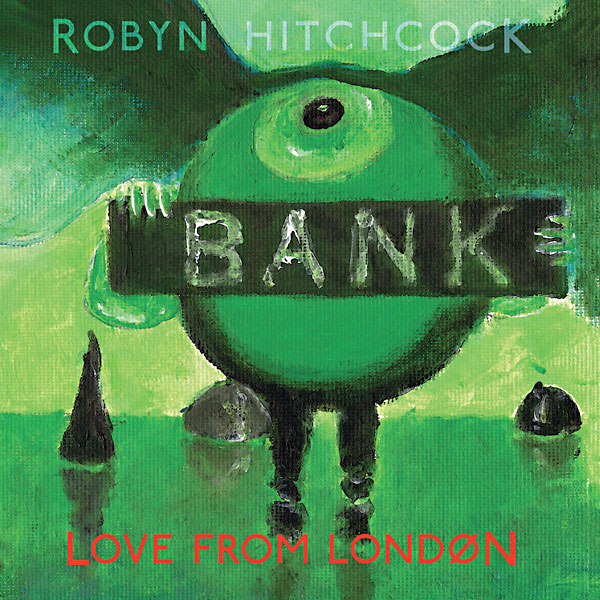
Album Review: Robyn Hitchcock-"Love From London" (2013)


Robyn Hitchcock, "Love From London," 2013.

Robyn Hitchcock’s latest album, “Love From London,” came out on March 5th. As usual, it’s an excellent album full of more Hitchcockian songs about love, fruit, and insects. “Love From London” is Robyn’s first album on the Yep Roc label since 2009’s “Goodnight Oslo.” That fact makes 2010’s “Propellor Time” and 2011’s Norwegian-only release “Tromso, Kaptein” seem like transitional works in between the two more major statements of “Goodnight Oslo” and “Love From London.” While I enjoyed both “Propellor Time” and “Tromso, Kaptein,” I think “Love From London” is a stronger album than both of them. I think “Propellor Time” in particular seems weaker in retrospect, as the songs on that album seem to be leftovers from 2006-7. Robyn was shown working on songs that ended up on “Propellor Time” in the 2007 documentary “Sex, Food, Death…and Insects,” but then “Goodnight Oslo” was his next album, and featured none of these songs. Which makes me think that Robyn held the songs on “Propellor Time” back for some reason, maybe because he felt they weren’t up to snuff? Who knows? 

“Love From London” is a very good album. To me, it has a different sound from the albums Robyn has done recently with his backing group the Venus 3. I like the sound on “Love From London,” as much as I love the Venus 3 albums. All the drums on “London” are artificial, which I think works well on this album. It gives Robyn’s music a slightly more modern sound. Jenny Adejayan plays the cello on “Love From London,” as she also did on “Tromso, Kaptein.” The addition of cello brings a new sonic color to Hitchcock’s palette, and gives the music a nice psychedelic vibe. 

“Love From London” opens with the almost ominous piano strains of “Harry’s Song.” The first line of “Harry’s Song” is “Nothing answers like the ocean,” which is nicely echoed by the sound of the ocean that closes the album. I heard Robyn sing “Harry’s Song” at the Dakota last fall, and I was struck by its beauty when I heard him sing it live. The song’s refrain of “I don’t know anything about you” could be a commentary on how difficult it is for people to actually connect with each other in the digital age. 

“Be Still” has a more upbeat, jaunty, jangly sound. The song is about the narrator trying to figure out more about a mysterious woman. “Be Still” has some lovely lyrics, here’s the final verse:

“Her hair is dark as berries and her skin is charcoal brown
She gazes to the future out to where the sun goes down
To where the night is falling on a lover, or a friend
Somebody’s beginning is just someone else’s end”

“Stupefied” also has a catchy, poppy sound, with bright piano chords outlining the song’s melody. “Stupefied” has some of my favorite lyrics on the album that keep getting stuck in my head:

“Ain’t no honey back in Norway
Ain’t no kroner in your pants
Must have blown it in the doorway
On those sugar coated ants”

Why does this verse get stuck in my head so much? It’s difficult to say, part of it is the mystery of the lyrics. We have a reference to Norway, and some of Robyn’s songs have referenced Norway recently, most notably “Goodnight Oslo.” (He even recorded a Norwegian language version of “Oslo” on “Tromso, Kaptein.”) A krone is the currency of Norway, so we’re in Norway and we’re broke. And we spent our money on sugar coated ants. This sounds like a ridiculous way to spend one’s money, if you ask me. But it brings to mind the image of someone selling sugar coated ants in a doorway, as though they’re contraband. “Hey, buddy, need some sugar coated ants?” I just like it, and I like the way Robyn’s voice caresses each letter as he sings “pants” and “ants.” 

One of Robyn’s early songs, from “I Often Dream of Trains,” was called “I Used To Say I Love You.” Now, nearly thirty years later, we get Robyn’s take on the simple song title “I Love You.” The song has a heavier sound than the previous two tracks. The song begins with Robyn simply singing “I love you, I love you, I love you” over a rock backing. Befitting its simple title, “I Love You” also features some simple and straightforward lyrics:

“Real love is generous, there’s nothing it withholds
It won’t desert you ‘cause you’re feeling nervous or you’re old
Every second that you get to spend together is pure gold:
I love you”

The heavier rock sound continues with the next track, “Devil on a String,” which is anchored by a funky bass line. Robyn sings breathily, almost dreamily on this song. I have no idea what the song is about, frankly, but it’s a fun listen, featuring lyrics like:

“Salvation pie, salvation pie
You gotta get a slice before you die”

Sure, everybody needs salvation, especially when the devil’s around.

Side two of the album opens with one of my favorite songs, “Strawberries Dress.” It’s a very sexy love song. Again, it’s hard to say exactly what it’s about, but I like the feeling of the song, I like the world it conjures up. “Strawberries Dress” has some lovely cello playing, and some vivid imagery:

“Testing your power
I dream in the rain
A fine young sprite
Naked from the navel downwards
I see you kiss the sun”

The narrator of the song seems under the spell of a woman, as he sings:

“You-I’m so weak with you
I’m scared that you’ll explode
Or walk away”

“Death & Love” is a song about, well, death and love, two of Robyn’s favorite topics. “Death & Love” features swooping synths that give the song a somewhat icy flavor, as Robyn sings:

“I can hear you talk my language,
Talk the tongue of love and death”

“Fix You” is an insistent rocker, and it’s about as political as Hitchcock gets. The lyrics deal with someone facing financial ruin. Robyn could be addressing a person in the song, or he could be addressing America, asking:

“Now that you’re broke
Who’s gonna fix you up?”

“Fix You” seems to comment on the global financial crisis of 2008, as Robyn sings:

“Well they sell you this stuff with the money that you never had
Then they want it all back
They make you redundant and blame you for being a slacker
While the financial backer
Is taking a call with a strawberry mousse”

“My Rain” is a slower song, featuring lovely guitar work from Robyn. It has a somewhat mysterious feeling, as it talks of the power of rainfall. 

The album closer, “End of Time,” seems to be Robyn addressing death, with the chorus of:

“Take me
Take me
I’m ready for the end of time”

I hope that Robyn isn’t really ready for the end of time, he only just turned 60, and he should have a lot of years of great writing ahead of him. One of my favorite lines in the song, and on the whole album is:

“Macy’s opens up at six
You can get some sixty-second feelings for yourself”

To me this line means that through commercialism we can buy some quick thrills and pleasures, some “sixty-second feelings,” but that ultimately these things don’t mean very much. “End of Time” features some lovely synth strings, giving the song a different feeling from most of Hitchcock’s work. As the song starts to fade out, around four minutes in, we hear the sounds of the ocean, and then a song fragment whose only lyrics are:

“Love from London
Love from London
Over here”

This is the only reference to the album’s title. I think that “Love From London” is Robyn’s message of hope and good vibes coming out of London to the rest of the world. Eventually that song fragment fades out and we’re left with the sound of the ocean to close the album. “Love From London” is a very strong album from start to finish, there are no throwaway songs. For me “Love From London” keeps Hitchcock’s late-career winning streak going. I think that his albums over the last ten years have been very strong, and “Love From London” is one of his strongest.

Wednesday, April 3, 2013

Robyn Hitchcock on NPR's "Wits"


Robyn Hitchcock

A couple of weeks ago, on March 15th, I attended the taping of Robyn Hitchcock’s appearance on NPR’s radio show “Wits” at the Fitzgerald Theater in Saint Paul. The two guests for the show were Robyn and Paula Poundstone. It’s only been six months since Robyn last came to the TwinCities, but I was more than happy to have him back again so soon. When he was at the Dakota he had said, “I’ll see you in the spring.”  Robyn sang some songs from his new album, and also appeared in a couple of sketches, playing “The Great Gazoo” from “The Flintstones,” the owner of a time travel shop, and also an evil scientist. (Which was a perfect part for Robyn and his wonderful speaking voice.) He also made up some theme songs to non-existent game shows, like “Ham Wing,” “Some For You, Some For the Astronauts,” and “One Question About A Bird,” which was the highlight of the evening for me. This segment gave us a glimpse of Robyn’s quick mind and his ability to make anything he sings sound very catchy.

Robyn also had some funny things to say during the interview part of the show. Host John Moe tried to get an answer as to why “Visions of Johanna” is Robyn’s favorite song, and Robyn gave one of the most straightforward answers I’ve ever heard him give in an interview. “It manages to go in two completely opposite emotional directions at once, not unlike life itself. On one level it’s really sad and on another level it’s incredibly funny.” 

I also learned that “Magnum Force,” the second Dirty Harry movie with Clint Eastwood, is a movie that Robyn would watch again and again. I think some people thought Robyn was being facetious with his answer, but I suspect he was actually being truthful, since his terrific 2006 song “(A Man’s Gotta Know His Limitations) Briggs” is based on the plot of “Magnum Force.” (Hence the song’s references to “Clint” and San Francisco.) 

“Wits” certainly wasn’t a full Robyn Hitchcock concert by any means, but it was still a very fun evening, and it was cool to hear some songs from his new album “Love From London,” just a week after it came out. Robyn performed lovely versions of “Be Still” and “End of Time,” as well as a rocking “Devil On a String.” All three of those songs are on “Love From London,” which I would strongly recommend to any Hitchcock fan. Robyn also sang a sing-along version of David Bowie’s “All The Young Dudes,” which I was more than happy to sing along with, doing my best faux-Bowie croon. As a bonus, Robyn also sang “My Favorite Buildings,” which he dedicated, as always, to the Foshay Tower, which must surely be one of Robyn’s favorite buildings, since he’s mentioned it at every show I’ve seen him do in the Twin Cities. “My Favorite Buildings” is one of my favorite Robyn Hitchcock songs, so I was very pleased to hear it.