Showing posts with label 1987 world series. Show all posts

Saturday, March 27, 2021

A Box of 833 Steve Carlton Cards!


833 more Steve Carlton cards! Woo-hoo!

Carlton's 1983 O-Pee-Chee card, and his 1984 O-Pee-Chee All-Star card, or "Etoile" card.

Lots of French on the back of Steve's 1984 O-Pee-Chee card. Steve is a wine collector, or "oenophilie." I think this has to be the only baseball card that mentions wine collecting on the back.

A while ago, I bought a lot of 833 Steve Carlton baseball cards from eBay. I know, more Steve Carlton cards? But these were too cheap to pass up. All of the cards were from the 1980’s, and there were some fun oddities included, like some O-Pee-Chee cards. O-Pee-Chee was a Canadian candy company that had an arrangement with Topps to sell Topps baseball cards in Canada under the O-Pee-Chee name. O-Pee-Chee cards can usually be distinguished from Topps by the thinner, cheaper cardboard they were printed on, and the lighter backs of the cards. Also, from 1970 onwards, O-Pee-Chee cards had text in French! It’s thanks to O-Pee-Chee that I know a pitcher is a “lanceur,” and an outfielder is a “voltigeur.” I hardly ever remember buying packs of O-Pee-Chee during my childhood, or even seeing them for sale, but somehow I’ve ended up with some random O-Pee-Chee cards here and there. I also bought the complete set of 1987 O-Pee-Chee, because the 1987 Topps set is the most beautiful set of cards in the history of baseball cards.

Two extremely similar pictures on Carlton's 1985 Topps Collectors' Series and 1985 Drake's Super Pitchers cards. If I were a batter, I wouldn't feel too confident seeing this picture, since it probably means there's a slider coming at me.

The back of Carlton's 1985 Drake's card. Much easier to read than the awful green of the 1985 Topps cards.

There were some other fun 1980’s oddities, like Carlton’s 1985 Drake’s Super Pitchers card, which was included with Drake’s snack cakes. According to Wikipedia, Drake’s is largely distributed in the Northeast, which explains why I’ve only heard of them because of these baseball cards. Drake’s had some kind of licensing deal with Topps, as their cards used the same backs as Topps did. But the front of the Drake’s cards had different photos from Topps cards, making them a desirable oddity, at least in my eyes. Drake’s cards featured “Big Hitters,” and in 1985 they expanded it to also included some “Super Pitchers,” like Steve Carlton. The 1985 Drake’s cards also featured a red back, rather than the awful green back found on 1985 Topps cards, which made them extremely hard to read.

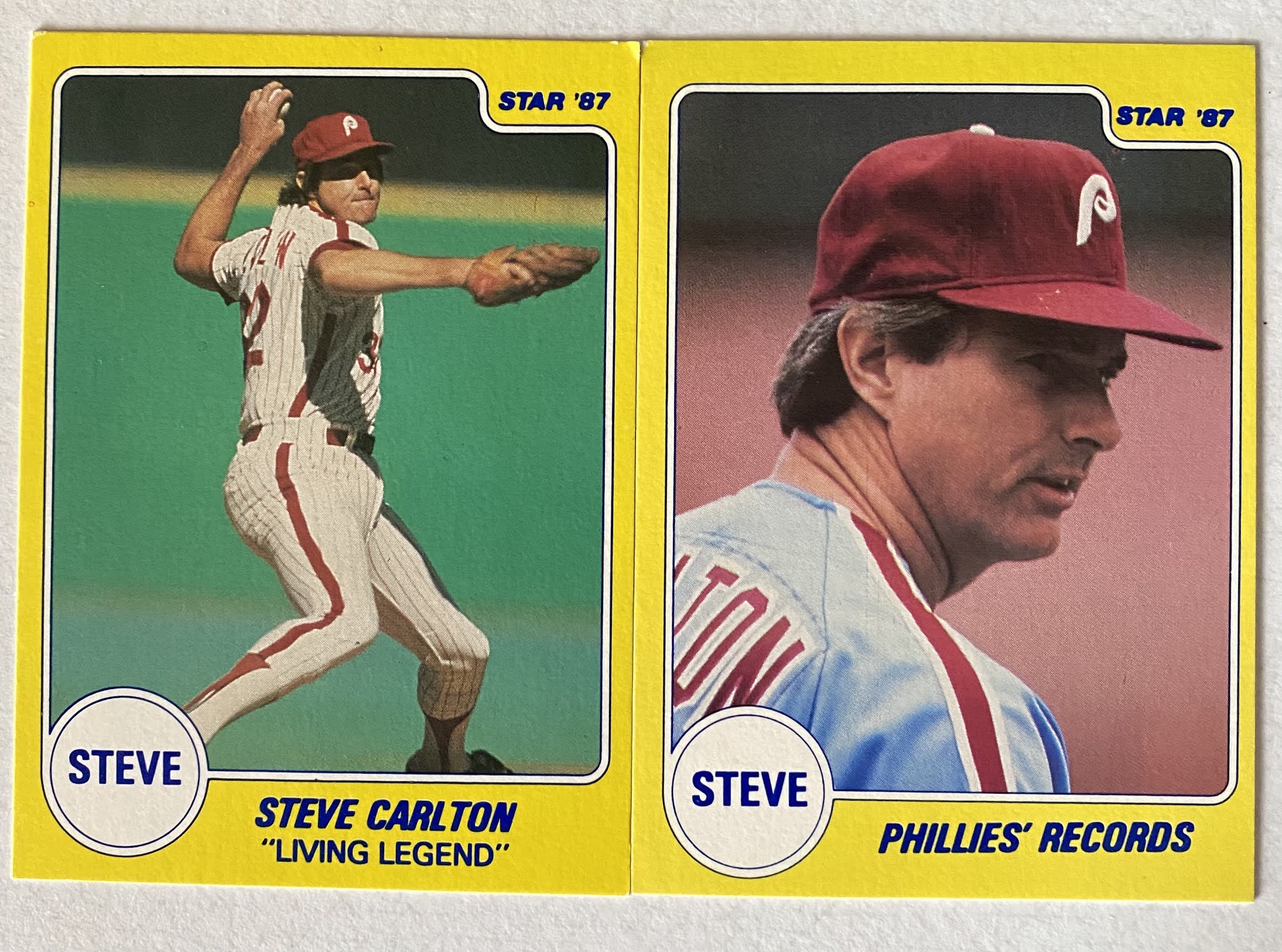
Cards number 1 and 10 in Star's 14-card Steve Carlton set, from 1987.

The back of card 10, showing Steve's amazing 135-55 record at the Vet in Philly.

There were also two cards from the 14-card Steve Carlton set issued by Star in 1987. Star issued sets of well, star players throughout the 1980’s. I don’t know how these were distributed, if you bought packs that had different players in them, or if you bought sets of the same player, or what. Star had also issued a 24-card Steve Carlton set in 1984. On the back of Carlton card number 10 from the 1987 set, you can see Carlton’s amazing dominance at Veterans Stadium: he was 135-55 at the Vet, for a winning percentage of .711. Wow. The 1987 Star set also features a rare card: Steve Carlton giving a press conference after he signed with the San Francisco Giants in 1986.

Steve Carlton's last card as an active player, his 1988 Fleer card, which is also the only card that shows him with the Minnesota Twins. Steve doesn't look too thrilled with the photographer.

The back of Carlton's 1988 Fleer card. When you pitch for so long that they run out of room on the back of your baseball card.

In this lot there were 121 cards of Carlton’s 1987 Topps card, and 50 of Carlton’s 1988 Fleer card, which was his last card as an active player, and the only card that pictured him with the Minnesota Twins. Even today, in 2021, there’s never been a card commemorating Carlton’s time with the World Champion 1987 Minnesota Twins. Which is kind of surprising, since Topps clearly has no shortage of random cards of retired players. So, Topps, get on that already! Yes, I know, Carlton was out of gas by the time he joined the Twins, and he only won one game for the team, but it was still a World Series-winning team, even if Carlton was left off the postseason roster. At the very least, we need a card commemorating the Twins’ visit to the White House after the World Series, where Carlton was listed in photo captions as an “unidentified Secret Service agent.”

It was a lot of fun to sort through these cards and find the fun oddities contained therein, as I continue my look into the baseball cards of Steve Carlton.

Tuesday, August 8, 2017

Don Baylor, 1949-2017


Don Baylor, batting for the Minnesota Twins in the 1987 ALCS.

I was saddened to hear that Don Baylor died yesterday at the age of 68. Baylor was one of the great power hitters of the 1970’s and 1980’s. For Twins fans like me, Baylor will always be well known for his game-tying home run in Game 6 of the 1987 World Series. Baylor played in just 20 regular season games for the Twins in 1987, and ironically enough, didn’t hit a home run in any of those games. But he came through when the chips were down in the postseason. 

Baylor had a 19-year playing career, from 1970 to 1988. His best season came in 1979, when he was the AL MVP, leading the league in both runs scored and RBIs, and slugging a career-high 36 home runs for the California Angels. Baylor wasn’t a Hall of Famer, but he was an excellent player for many years, and he put up some pretty awesome career numbers. His 338 home runs are still good enough for 100th on the all-time list. To give you an idea of how the game has changed over the last 23 years, in 1994 he was 50th on the all-time home run list. Baylor also had good speed, as he stole 285 bases over his career, with a high of 52 for the Oakland A’s in 1976. Of course, no summary of Baylor’s career would be complete without mentioning his knack for getting hit with a pitch. Baylor was hit 267 times in his career, setting a modern-day record that Craig Biggio eventually broke. 

I met Don Baylor at a baseball card show when I was a kid, it must have been shortly after he retired, probably 1989 or 1990. I can’t remember a lot about him, but I remember him being nice, and all of the pieces I’ve read about him today reinforced that he was truly a nice guy. The signed picture I have of him is with his second stop with the Oakland A’s, in 1988, when he achieved the unique distinction of playing in the World Series in 3 consecutive years with 3 different teams-1986 Boston Red Sox, 1987 Minnesota Twins, and the 1988 Oakland A’s. 

I read Don Baylor’s autobiography when I was a kid, but I can’t say I remember a lot about it. Autobiographies of baseball players made up a lot of my reading back in those days of my childhood. I’ve always been struck by how Don Baylor’s career is kind of a reverse image of Reggie Jackson’s. Granted, Baylor never climbed the ladder of super-duper stardom the way that Reggie did, but Baylor played for all of the same teams that Reggie did. Jackson and Baylor were part of the blockbuster trade that sent Reggie to the Orioles in April of 1976. Jackson played only one year for the Orioles, while Baylor only played one year for the A’s. While Reggie went to the Yankees and then to the Angels, Baylor went to the Angels and then to the Yankees. Jackson and Baylor were teammates for one year, on the 1982 Angels. Jackson led the AL in home runs that year with 39, while Baylor added 24 home runs of his own. Adding to the symmetry of their careers, both played their last season for the Oakland A’s, Jackson in 1987, Baylor in 1988. 

Don Baylor was a great baseball player, and his memory will continue to live on.

Saturday, November 5, 2011

Bob Forsch, Cardinals pitcher: 1950-2011

Bob Forsch, 1950-2011.
Bob Forsch won 163 games for the Cardinals from 1974-1988, and he threw two no-hitters.
Bob Forsch on the Cardinals Leaders card from the 1986 Topps set.

Bob Forsch, a right-handed pitcher for the St. Louis Cardinals from 1974-88, died on Thursday at the age of 61. Forsch threw out the first pitch at Game 7 of the World Series just a week before he died. This just makes me really sad. I never saw Forsch pitch, but he was a player I was very familiar with through my baseball card collection and my fondness for the Cardinals. I’m a Minnesota Twins fan through and through, but the Cardinals are my second favorite baseball team. As a kid, red was always my favorite color, and the cardinal was always my favorite bird, so it was inevitable that I would like the Cardinals. I was rooting for the Twins during the 1987 World Series, though. Even at age 6 I had to support my hometown team. It always makes me sad when someone who played baseball during the 1980’s dies, as it serves as a continuing reminder of my own creeping mortality and it also means that my childhood has been over for a long time. Forsch was also way too young to die at 61. He looked very healthy and vital when he appeared at Game 7. Forsch died of an aneurysm, which sounds like the kind of thing that could happen to pretty much anyone his age.

Forsch wasn’t a Hall of Famer. Heck, he was never even an All-Star. But he was a good, solid, steady, dependable starter for 16 big-league seasons, from 1974-1989. (After pitching for the Cardinals, Forsch finished up his career pitching for the Houston Astros in 1988-89.) Forsch won 168 games and lost 136, with a lifetime ERA of 3.76. Those are really good career numbers, but not great. But as I’ve gotten older, I’ve come to appreciate players like Forsch more. It’s so unbelievably hard to just make it to the major leagues, let alone to be a consistent starting pitcher for 15 years, that I tip my hat to Bob Forsch. I was looking through my set of 1988 Fleer baseball cards a couple of weeks ago when I came across Bob Forsch’s card. I said to my wife, “You know, Bob Forsch wasn’t a Hall of Famer, but he had a pretty darn good career. Winning more than 150 games is really impressive.” That I randomly picked Bob Forsch’s card out and had been thinking about his career recently is definitely one reason why I’m writing this post. It’s easy to like the superstars and the Hall of Famers. They’re the best of the best, and they will never lack fans. But for every Tom Seaver, there are a lot of guys like Bob Forsch, players who did the best with what they had and made the most out of their talent, even if it didn’t carry them all the way to Cooperstown. As a baseball fan, I’m in awe of anyone who made it to the major leagues, since I would probably sell my soul to get just one major league hit. 

Forsch won 20 games once during his career, in 1977, when he went 20-7 with a 3.48 ERA. His best season might have been his second, 1975, when he went 15-10 with a 2.86 ERA. Forsch also threw 4 shutouts that year. Forsch was not a strikeout pitcher, as he only had 3 seasons in which he topped 100 strikeouts. Forsch consistently threw 200 innings a year for the Cardinals, with a high of 233 and 2/3 innings pitched in 1978. All told, he had 7 seasons over 200 innings. Besides 1977 and 1975, he had just one other year in which he won 15 games, 1982, when he went 15-9. Forsch had a lot of seasons where he won 11 games. He must have been injured in 1984, and in 1985 he wasn’t used very much as a starter. Forsch did get a lot of post-season playing time, as he was with the Cardinals when they had a resurgence in the 1980’s. Forsch pitched in the 1982, 1985, and 1987 World Series. He threw a shutout against the Braves in the 1982 NLCS, giving up just 3 hits. Forsch started Games 1 and 5 in the 1982 World Series, but lost both starts. The Cardinals won the Series in 7 games against the Brewers. Like the rest of the Cardinals, Forsch didn’t do well in the 1985 World Series, getting an early exit from his Game 5 start. But he did pitch an inning of scoreless relief in the disastrous Game 7, which the Cardinals lost 11-0 to the Royals. Oddly enough, Forsch was only used as a reliever in the 1987 post-season. He pitched scoreless relief in Games 2 and 3 of the NLCS against the Giants, and he got the win in Game 3, but then blew up in Game 5, giving up four runs without retiring a batter. The Twins hit Forsch hard in the World Series, tagging him for seven runs over six and a third innings pitched. But Forsch pitched well enough in Game 4 to earn the win, his only World Series win. 

Forsch was also a good hitter for a pitcher, hitting 12 career home runs and winning two Silver Slugger awards at pitcher, in 1980 and 1987. He hit .295 in 1980, .298 in 1987, and .308 in 1975! In August of 1988 Forsch was traded to the Astros and finished his career there as a spot starter and long reliever. Forsch started 422 games in his career, which puts him at 99th on the all-time list. That’s pretty impressive, that only 98 guys in the history of the game ever got the call to start more than Bob Forsch. Forsch ranks 3rd on the all-time Cardinals win list with 163, he’s only behind Hall of Famers Bob Gibson and Jesse “Pop” Haines. Forsch threw 19 shutouts in his career, which is 15 more than Andy Pettitte threw. Of those 19 shutouts, two were no-hitters, putting Forsch on a short list of pitchers with more than one no-no. Bob’s brother Ken was also a pitcher and threw a no-hitter, making the Forsches the only brother combination to both throw no-hitters. Bob’s no-hitters came against the Phillies in 1978 and the Expos in 1983. In both games, he faced 29 batters, just two more than a perfect game. He gave up two walks to the Phillies, and against the Expos he hit Gary Carter with a pitch and the next batter, Chris Speier, reached on an error. The 1983 Expos were a very good hitting team; the heart of their lineup was Andre Dawson, Al Oliver, Tim Raines, and Gary Carter. Dawson, Oliver, Raines and Carter had a combined total of 10,214 hits in the major leagues, so holding all of them hitless for a game is pretty darn impressive. 

From what I’ve read about Bob Forsch it sounds like he was also a really nice guy, in addition to being a pretty awesome pitcher. It sounds like he was very humble and down to earth, and was a great mentor for younger pitchers as his career wound down. Like I said at the beginning of this post, I’m not an expert on Forsch’s career and I never saw him pitch, so there are certainly lots of people out there who know more about him than I do. But I have very fond memories of him through my baseball card collection, and I think it’s important for baseball players like Bob Forsch to be remembered.