Showing posts with label karl malden. Show all posts

Monday, March 28, 2016

Movie Review: Gypsy, starring Rosalind Russell, Natalie Wood, and Karl Malden (1962)


Original poster for Gypsy, 1962.


Natalie Wood as Louise, and Rosalind Russell as Rose in Gypsy.

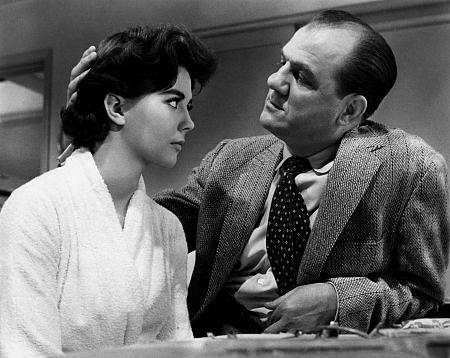
Natalie Wood as Louise and Karl Malden as Herbie in Gypsy. (Note Caroline the cow in the background.)
Natalie Wood after Louise's transformation into Gypsy Rose Lee. *Sigh* She was so beautiful.

Natalie Wood on the set with the real Gypsy Rose Lee, who was at least 5 inches taller than Natalie.

Natalie Wood in her dressing room. I love this photo, and not just because of what Natalie's wearing. It's such a great composition, the way Natalie is standing is such an interesting pose. She seems unaware of the camera, and there's the mystery of all the people whose faces we don't see. Who are they?
The 1959 Broadway musical Gypsy introduced the world to a character with a huge personality: dedicated stage mother Rose Hovick, whose only ambition in life is to make her daughter June a vaudeville star. No matter that vaudeville is already on the way out, Rose will find a way to make it happen. The character of Rose is widely known in pop culture as “Mama Rose,” but she’s actually never referred to that way in either the play or the 1962 movie version. Gypsy featured a book written by Arthur Laurents, with music by Jule Styne, and lyrics by Stephen Sondheim. Laurents and Sondheim had previously collaborated on West Side Story. Oddly enough, Natalie Wood starred in both the movie versions of West Side Story and Gypsy

The score of Gypsy is simply fantastic, and it features many great songs like “Small World,” “You’ll Never Get Away From Me,” “All I Need is the Girl,” “Everything’s Coming Up Roses,” and “Let Me Entertain You.” While the Broadway production starred the legendary Ethel Merman as Rose, the movie starred three actors not known for their singing voices: Rosalind Russell, Natalie Wood, and Karl Malden. The decision was made by someone to cut all of the songs that Karl Malden’s character, Herbie, sings, turning it into a non-singing part. That decision meant ditching the super cute song “Together (Wherever We Go),” which was filmed, but then cut. It’s included on the DVD as a bonus feature. Natalie Wood had her singing voice dubbed for West Side Story, much to her annoyance, and she did all of her own singing in Gypsy. Rosalind Russell had appeared in musicals before, as she starred in the original Broadway production of Wonderful Town, with lyrics by Betty Comden and Adolph Green, and music by Leonard Bernstein. But for Gypsy her vocals were mixed with those of Lisa Kirk. Some songs, like “Mr. Goldstone, I Love You” are all Russell’s voice, while others are a mix, and Kirk did an excellent job of matching Russell’s voice. 

In terms of acting, Russell, Wood, and Malden all did excellent work. The role of Herbie, Rose’s long-suffering boyfriend, requires a “normal guy” actor, and Karl Malden certainly fit that bill. Malden is by turns intense and also good-naturedly laid-back, and it’s another superb performance from an actor whose career was full of them. Russell is marvelous as Rose, who comes off as something of a more intense version of Russell’s Auntie Mame. Like Mame, Rose sucks all the oxygen out of any room she’s in. Sometimes in a good way, and sometimes in a bad way. Wood is fabulous as Louise, the plain older sister who is never the star, but finally blossoms into the burlesque queen Gypsy Rose Lee. For the role of Louise, you need someone who is believable as both a shy wallflower and as the belle of the ball. Wood was such a good actress that she pulled it off very convincingly. I know, we all KNOW Natalie Wood is gorgeous, even when she’s dressed up as plain as she can possibly be. The costume designers did a really good job of making Wood look plain as Louise. (Orry-Kelly designed Natalie’s dresses for the burlesque scenes, but I doubt he had anything to do with the drab clothes Wood wears as Louise.)

Gypsy was directed by Mervyn LeRoy, who had a long career in Hollywood stretching back to the dawn of the talkies. An old school studio director who could handle any genre, two of LeRoy’s best known films today are Mister Roberts and Quo Vadis. I really enjoyed the sets in Gypsy. The sets throughout the movie are obviously fake. For example, the train station where Rose sings “Everything’s Coming Up Roses,” and the Western set as Louise becomes the new star of the act after June leaves. I think it was an obvious choice to make the sets look like sets, and I took that to be a way of showing the audience that these characters don’t exist in the “real world.” Their whole lives revolve around showbiz, and they are disconnected from any other kind of reality. Especially Rose, who creates her own reality wherever she goes. 

There aren’t many interesting behind the scenes stories from the set of Gypsy. As a small nod to my ongoing fascination with Warren Beatty, I’ll point out that Beatty was dating Wood during the production of Gypsy, and most days he could be found on the set, being a supportive boyfriend. According to Gavin Lambert’s 2005 biography of Natalie Wood, the reason that Rosalind Russell played Rose instead of Ethel Merman was a simple one: Russell’s husband, theatrical producer Frederick Brisson, owned the film rights to Gypsy, and sold the rights to Warner Brothers on the condition that Russell would play Rose. (Natalie Wood: A Life, by Gavin Lambert, p.184) 

Natalie Wood began her career as an actress at the age of 5, and Wood’s biographer Suzanne Finstad has a rather dramatic view of her role in Gypsy: “Natalie was driven by demons to play the stripper with the stage mother of all stage mothers, Mama Rose-played in the movie by Rosalind Russell-viewing Gypsy as the catharsis for all her years as a child star under the tyranny of Mud.” (Mud was a nickname for Natalie’s mother Maria Zakharenko.) (Natasha: The Biography of Natalie Wood, by Suzanne Finstad, p.279) However, Christopher Nickens’ 1986 book Natalie Wood: A Biography in Photographs, says the opposite. Nickens writes, “Maria realized early on that Natalie was destined to be a performer, and she was wise enough to encourage her daughter’s talents and help her make the most of them.” Nickens also includes two quotes from Natalie to back up his point. Natalie told Hedda Hopper during the filming of Gypsy, “My mother was the furthest thing from a stage mother.” When asked how she dealt with being a child actor, Wood told the Los Angeles Times: “It all depends more than anything else on the parents. I happened to enjoy it all. I wanted it. I wasn’t being pushed. I was lucky.” (All three quotes from Natalie Wood: A Biography in Photographs, by Christopher Nickens, p.113) 

So, which was it? Was Gypsy just like Natalie Wood’s own childhood? Or was her mother nothing at all like Rose Hovick? The truth is probably somewhere in the middle. I think it’s fair to say that Wood had a sometimes difficult relationship with her mother, and she probably related to Louise in some ways. Natalie’s beautiful rendition of the song “Little Lamb” is proof enough for me that she felt a connection to Louise. 

Another member of the Wood/Zakharenko family who might have felt a close connection to the overlooked Louise was Natalie’s little sister, Lana Wood, who also became an actress but whose career never climbed to the same heights as Natalie’s. 

Wood was at the peak of her movie stardom when Gypsy was released in November 1962, and if you watch the trailer you’ll see that Warner Brothers was really selling the movie as “Natalie Wood Strips,” while in reality it’s only the last 15% of the movie that’s about Louise’s transformation into Gypsy Rose Lee. Wood received some stripping tips from Gypsy Rose Lee herself on the set. Wood was understandably a bit nervous about the stripping scenes, but in the finished film she handles them with aplomb. Because Wood was so petite, with reports of her height ranging from 5’0” to 5’3”, and the real Gypsy Rose Lee was 5’8”, director Mervyn LeRoy and director of photography Harry Stradling Sr. did their best to make Natalie look as tall as possible during the stripping scenes. Natalie’s clothes were made to accentuate her legs and give the illusion of greater height. Most of the camera angles are low, so you’re looking up at Wood, making her look taller. And notice how during the New Year’s Eve strip, the showgirls disappear into the wings by the time Natalie appears on screen, so you never see a showgirl towering over her. Wood certainly looked glamorous and very beautiful and attractive in the scenes where she’s Gypsy Rose Lee.

Gypsy was a financial success, earning $11 million at the box office, making it the 9th highest grossing movie of 1962. Warner Brothers’ other 1962 musical release, The Music Man, made just under $15 million, making it the 5th highest grossing movie of 1962. Wood and Russell were both nominated for Golden Globes for Best Actress in a Motion Picture: Musical or Comedy, and Russell took home the trophy. Malden was nominated for Best Actor in a Motion Picture: Musical or Comedy, losing out to Marcello Mastroianni in Divorce, Italian Style

Gypsy is a wonderful film of one of the great American stage musicals, and it showcases great performances from Rosalind Russell, Natalie Wood, and Karl Malden.

Wednesday, November 11, 2015

Movie Review: Bombers B-52, starring Natalie Wood, Karl Malden, and Efrem Zimbalist, Jr. (1957)


Poster for Bombers B-52. The poster says it's Natalie Wood's "most exciting role!" It's lying.


Natalie Wood and Efrem Zimbalist, Jr. make a cute couple in Bombers B-52, even if he is twice her age.

Natalie Wood and Karl Malden as father and daughter in Bombers B-52, 1957.
Natalie Wood’s only movie release of 1957 was Bombers B-52, a movie in which she received top billing, but played a supporting role to the Air Force’s latest long-range bomber. Wood stars along with the always excellent Karl Malden as her father, an Air Force engineer, and Efrem Zimbalist, Jr., as a flashy pilot. It takes a while for Bombers B-52 to figure out exactly what kind of movie it’s going to be. At first it seems like an elongated sitcom episode, as the plot involves Malden’s character going on a television quiz show and winning $4,000 by answering questions about baseball. (He buys his daughter a beautiful yellow Ford convertible with the winnings.) There’s conflict between Wood and Malden, as she tries to convince him to take a job in the private sector. Then Zimbalist shows up and gets put in charge of the base where Malden works. Malden is not happy about this. Malden and Zimbalist encountered each other in Korea, and Malden thinks Zimbalist is just a glory-seeking hot shot. But Zimbalist keeps Malden from resigning by showing him the new B-52 Stratofortress planes that the base will get. That’s enough to keep Malden happy. But he’s less happy once Zimbalist starts dating Wood. There’s some drama about test flights of the B-52, but it all ends well. Unfortunately, Bombers B-52 just isn’t a very exciting movie, although it does feature some great aerial photography of the B-52. The unintentional comedic highlights of the film are the mid-air refueling scenes, which just made me think of the opening credits for Stanley Kubrick’s Dr. Strangelove, in which the sexual symbolism is played up as a B-52 is refueled to the romantic strains of “Try a Little Tenderness.” The most unintentionally funny line of dialogue in the movie is at the end of the refueling scene, when someone says, “Tanker to receiver-you’ve got it all.” Wink wink, nudge nudge. 

I would guess that Bombers B-52 was not a fun movie for Natalie Wood to make, as her character really doesn’t have much to do. Wood was trying to become a serious actress, and Bombers B-52 did not put any strain on her acting talents. It must have been a letdown for her after making great dramas like Rebel Without a Cause and The Searchers. Wood certainly looks beautiful in Bombers B-52, but she’s just window dressing.

We don’t see enough of the romance between Wood and Zimbalist to really care about it, or be invested in their relationship. And while Efrem Zimbalist certainly looks more than capable of piloting a B-52, he’s a little old to be romancing an 18 or 19 year old Natalie Wood. Zimbalist was 19 years older than Wood! A more age appropriate love interest would have been Tab Hunter, who had already made two movies with Wood, but Hunter turned the role down. 

Zimbalist does a fine job in one of his early movie roles. Zimbalist is most well-known for his television work in the 1950’s, 1960’s, and 1970’s, on the long running series 77 Sunset Strip and The FBI. He was a handsome man, with good hair, a strong jaw, and an air of authority. You’d trust him to pilot a B-52. Zimbalist’s father, Efrem Zimbalist Sr., was a classical violinist, and his mother, Alma Gluck, was a soprano who made several popular records in the 1910’s. Both Efrem Zimbalist Sr. and Jr. lived to be 95 years old. Karl Malden made it to 97 years old, which means that Bombers B-52 starred two of the longest-lived leading actors ever. 

Karl Malden was one of the great film actors, as even in a potboiler like this, he gives every line his complete dedication as an actor. Malden’s rather ordinary looks, and his formidable talent, allowed him the versatility of moving between leading roles and character roles. Malden later starred with Wood in two more movies, 1962’s Gypsy and the 1979 disaster flick Meteor. Malden got along well with Natalie Wood, and Wood biographer Suzanne Finstad writes about an interesting anecdote during the filming of Bombers B-52: “Malden glimpsed the loneliness underneath Natalie’s surface gaiety when he discovered she had never been on a family picnic, and arranged to take her on one. She told him, afterward, that it was one of the happiest days of her life, which Malden found desperately sad.” (Natasha: The Biography of Natalie Wood, by Suzanne Finstad, p.237) Like many child stars, Natalie really didn’t have much of a childhood, and thus she missed out on a lot of life experiences. 

The screenplay for Bombers B-52 was written by Irving Wallace, who wrote many popular novels, and was also one of the editors for The Book of Lists, which makes him a hero in my eyes, since that was my favorite book when I was 13 years old. Yay for books of random trivia!

Bombers B-52 was directed by Gordon Douglas, who has a lot of “second movies in a series” among his credits. He did 1967’s In Like Flint, the second Flint spy movie with James Coburn, and the second movie in which Sidney Poitier played detective Virgil Tibbs, 1970’s They Call Me Mister Tibbs! He also directed Frank Sinatra in five movies. 

Perhaps the best summation of Bombers B-52 was written at the time it was released in November, 1957, when Time magazine called it a “$1,400,000 want ad for Air Force technicians.” It’s no surprise when at the end of the movie there’s a credit expressing the filmmaker’s thanks towards the Air Force. Without the cooperation of the Air Force, there wouldn’t have been a movie.  

Sunday, April 15, 2012

The Films of Warren Beatty: All Fall Down, starring Warren Beatty, Eva Marie Saint, Brandon De Wilde, Karl Malden, and Angela Lansbury, directed by John Frankenheimer (1962)

Warren Beatty in All Fall Down, 1962. Author Ellis Amburn used this photo for the cover of biography of Beatty, The Sexiest Man Alive.

Warren Beatty’s third film, All Fall Down, from 1962, is not that great. The movie boasts an impressive pedigree, as it was produced by John Houseman, directed by John Frankenheimer, and also stars Eva Marie Saint, Angela Lansbury, Karl Malden, and Brandon De Wilde. The script was by playwright William Inge, famous for plays like Picnic, and Bus Stop. Inge adapted All Fall Down from the novel of the same name by James Leo Herlihy, who would go on to write the novel Midnight Cowboy. Inge was an important benefactor in the early career of Warren Beatty, as he had also written Beatty's first movie, Splendor in the Grass, and Beatty's first and only Broadway play, A Loss of Roses. All Fall Down is an offbeat story about a dysfunctional family. If the movie were made today, it would be a quirky indie movie, and it would probably be played for more laughs. 

Beatty plays a callous ladies’ man with the improbable name of Berry-Berry Willart. No, really. And by the end of the movie you will be very sick of hearing other characters say the name “Berry-Berry.” His name is mentioned about every third line. Lansbury plays another one of her overbearing mother roles, just as she would play Laurence Harvey’s overbearing mother in Frankenheimer’s The Manchurian Candidate, released later in 1962. Like her character in The Manchurian Candidate, Lansbury’s mother in All Fall Down seems to have an unhealthy obsession with her son Berry-Berry. There’s even a moment in All Fall Down where it looks like she is about to kiss her son on the lips, but she just gets very close to Berry-Berry and then runs away. This prefigures a famous moment in The Manchurian Candidate when Lansbury’s character kisses her son on the lips. This one moment tells us all we need to know about their relationship. Another similarity between the two films is that Lansbury is playing characters much older than herself, as she was not old enough to be the mother of the men who were playing her onscreen sons. In real life, Lansbury was just three years older than Laurence Harvey, eleven years older than Beatty, and nine years older than Elvis Presley-whose mother she played in Blue Hawaii, from 1961. (There are no Freudian overtones in Blue Hawaii, however.) 

The story of All Fall Down is told from the point of view of Berry-Berry’s 16-year-old little brother, Clinton, played very well by Brandon De Wilde, whose most famous role was the little boy in Shane. De Wilde played a very similar part the following year in Hud, where he plays little brother to Paul Newman’s amoral Hud. Both Berry-Berry and Hud are completely selfish people, leaving a trail of emotional wreckage behind them. 

Beatty as Berry-Berry is very much in James Dean mode, as he was in his first movie, Splendor in the Grass, which is a much better film than All Fall Down. Beatty broods, and though Berry-Berry attracts women like flies, he quickly discards them in very hurtful ways, often using physical violence. It’s rather ridiculous how easily women are attracted to Beatty in the movie. All it takes is one look at Beatty for them to suddenly offer to bring him along on a vacation with them. Of course, Beatty was a stunning physical specimen in 1962, with his full head of dark hair, piercing blue eyes, and full lips. But it gets tiring to see women fall all over themselves for him. One woman even says to him, “If I were a young man as handsome as you are, I would go to Hollywood and try to get into movies.” Berry-Berry is very similar to the role that Beatty had just finished playing, the gigolo Paulo in The Roman Spring of Mrs. Stone. There’s nothing redeeming about Berry-Berry’s character, even though his parents hold him up as the ideal son. 

Things start happening in All Fall Down when the daughter of a family friend, Echo, played by Eva Marie Saint, comes to town to stay with them. The first time she stays with them, Clinton falls deeply in love with her, even though she’s a much “older woman” of 31, who has never been married. When Berry-Berry meets Echo the second time she stays with the family, he literally doesn’t have to say a word to her, he just takes her hand in the backyard and they go off somewhere to make out. And Clinton is heartbroken at this turn of events. Karl Malden plays the ineffectual alcoholic father, and does the most he can with the part. But he is incapable of offering advice or wisdom to his two sons. (Malden and Marie Saint famously worked together before in On the Waterfront.) Berry-Berry and Echo start dating, his mother claims she is happy for them, Berry-Berry gets Echo pregnant, they have an argument, he leaves, and she drives off grief-stricken and dies in a car crash. We don’t really know if the car crash is an act of suicide or not, but my guess is that it probably was. Side note: given their ridiculous names, what on earth would Berry-Berry and Echo have named their baby? One shudders to think. Clinton then almost shoots Berry-Berry, but decides not to, leaving Berry-Berry to deal with the fact that he’s a jerk who ruins every significant relationship in his life. The end. Not an especially uplifting movie. 

So that’s the movie, an overheated pseudo-Freudian mishmash, with some teen angst thrown in for good measure. One of the oddest moments in the movie is the scene where Echo tells Lansbury’s character how her former boyfriend killed himself-carbon monoxide poisoning, which is the same way that screenwriter William Inge would kill himself eleven years later. Ugh. 

Behind the scenes, Warren Beatty rubbed everybody the wrong way from day one of rehearsal, and no one except for Karl Malden really liked him. Beatty’s penchant for Method-y brooding annoyed the other actors and won him no friends. To be fair to Beatty, at the time he was making All Fall Down in the summer of 1961 he was getting a lot of media attention as the “Next Big Thing,” but none of his movies had been released yet. Splendor in the Grass, Beatty’s very first movie, wasn’t released until October, 1961. Beatty may have been feeling a lot of pressure to live up to his publicity hype. And his fellow actors had not had a chance to see him act on screen, so they had no idea who this guy was. Beatty might also have been intimidated by the success of his fellow actors, who had all been in the business for a long time. At the time Beatty was making All Fall Down, he was a man who was famous, but not because of anything he had actually accomplished. He was famous because he was Shirley MacLaine’s kid brother, and because he was having very public romances with Joan Collins and Natalie Wood. (Beatty was accused of breaking up Wood’s first marriage to Robert Wagner.) Beatty was famous because of his personal life, not because of any talent he showed as an actor. This must have annoyed Beatty considerably, since he is ironically a very private man who doesn’t like discussing his personal life. This mistake early in his career of letting his private life become so public perhaps set the tone for the rest of his career. Also, Beatty had a tendency to date women at the absolute peak of their fame. Had he wanted less publicity about his private life, he should have started dating women who were not in show business. 

After an amazing start in movies in Splendor in the Grass, Beatty appeared in two duds in quick succession, The Roman Spring of Mrs. Stone, which was released in December, 1961, and All Fall Down, which was released in April, 1962. Beatty then took a long break from movies; turning down everything he was offered, including the part of a young John F. Kennedy in PT 109. (Cliff Robertson ending up playing Kennedy.) Given all that we now know about Kennedy’s sexual life, Beatty probably would have been an ideal choice. After All Fall Down, Beatty didn’t appear onscreen again until Lilith, released two and a half years later. Beatty didn’t make another hit movie until 1967’s Bonnie and Clyde, which finally confirmed his talent as an actor and producer.