|
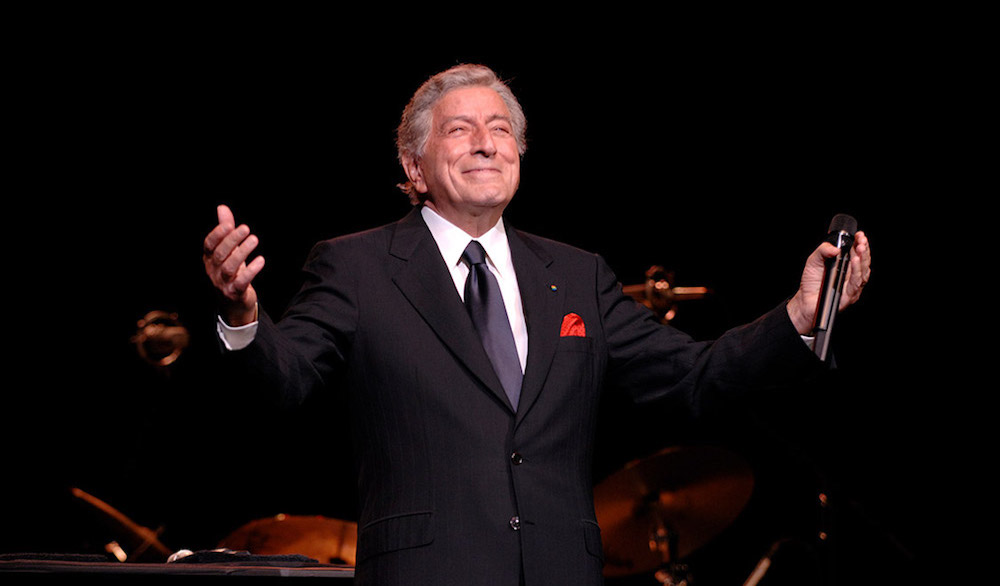
| Tony Bennett and Dave Brubeck, "The White House Sessions, 1962" |
 |
| Dave Brubeck and Tony Bennett in 2009. |
Who would think that nearly fifty-one years after it was
recorded, a concert pairing Dave Brubeck and Tony Bennett would surface? But
thankfully it has, and earlier this month, Columbia issued the live album “The
White House Sessions, 1962,” a rare live collaboration between Tony Bennett and
Dave Brubeck. The concert was held in Washington, D.C., on August 28, 1962, as
a celebration for college students who had come to work in D.C. for the summer.
The set captures both artists at a peak of their popularity.
The Dave Brubeck Quartet issued their most popular album, the million-selling
“Time Out,” in 1959 and they were selling out concerts all around the world.
Tony Bennett had just recorded his most well-known song, “I Left My Heart in
San Francisco,” and would record many of his signature songs in the next few
years, like “I Wanna Be Around,” “The Good Life,” “Who Can I Turn To?” and “If
I Ruled the World.” That being said, despite continuing changes in the musical
tastes of the record-buying public, both Bennett and Brubeck would continue to
perform at a peak level for many, many years to come.
It’s surprising that Columbia didn’t encourage Bennett and
Brubeck to record a full album together in 1962. Both artists were on Columbia
Records, and with Bennett’s affinity for jazz and Brubeck’s sympathetic
accompaniment of vocalists, it would have been a great album. It also would
have sold a lot of records, considering how popular both artists were in the
early 1960’s. Although Bennett never recorded an album with Brubeck, he did
record two classic duet albums with another legendary jazz pianist, Bill Evans,
in the mid-1970’s.
I’ve wanted to hear “The White House Sessions” for 10 years,
since one song from the concert “That Old Black Magic” was issued on “The
Essential Dave Brubeck” in 2003. I had no idea that Bennett and Brubeck
recorded together, and I wanted to hear any other tracks they had recorded. I
didn’t know where “That Old Black Magic” came from, and why it was the only
track that surfaced. Now finally we can hear Brubeck and Bennett’s full sets,
and all four songs that they played together. My only complaint with “The White
House Sessions” is that the glimpse of Bennett and Brubeck together is too
short, too tantalizingly brief. There are but four songs, lasting not even 12
minutes. Well, we just have to be thankful that it happened and that it was
recorded.
Bennett and Brubeck were exquisitely matched as
personalities; they were both wonderfully humble and nice men who shared an
optimistic outlook on life. They are wonderfully happy, extroverted
personalities on record. This doesn’t mean that they couldn’t handle a ballad,
because they both could squeeze all the tenderness out of a song. But when
Bennett and Brubeck swing, there is an infectious joy in their performances.
The Dave Brubeck Quartet opens their set with their
signature song, “Take Five.” Written by alto saxophonist Paul Desmond, this
version of “Take Five” features a lilting solo by Desmond, and oddly enough,
features a piano solo from Brubeck, and no drum solo from Joe Morello. On the
studio recording of “Take Five” there is no piano solo, as Brubeck keeps
repeating the same vamp throughout the song. But sometimes during concerts Brubeck
wanted to stretch out more on the song and would take a solo. His solo here is
rhythmic and driving. It’s more unusual that Morello doesn’t get a drum solo,
as his solo on “Take Five” was part of what made the song so famous. And of
course, as always, Eugene Wright keeps a solid bass groove. This performance is
typical of the Brubeck Quartet during this period. Absolutely great, swinging,
each musician doing what he did best but also blending together so well. Paul
Desmond was as smooth as silk, and I don’t think I’ve ever heard an awkward
phrase from him. Desmond and Brubeck had a deep musical connection, and they
have an easy rapport.
“Nomad” is a real swinger, with a great Desmond solo.
Brubeck just keeps firing off great ideas during his solo. As usual during a
swinging Brubeck solo, he keeps building the tension and intensity until he
passes it off to Morello. Brubeck trades some phrases with Morello during his
solo, which is fun to hear. Brubeck loved Morello’s drumming and he knew as
soon as he heard him that Morello was the drummer who would be able to play the
complex rhythms that Brubeck wanted to incorporate into the Quartet’s music.
Desmond, on the other hand, preferred a softer touch on the drum skins. On his
solo albums Desmond usually used drummers who were more reserved than Morello, although
over time he learned to enjoy Morello’s playing as well.
“Thank You (Dziekuje)” is inspired by the music and people
of Poland. Brubeck and his Quartet had visited Poland on their 1958 tour, which
was sponsored by the United States State Department. This trip led to Brubeck
discovering many of the “unusual” time signatures that would become the
trademark of the group in the next few years. One of Brubeck’s most famous
songs, “Blue Rondo a la Turk,” was inspired by Turkish musicians he heard on
that trip playing in the time signature of 9/8. “Thank You (Dziekuje)” features
some lovely soloing by Desmond and a slightly more restrained solo from Brubeck
that has some classical flourishes, inspired by Chopin. Despite being trained
in some classical music and majoring in music, Brubeck never learned to read music.
However, this didn’t deter him from becoming an excellent composer.
Both “Nomad” and “Thank You (Dziekuje)” are from the
Quartet’s excellent 1958 album “Jazz Impressions of Eurasia.” “Castilian Blues”
is in 5/4 time, the same signature as “Take Five.” “Castilian Blues” was from
the Quartet’s most recent LP at the time, “Countdown: Time in Outer Space,” the
follow up to “Time Out” and 1961’s “Time Further Out.” “Castilian Blues”
features an aggressive short solo from Brubeck, and a long drum solo from
Morello. Morello was a drummer who could keep the audience’s attention during a
long solo, and he shows the audience just how skilled he was behind the drums.
Bennett opens his set with the swinging “Just in Time,” one
of his more well-known songs. Bennett is backed by his longtime pianist Ralph
Sharon, Hal Gaylor on bass, and Billy Exiner on drums. Tony then sings the
tender ballad “Small World,” from the musical “Gypsy.” Bennett’s exuberant
voice is perfectly suited for the next song, “Make Someone Happy,” which could
be his theme song. Bennett hits some big notes, and it’s clear how powerful his
voice is. “Rags to Riches,” one of Bennett’s biggest hits, is given a brief
outing, featured some short jazzy phrasing from Tony. “One for My Baby (And One
More for the Road)” is done very up-tempo, in an almost breezy style, the
opposite of the way Frank Sinatra sang this torch song. Tony then closes his
set with the then newly-recorded “I Left My Heart in San Francisco.” It’s
interesting to hear him sing his most famous song at a time when it was still
very new. The song still has the same impact performed with only a trio, and we
can listen even closer to Bennett’s gorgeous phrasing.
After Bennett’s set, Brubeck, Eugene Wright, and Joe Morello
come back to the stage to perform with him. Tony says “We haven’t rehearsed
this, so lotsa luck folks.” But whether they rehearsed or not doesn’t matter,
this is music for the ages.
The first song is “Lullaby of Broadway,” with a nice intro
by Brubeck, and great drumming by Morello. “Come on along and listen to the
lullaby of Dave Brubeck!” shouts Tony as an intro to Brubeck’s solo. Brubeck
was a good accompanist of vocalists; he doesn’t try to overshadow Bennett.
Bennett’s vocal is easy and jazzy on this song.
“Chicago (That Toddlin’ Town)” is less successful to my
ears, as Bennett is more cautious with his phrasing. Brubeck has a good solo,
but the song just doesn’t catch fire.
“That Old Black Magic” is the highlight of the
Bennett/Brubeck collaboration for me. Brubeck and Morello work in some nice
Latin-sounding phrases, and Bennett is more adventurous, almost shouting “That
old black magic called LOVE!” before Dave’s solo. Brubeck’s solo is fierce, as
he pounds out the chords, and then Tony comes back in. It’s marvelous.
“There Will Never Be Another You” starts out slow. Then
Bennett double times it, and Brubeck and Morello are off to the races for
Dave’s solo. This is true jazz collaboration, musicians listening and
responding to each other in real time, in the moment. Brubeck’s solo is a gas,
and Morello adds fuel to the fire. Bennett then comes back in, singing at the
faster tempo, and then, all too quickly, it’s over. Tony Bennett and Dave
Brubeck did perform together other times, but to my knowledge this is their
only recorded pairing. Dave Brubeck continued recording and performing until
just before his death last December at the age of 91. Tony Bennett is still
going strong at age 86, still touring and recording and introducing new fans of
all ages to jazz and the Great American Songbook. “The White House Sessions” is
an essential purchase for fans of either performer.