Saturday, March 27, 2021

A Box of 833 Steve Carlton Cards!


833 more Steve Carlton cards! Woo-hoo!

Carlton's 1983 O-Pee-Chee card, and his 1984 O-Pee-Chee All-Star card, or "Etoile" card.

Lots of French on the back of Steve's 1984 O-Pee-Chee card. Steve is a wine collector, or "oenophilie." I think this has to be the only baseball card that mentions wine collecting on the back.

A while ago, I bought a lot of 833 Steve Carlton baseball cards from eBay. I know, more Steve Carlton cards? But these were too cheap to pass up. All of the cards were from the 1980’s, and there were some fun oddities included, like some O-Pee-Chee cards. O-Pee-Chee was a Canadian candy company that had an arrangement with Topps to sell Topps baseball cards in Canada under the O-Pee-Chee name. O-Pee-Chee cards can usually be distinguished from Topps by the thinner, cheaper cardboard they were printed on, and the lighter backs of the cards. Also, from 1970 onwards, O-Pee-Chee cards had text in French! It’s thanks to O-Pee-Chee that I know a pitcher is a “lanceur,” and an outfielder is a “voltigeur.” I hardly ever remember buying packs of O-Pee-Chee during my childhood, or even seeing them for sale, but somehow I’ve ended up with some random O-Pee-Chee cards here and there. I also bought the complete set of 1987 O-Pee-Chee, because the 1987 Topps set is the most beautiful set of cards in the history of baseball cards.

Two extremely similar pictures on Carlton's 1985 Topps Collectors' Series and 1985 Drake's Super Pitchers cards. If I were a batter, I wouldn't feel too confident seeing this picture, since it probably means there's a slider coming at me.

The back of Carlton's 1985 Drake's card. Much easier to read than the awful green of the 1985 Topps cards.

There were some other fun 1980’s oddities, like Carlton’s 1985 Drake’s Super Pitchers card, which was included with Drake’s snack cakes. According to Wikipedia, Drake’s is largely distributed in the Northeast, which explains why I’ve only heard of them because of these baseball cards. Drake’s had some kind of licensing deal with Topps, as their cards used the same backs as Topps did. But the front of the Drake’s cards had different photos from Topps cards, making them a desirable oddity, at least in my eyes. Drake’s cards featured “Big Hitters,” and in 1985 they expanded it to also included some “Super Pitchers,” like Steve Carlton. The 1985 Drake’s cards also featured a red back, rather than the awful green back found on 1985 Topps cards, which made them extremely hard to read.

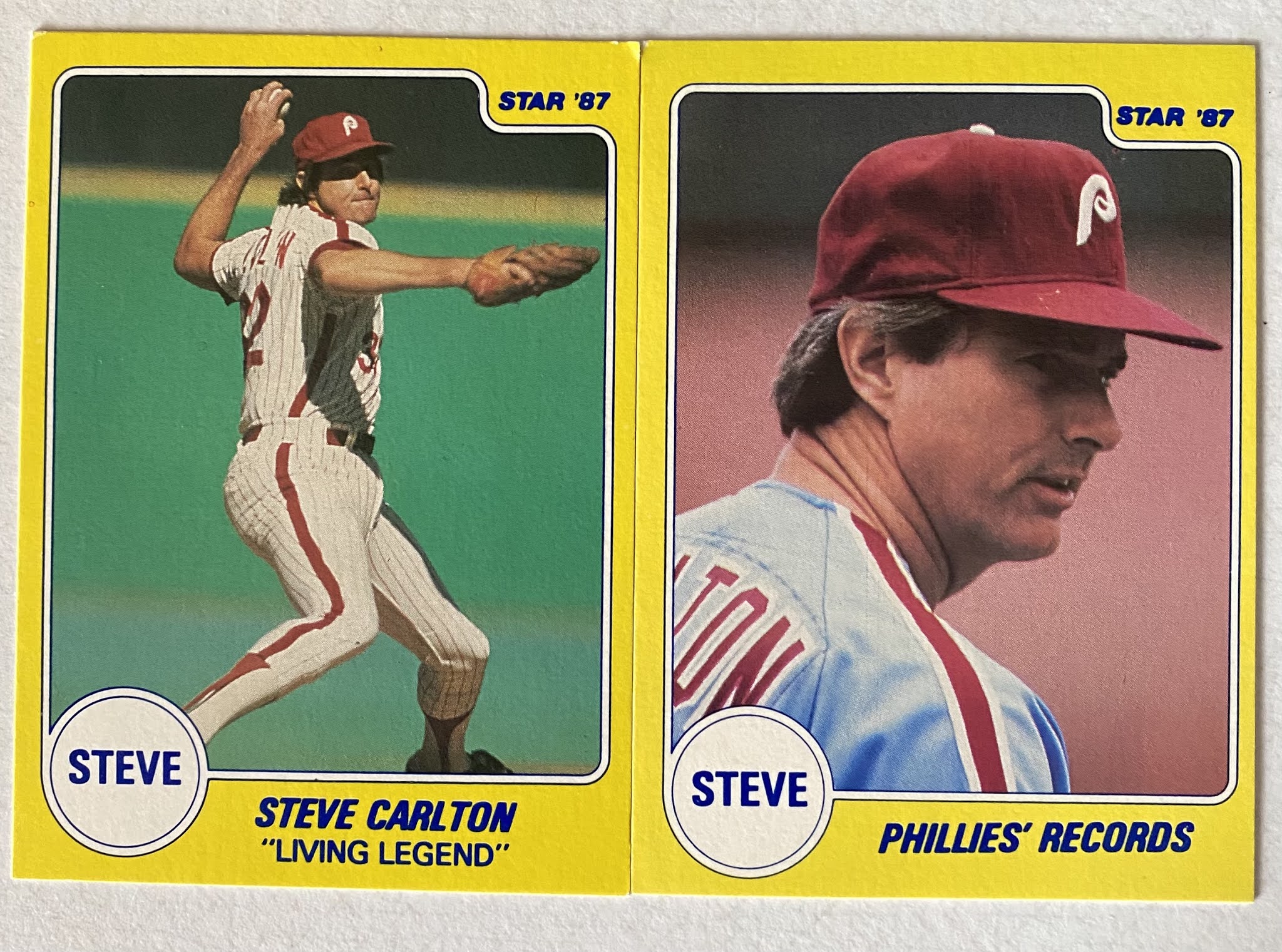
Cards number 1 and 10 in Star's 14-card Steve Carlton set, from 1987.

The back of card 10, showing Steve's amazing 135-55 record at the Vet in Philly.

There were also two cards from the 14-card Steve Carlton set issued by Star in 1987. Star issued sets of well, star players throughout the 1980’s. I don’t know how these were distributed, if you bought packs that had different players in them, or if you bought sets of the same player, or what. Star had also issued a 24-card Steve Carlton set in 1984. On the back of Carlton card number 10 from the 1987 set, you can see Carlton’s amazing dominance at Veterans Stadium: he was 135-55 at the Vet, for a winning percentage of .711. Wow. The 1987 Star set also features a rare card: Steve Carlton giving a press conference after he signed with the San Francisco Giants in 1986.

Steve Carlton's last card as an active player, his 1988 Fleer card, which is also the only card that shows him with the Minnesota Twins. Steve doesn't look too thrilled with the photographer.

The back of Carlton's 1988 Fleer card. When you pitch for so long that they run out of room on the back of your baseball card.

In this lot there were 121 cards of Carlton’s 1987 Topps card, and 50 of Carlton’s 1988 Fleer card, which was his last card as an active player, and the only card that pictured him with the Minnesota Twins. Even today, in 2021, there’s never been a card commemorating Carlton’s time with the World Champion 1987 Minnesota Twins. Which is kind of surprising, since Topps clearly has no shortage of random cards of retired players. So, Topps, get on that already! Yes, I know, Carlton was out of gas by the time he joined the Twins, and he only won one game for the team, but it was still a World Series-winning team, even if Carlton was left off the postseason roster. At the very least, we need a card commemorating the Twins’ visit to the White House after the World Series, where Carlton was listed in photo captions as an “unidentified Secret Service agent.”

It was a lot of fun to sort through these cards and find the fun oddities contained therein, as I continue my look into the baseball cards of Steve Carlton.

Tuesday, March 23, 2021

Steve Carlton: 60 Baseball Cards


I found a cheap lot of 60 Steve Carlton baseball cards on eBay last week, so I decided to get it. There was nothing truly rare or amazing in this lot, but with shipping and taxes, I paid $7.50 for it, and at 12.5 cents a card, I felt it was too good of a deal to pass up. The lot included a mixture of Carlton cards from 1978-1987, beginning with Carlton’s 1978 Topps card, which gives us the following grammatically incorrect sentence on the back: “Steve led major in Wins in 1977.” Indeed, Carlton won 23 games in 1977, and had a sparkling 2.64 ERA. After the 1977 season, Carlton won his second Cy Young Award.

1978 Topps 1977 Victory Leaders card. Only one of these four pitchers had a best-selling underwear poster. Dennis Leonard's underwear poster was only available as a special giveaway with Die Hard batteries at select Kansas City Sears locations. (I made that up.) Steve Carlton did do a Jockey ad in 1977. (I didn't make that up.)

On the 1978 Victory Leaders card, we see Carlton and the three pitchers who tied for the AL lead in wins in 1977: Dave Goltz of the Twins, who hailed from Pelican Rapids, Minnesota, Dennis Leonard of the Royals, who had 3 20-game winning seasons in the span of 4 years, and Jim Palmer of the Orioles, who had his 7th season of 20 wins in 1977. (Palmer had one more 20-game winning season in 1978.) Fun fact: Dennis Leonard and Steve Carlton were the pitchers of record in 4 of the 6 games of the 1980 World Series. Leonard lost Game 1, Carlton won Game 2, Leonard won Game 4, and Carlton won the decisive Game 6. Is Dennis Leonard the most obscure 3-time 20-game winner? He’s probably the only 3-time 20-game winner to not even be an All-Star. You could probably win some bar bets with this trivia question: who had more 20-game winning seasons, Greg Maddux, or Dennis Leonard? It’s Leonard, 3-2. (Maddux won 211 more career games than Leonard and won 19 games in a season 5 times.) Carlton and Jim Palmer faced off in Game 3 of the 1983 World Series. Palmer didn’t start the game, but he entered the game in the top of the 5th, with the Phillies leading 2-0. Palmer pitched 2 innings and didn’t give up any runs. He was still the pitcher of record when the Orioles scored 2 runs in the top of the 7th to take the lead, 3-2. That ended up being the final score of the game, as Palmer was the winning pitcher and Carlton was the losing pitcher. It was both pitchers’ final World Series game, and it ended up being the last win of Palmer’s illustrious career. That win gave Palmer an amazing achievement: he won World Series games in 3 different decades.


Steve Carlton, rocking a perm on his 1981 Fleer, 1982 Topps, and 1982 Fleer cards.


The oldest cards in this lot, from 1978, 1980, and 1981, and show some wear. Their corners are a little battered, but that’s okay with me—I take it to be evidence that the previous owners enjoyed these baseball cards, and frequently flipped through them. In the early 1980’s cards, we get Steve with a perm, which was actually a thing back in the 70’s and 80’s for guys. I’m pretty sure Steve’s 1981 Fleer, 1982 Fleer, and 1982 Topps cards were all taken at the same game, just moments apart. Fortunately, the perm quickly recedes into the past by Carlton’s 1983 cards. 1982 Fleer also gave us one of the truly great baseball cards: Steve Carlton and Carlton Fisk. The card is titled: “Steve & Carlton, Carlton & Fisk.” The photo was taken at the 1981 All-Star Game, which was the first game played after the 1981 strike was resolved. Oddly enough, Carlton and Fisk did become teammates briefly on the 1986 White Sox. Fisk only caught Carlton twice, on August 12, 1986, in Carlton’s first start for the White Sox, and on September 13, 1986. Unfortunately, no one from Fleer thought to revisit their classic 1982 card when the two became teammates.

1982 Fleer: Steve & Carlton, Carlton & Fisk. You can see from this card how short Steve Carlton's torso is, and how long his legs are.

Included in this lot was one of the 1983 Topps League Leaders Sheet, which I discussed in this post. It’s not a valuable rarity, but it’s one of those odd cards that I didn’t know about until I was an adult. There’s a generous sampling of Carlton cards from 1984, including the Topps All-Star Glossy Send-In, and the Ralston Purina.

1984 Topps NL Active Career Strikeout Leaders, featuring 3 of the best pitchers ever.

The back of the 1984 Topps NL Strikeout Leaders card. The top 10 strikeout leaders is a pretty impressive list of pitchers.

There were also 2 cards of the 1984 NL Active Career Strikeout Leaders card, which is one of my favorite Steve Carlton cards, as it shows Steve as the all-time strikeout leader, a title he held at various times in 1983 and 1984. It’s also a very cool card, as it features Carlton, Nolan Ryan, and Tom Seaver—three of the greatest pitchers ever. From the back of the card, you can see the top 10 leaders in strikeouts at that time. It’s incredible to see how far ahead of everyone Walter Johnson was. No pitcher got within 500 strikeouts of Johnson until Bob Gibson in 1974, 47 years after Johnson retired. Granted, if Bob Feller hadn’t lost so many seasons to WWII, or if Sandy Koufax hadn’t been forced to retire at age 30 because of arthritis in his elbow, they might have made it to 3,000 strikeouts. Sneaking in at number 10 on the all-time list is Jim Bunning. I didn’t realize until I read in Jim Bunning’s obituary that when he retired after the 1971 season, he was second on the all-time strikeout list behind Johnson. (If Bunning had pitched one more season for the Phillies, he would have been a teammate of Carlton’s.)

It’s also interesting to look at the top 10 strikeout pitchers, and to see that all of them, except for Walter Johnson, were pitching at roughly the same time: all 9 were active from 1966-1971. This shows us that strikeouts were becoming more and more common, but also tells us what an amazing generation of starting pitchers that group was.

1981 Topps 1980 Strikeout Leaders card. The photographer didn't seem to care that Steve's face is half in shadow, half in light.

Back of the 1981 Topps 1980 Strikeout Leaders card. Who knew that Moose Haas was 9th in strikeouts in the AL in 1980? Thanks to Moose's 1987 Topps card, I know that he's also an amateur magician and a certified locksmith. AND he has a black belt in Tae Kwon Do! Truly a Renaissance man.

Oh, and can we talk about how dominant Steve Carlton’s 1980 season was? Carlton’s spectacular 1972 season, in which he won 27 games while pitching for a last-place team, rightly gets a lot of ink, but his 1980 season was pretty amazing as well. Carlton threw 304 innings in 1980, thus becoming the last pitcher to throw 300 innings in a season. (A record that I suspect he will hold for many more years.) Carlton struck out 286 batters, 86 more than any other pitcher in 1980. Carlton’s strikeout total was 99 more than the AL leader, Len Barker. Carlton led all players in the NL in WAR with 10.2. His total of 24 wins led the NL, but wasn’t quite enough to lead the major leagues, as Steve Stone reeled off one of the most improbable seasons ever, as he won 25 games for the Orioles. 1980 was the only season of Carlton’s 4 Cy Young Award-winning seasons in which he didn’t lead the major leagues in wins. Carlton narrowly lost the ERA title to Don Sutton, as Sutton had a 2.20 ERA and Carlton finished second with a 2.34 ERA. Carlton was amazingly consistent throughout the season, and from May 27th to July 2nd, his ERA was under 2, with his lowest ERA of the year being 1.74 after his start on June 18th.

So, there you go, another look into the baseball cards of Steve Carlton.

Tuesday, March 16, 2021

Album Review: Harriet, by Harriet (2016)


The cover of Harriet's debut album, 2016.

Concert poster for Harriet, 2017.

London-based singer/songwriter Harriet released her first full-length album in 2016. Harriet co-wrote 11 of the 12 songs on the album, titled Harriet. Harriet has an excellent pop voice, a contralto that is reminiscent of Karen Carpenter’s. Like Karen Carpenter, Harriet has that knack of sounding a little sad when she sings happy songs, and a little happy when she sings sad songs.

I discovered Harriet’s music when I was listening to the Debutantes (you can read more about the Debutantes here) and Spotify recommended Harriet to me. I had never heard of Harriet before, but I thought, “I’ll give her a listen,” and I was instantly won over.

If you like pop music with strong melodies that harken back to the 1970’s, you’ll enjoy Harriet’s music. Harriet’s main collaborator on the album is Steve Anderson, who co-wrote almost all of the songs with her as well as playing the piano. Anderson has worked with many artists over the years, including one of my favorites, Kylie Minogue. Anderson has written and produced many songs for Kylie since the 1990’s, and he’s done the arranging for almost all her concert tours.

The songs on Harriet feature orchestral work by the Royal Philharmonic Orchestra. The orchestra complements the songs very nicely and never threatens to overpower the songs or turn them into easy listening-sludge.

The album starts with “Afterglow,” with only Harriet’s voice and a piano at the beginning. This simple intro highlights the warmth of Harriet’s vocal timbre and pulls the listener into the song. “Afterglow” tells the story of a romance that has seemingly run its course, but Harriet refuses to give up, singing “Remember how I made you laugh/I’m not ready to let go/let’s chase the afterglow.” Although I don’t know if that’s the best relationship advice, it’s a beautiful song.

“What’s Mine Is Yours” is another excellent song that starts out with Harriet singing acapella. It’s an interesting song that’s about the power of connection through music. The lyrics seem to hint at a sort of musical reincarnation:

“Some part of me has been here before

You hear it in my voice

I’ll give it up if you’re listening

What’s mine is yours

You say that when I sing

I make you feel something

You don’t understand”

Those lyrics are a great summary of what music does: make us feel something we don’t always understand.

I interpret some of the lyrics as being about Harriet’s voice. I think the “it” in the next stanza is her voice, or perhaps her music:

“I don’t know where it came from

I don’t know why it’s mine

It’s in the music somebody played me

From a warmer time”

There is something mysterious about music—why it produces such strong emotions in us, how it works, how we create it. Even a musical genius like Paul McCartney gets a bit mystical when he talks about where his songs come from—there’s an element of mystery and chance in it.

I won’t discuss every song on the album in detail, but other highlights include the bouncy “First and Last,” and the fun and flirty “Permission to Kiss.” One of my favorite songs on the album is “Love Will Burn,” with soaring strings that make it sound like it could be the theme song for a James Bond movie. The sprightly “Fly” is an excellent pop song, with a catchy chorus: “And I don’t wanna feel the ground beneath my feet/I wanna fly and know how it feels/to let love come right and sweep me off my feet/I wanna fly and know how it feels.”

The only cover on the album is the last song, “She’s Out of My Life,” written by Tom Bahler and made famous by Michael Jackson, whose version appeared on his 1979 album Off the Wall. Interestingly enough, there’s a connection to Karen Carpenter, as Wikipedia tells me that it was rumored that Bahler wrote the song about his relationship with Karen Carpenter, but Bahler states this is untrue. Harriet delivers an excellent rendition of the song, and she leaves the narrative gender unchanged.

Harriet is a superb debut album showcasing a gifted songwriter with a fantastic voice. If you like good pop music, you should check it out.