Monday, October 10, 2022

Book Review: Tales of the Jazz Age, by F. Scott Fitzgerald (1922)

The original cover of Tales of the Jazz Age, with drawings by illustrator John Held, Jr., 1922.

Author F. Scott Fitzgerald, looking handsome in the early 1920's.

 F. Scott Fitzgerald’s second short story collection Tales of the Jazz Age was published on September 22, 1922, two days before Fitzgerald’s 26th birthday. It was Fitzgerald’s fourth book. Shortly after Tales of the Jazz Age was published, Fitzgerald left his hometown of Saint Paul, Minnesota for what would turn out to be the last time. Scott and Zelda and their daughter Scottie moved to Great Neck, on Long Island, where Scott would work on his play The Vegetable, which he was hoping would become a hit on Broadway. Fitzgerald was also starting to outline ideas for his third novel. You might know, old sport, that Scott’s third novel ended up becoming slightly more successful than The Vegetable.  

If you only know Fitzgerald’s writing from The Great Gatsby, you’d probably assume that all Fitzgerald’s short stories are about love and class and money. Those are certainly important themes that run throughout much of his work and many of his short stories. But if you dive into Fitzgerald’s short stories, you’ll find a more diverse subject matter, and some real oddities.  


Tales of the Jazz Age is a mixed bag. It contains three of Fitzgerald’s finest short stories: “May Day,” “The Diamond as Big as the Ritz,” and “The Curious Case of Benjamin Button.” It also contains clunkers like “Tarquin of Cheapside,” “Mr. Icky,” and “Jemina, the Mountain Girl.” There are also entertaining stories full of Fitzgerald’s trademark beautiful prose: “The Jelly-Bean,” “The Camel’s Back,” and “Porcelain and Pink.”  


I’ll briefly review the stories, in the order in which they appear in the book.  


“The Jelly-Bean" is one of Fitzgerald’s Southern stories. Because of Scott’s marriage to Zelda Sayre, a Southern belle from Montgomery, Alabama, several of his stories touch on the differences between the North and the South. “The Ice Palace,” “The Last of the Belles,” “The Dance” and “The Jelly-Bean” are all fine examples of Fitzgerald’s relationship with the South. Devoted Fitzgerald fans should look out in “The Jelly-Bean" for a name-check of Sally Carrol Hopper, the heroine of Fitzgerald’s 1920 short story “The Ice Palace.” “The Jelly-Bean" is quite entertaining, as Fitzgerald spins a tale of a Southern ne’er-do-well. There’s a beautiful sentence at the end: “All life was weather, a waiting through the hot where events had no significance for the cool that was soft and caressing like a woman’s hand on a tired forehead.” (p.26)  


“The Camel’s Back” is a fun yarn, set at a holiday party in Saint Paul.  


“May Day” is a superb story, one of the few times Fitzgerald explicitly used political themes in his fiction. It’s also one of the few times where Fitzgerald shifts among different groups of characters in a short story. 


“Porcelain and Pink” is a trifle. Written in play form. 


“The Diamond as Big as the Ritz” is one of Fitzgerald’s finest short stories. A beguiling fantasy that satirizes wealth in America.  


“The Curious Case of Benjamin Button” is beautiful. When Benjamin Button was born in 1860, he emerged as an old man. To everyone’s amazement and consternation, Benjamin ages backwards, getting younger every year. The last few paragraphs of the story, written as Benjamin reverts into a baby, moving ever closer to death, are as beautiful and haunting as anything Fitzgerald ever wrote: 


“He did not remember. He did not remember clearly whether the milk was warm or cool at his last feeding or how the days passed—there was only his crib and Nana’s familiar presence. And then he remembered nothing. When he was hungry he cried—that was all. Through the noons and nights he breathed and over him there were soft mumblings and murmurings that he scarcely heard, and faintly differentiated smells, and light and darkness. 


Then it was all dark, and his white crib and the dim faces that moved above him, and the warm sweet aroma of the milk, faded out altogether from his mind.” (p.223-4) 


“Tarquin of Cheapside,” in which Fitzgerald ponders if William Shakespeare wrote the poem “The Rape of Lucrece” from personal experience, thus accusing the most well-known writer in the English language of sexual assault. Written during Fitzgerald’s college days, and published in the Nassau Literary Magazine in 1917, "Tarquin” also appeared in The Smart Set magazine in 1921. It’s not my favorite Fitzgerald short story, and I think Tales of the Jazz Age would be just fine without it.  


“O Russet Witch!” is fine. Good, but not great.  


“The Lees of Happiness” tells the tale of a woman who has to take care of her husband, rendered an invalid by a stroke. This story prefigures some of Fitzgerald’s stories with medical themes written in the 1930’s after Zelda’s mental breakdowns. “The Lees of Happiness,” “O Russet Witch!” and “Benjamin Button” all cover a long time span and putting “Lees” and “Russet” right next to each other does no favors to either story. It also doesn’t help that “Lees” and “Russet” have to follow “Benjamin Button,” by far the strongest of the three stories.  


“Mr. Icky” is a rather surreal little play. Plays and the dramatic form are an interesting recurring theme in Fitzgerald’s work. Fitzgerald wrote four plays during the summers of 1911-1914, which he also acted in. At Princeton, Fitzgerald wrote material for several Triangle Club shows. He wrote the aforementioned play The Vegetable, which was not a success. And he spent the last years of his life living in Hollywood, working as a screenwriter. I’d be interested to know if any Fitzgerald scholars have analyzed all of his work in the dramatic medium, as it was a form that he kept returning to throughout his career. I think one of the reasons why the dramatic medium is not Fitzgerald’s most successful is that it’s usually antithetical to what is best about Fitzgerald’s work: the narration and descriptions. 


“Jemina, the Mountain Girl” is, well, more than a little ridiculous. Fitzgerald isn’t his funniest when he’s trying to be funny, as he is in “Jemina.” I think he’s much funnier when he lets his fine sense of irony take over, as he does in “The Diamond as Big as the Ritz.”  


Fitzgerald didn’t include his short story “The Popular Girl” in Tales of the Jazz Age. Perhaps I’m biased because I live in Saint Paul, and I enjoy the description of “Crest Avenue” (the real-life Summit Avenue) that’s found in “The Popular Girl,” but I quite enjoy the story. Fitzgerald himself wasn’t fond of “The Popular Girl,” and while he was an incisive critic of his own work, he was also quite hard on himself. Had I been in charge of compiling Tales of the Jazz Age, I would have included “The Popular Girl” and cut “Tarquin of Cheapside,” “Mr. Icky,” and “Jemina, the Mountain Girl.” But that’s just me.  


F. Scott Fitzgerald would no doubt be amazed to know that his term “the Jazz Age” is still being used to describe the 1920’s. In addition to giving a name to a decade, Tales of the Jazz Age contains short stories that still vividly leap off the page now, more than 100 years after their first publication in book form.  

Thursday, October 6, 2022

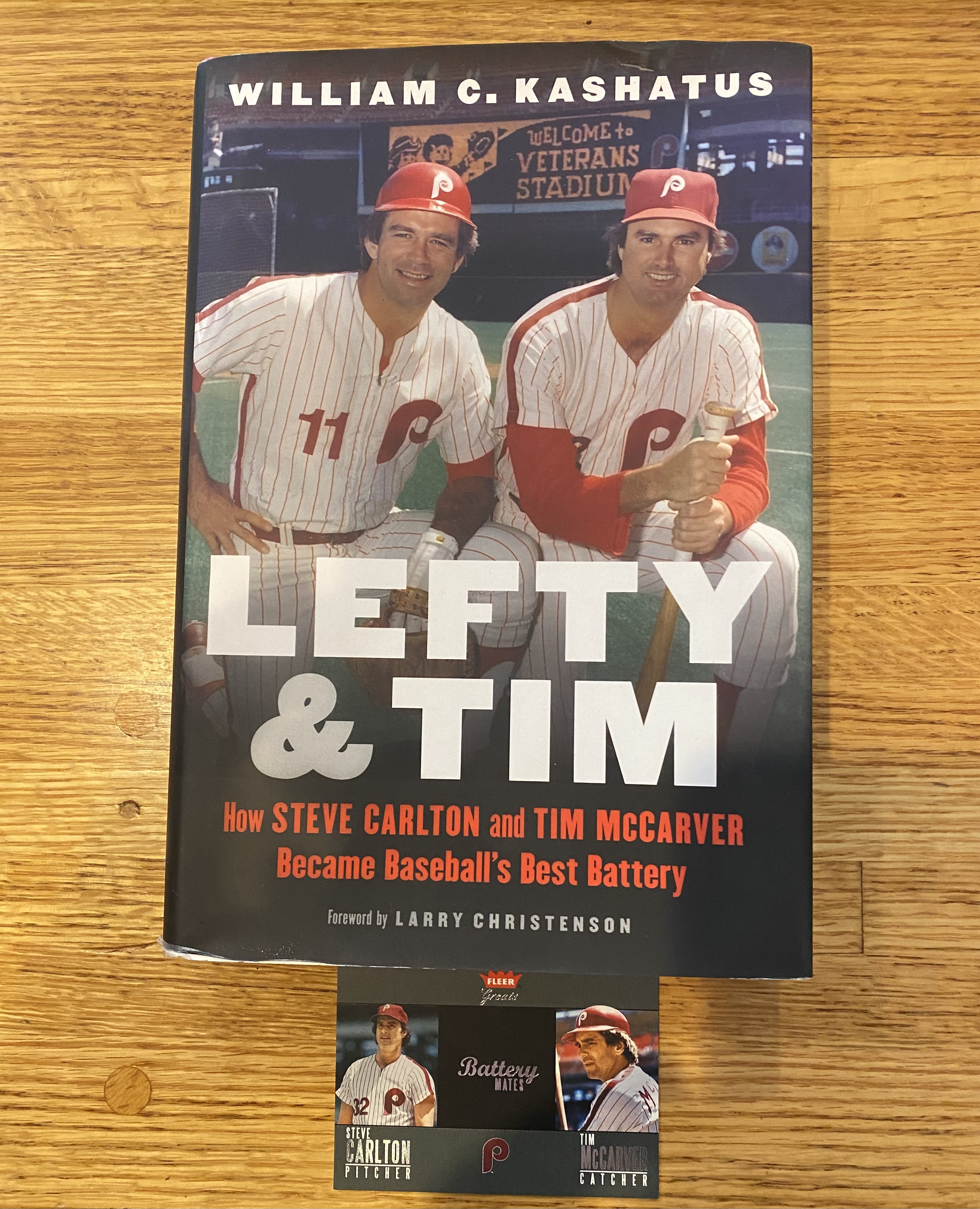
Book Review: Lefty & Tim: How Steve Carlton and Tim McCarver Became Baseball's Best Battery, by William C. Kashatus (2022)

Cover of Lefty & Tim, by William C. Kashatus, 2022. With 2004 Fleer baseball card of Steve Carlton and Tim McCarver. (Photo by Mark C. Taylor)
 
Historian and author William C. Kashatus.


Steve Carlton was one of the best pitchers in baseball history. Carlton won 329 games, the 2nd highest total for a left-hander. He struck out 4,136 batters—a record for left-handers at the time he retired in 1988. Carlton was the first pitcher to win 4 Cy Young Awards, and he set a record for most strikeouts in a game when he fanned 19 Mets in 1969. Carlton, known by his nickname of “Lefty,” was a first ballot Hall of Famer, easily elected in 1994 when he was named on 95.82% of the ballots. Throughout his career, Carlton was known for his unorthodox training regimen, which included martial arts exercises, and for his silence with the media.  

William C. Kashatus’ 2022 book Lefty & Tim: How Steve Carlton and Tim McCarver Became Baseball’s Best Battery, examines the careers of Carlton and Tim McCarver, who became Carlton’s “personal catcher” with the Phillies from 1975-1979. The connection between McCarver and Carlton began in 1965 with the St. Louis Cardinals. Carlton was a rookie: 1964 was his first year in professional baseball. McCarver, only 3 years older than Carlton, was already well-established as a major leaguer. He had made his MLB debut at the tender age of 17 in 1959, and by 1963 he was the Cardinals’ starting catcher. McCarver was a hitting star of the 1964 World Series, appearing in all 7 games and hitting .478 as the Cardinals beat the New York Yankees.  


Carlton and McCarver were both stubborn men. Carlton wasn’t impressed by McCarver’s status, as he approached the catcher during spring training and said to him “Hey, you’ve gotta call for more breaking pitches when we’re behind in the count.” McCarver yelled at Carlton for having the gall to question his pitch calling. Carlton calmly walked away. The next day, McCarver apologized to Carlton for chewing him out. Carlton accepted McCarver’s apology and said, “I wasn’t listening anyway.” (Lefty & Tim, p.32-3)  


Despite this rocky beginning to their relationship, Carlton and McCarver soon became good friends, and McCarver was behind the plate during 1967, 1968, and 1969 as Carlton established himself as one of the best young pitchers in baseball. McCarver had another stubborn ace pitcher to deal with on the staff of the St. Louis Cardinals: Bob Gibson. McCarver and Gibson had clashed early on, but eventually came to a terrific understanding of one another, both as baseball players and as human beings. Gibson was also influential on Steve Carlton’s development as a pitcher. Gibson was no-nonsense on the mound. The mound was his office, and you didn’t mess with Gibson in his office. To Gibson, opposing hitters were the enemy. They were not to be fraternized with. Carlton developed the mental attitude to act the same as Gibson did on the mound.  


Carlton was known for his long silence with the media, so he might seem like an unlikely candidate for a biography. There have been two books written about Carlton’s amazing 1972 season, when he won 27 games for the last-place Philadelphia Phillies, but Kashatus takes a wider view of Carlton’s career. Kashatus got a lot of information from Carlton off the record, but ultimately, Lefty decided not to do any on the record interviews for the book. It’s a shame, because it would be fantastic to have Carlton’s story in his own words, but Kashatus did a terrific job of writing Lefty & Tim, even without the participation of one of the two subjects. (And besides, the garrulous McCarver, who did several interviews with Kashatus, probably did enough talking for two people.)  


Kashatus has done an excellent job of combing through the historical record to find good quotes from Carlton in the interviews he has done. The myth is that Steve Carlton never talked to the press, but that’s not true. Carlton gave plenty of interviews from 1965 until 1977, and even during his media silence from 1977 to 1986, Lefty still did the occasional interview here and there.  


Carlton began his career with an excellent fastball and curveball, and in 1969 he added a devastating slider. Carlton threw the slider from the same arm slot as his fastball, which meant that batters couldn’t tell which pitch was coming. Lefty’s slider broke down and in on right-handed batters, and down and away on left-handed batters. Standing 6 foot 4 and weighing 210 pounds in his prime, Carlton was strong enough to throw the slider without putting strain on his elbow.  


Lefty had one of the greatest seasons a starting pitcher has ever had in 1972, when he won 27 games and claimed his first Cy Young Award. But from 1973-1975, Carlton’s won-loss record was 44-47. But things were about to change. In mid-1975, the Phillies reacquired McCarver, after he was released by the Red Sox. The Phillies had one of baseball’s great defensive catchers in Bob Boone, but Boone and Carlton had different theories about pitch calling. Slowly, McCarver started to catch all of Carlton’s starts.  


Bob Boone had introduced Carlton to strength and martial arts coach Gus Hoefling, and the strenuous workouts helped improve Carlton’s performance on the mound. One of the best-known exercises called for Carlton to stick his left arm into a barrel of rice and try to work his hand down to the bottom of the barrel. Phillies starter Jim Lonborg, plagued by elbow problems, tried the rice workout and never had elbow issues again. Hoefling’s training also focused on the mental aspect of sports. One day, fellow starting pitcher Larry Christenson saw Carlton lying on the trainer’s table before a start with his eyes closed. Christenson asked Lefty what he was doing. Kashatus writes that Lefty’s response was that “he was visualizing the spin on his slider and how he was planning to throw it against the various batters in the opposing team’s lineup that night.” (p.186) 


After the 1975 season, Carlton’s lifetime record stood at 148-119, for a winning percentage of .554. From 1976 through the 1984 season, Carlton’s record was 165-88, for a winning percentage of .652. Carlton won 20 games 4 times from 1976-1982, and he won 3 more Cy Young Awards. The Phillies also turned into a powerhouse, making the playoffs 6 times from 1976-1983, culminating in the team winning their first World Series in 1980.  


Lefty & Tim will serve as the definitive book about how Steve Carlton became one of the most dominant pitchers of his era. Lefty & Tim also makes a compelling case for Tim McCarver’s reputation as a great handler of pitchers, and as a superbly intelligent student of baseball. Kashatus has interviewed many people close to Carlton and McCarver to create a comprehensive account of their baseball careers. If you’re a fan of either Steve Carlton or Tim McCarver, you should read Lefty & Tim.  

Wednesday, September 21, 2022

Book Review: Has Anyone Seen My Toes? a novel by Christopher Buckley (2022)

The cover of Has Anyone Seen My Toes? by Christopher Buckley, 2022.

Author Christopher Buckley.

 Christopher Buckley's 20th book, Has Anyone Seen My Toes? is a humorous journey through the COVID pandemic. The book's main character is an unnamed screenwriter who lives in South Carolina. Said screenwriter is also stress-eating his way through the pandemic, aided by the gluttonous portions at the fast-food restaurant Hippo King.  

In between meals from Hippo King, our screenwriter is trying to complete a screenplay about a fictitious attempt during WWII by the Germans to kidnap FDR from Bernard Baruch's South Carolina estate. The title of the screenplay? Heimlich's Maneuver. It's always a joy to read a great writer writing deliberately terrible prose, and if that idea sounds humorous to you, then you're going to LOVE Heimlich's Maneuver.  


Our screenwriter is also obsessed with the local race for county coroner, which seems to be getting particularly heated, and may be susceptible to interference by the Russians. The Russians? Ah, yes, The Russians was a best-selling 1976 non-fiction book by New York Times reporter Hedrick Smith, covering Russian life during the Brezhnev years. You know, Hedrick Smith won 2 Pulitzer Prizes back in the 1970’s. Has any other reporter won 2 Pulitzer Prizes? I must look that up. Oh, sorry! But you see our screenwriter friend has quite a digressive mind, and he's constantly thinking of things that he must look up! As someone who spends a fair amount of time seated in front of a computer screen, banging away at my latest masterpiece, I can identify with these digressive distractions. 


There’s a brief mention of South Carolina’s Senator Squigg Lee Biskitt, a character first introduced in Buckley’s 2020 satire Make Russia Great Again. Senator Biskitt is a Republican who was vociferously against the candidacy of Donald Trump, but once Trump was elected, quickly became one of his chief myrmidons in the Senate. Is Senator Biskitt based upon a real person? It seems doubtful. How could anyone be so unprincipled?  


In Christopher Buckley’s best satires, there are larger issues and ideas that animate his plots and characters. Has Anyone Seen My Toes? is satire on a smaller scale. The screenwriter is stuck in his own mind throughout the book. This is one of the shortcomings of the novel, but at the same time, it means that the book is truly reflective of the pandemic. It’s possible that future readers may regard Has Anyone Seen My Toes? as one of the comedic novels that best demonstrates what it was like to be alive during 2020 and 2021.  

Wednesday, September 14, 2022

Ramsey Lewis 1935-2022


The great jazz pianist Ramsey Lewis, 1935-2022.

My Dad's copy of The Ramsey Lewis Trio at the Bohemian Caverns, 1964. (Photo by Mark C. Taylor)

My Dad's copy of Barefoot Sunday Blues, 1963. (Photo by Mark C. Taylor)

Ramsey Lewis in concert, 1981.

The jazz pianist Ramsey Lewis passed away on Monday at the age of 87. Lewis was a superb musician, and he took a vast array of influences-blues, gospel, pop, and classical, and combined them into his own unique style of jazz. Lewis had a huge hit in 1965 with his version of the pop song "The 'In' Crowd." The single peaked at number 5 on the pop charts, becoming an even bigger hit than the original. The album The In Crowd also soared into the Top Ten, peaking at number 2 on the LP chart. 

I was lucky enough to see Ramsey Lewis in concert several times: in 2009 at Orchestra Hall, and at the Dakota Jazz Club in 2012, 2015, and 2017. I also wrote short reviews of two of Lewis' 2020 concerts on Stageit. I went to most of these concerts with my Dad, who had been a fan of Ramsey Lewis since the 1960's. He owned several Ramsey Lewis albums: The In Crowd, Barefoot Sunday Blues, and At the Bohemian Caverns. My Dad was a jazz fan, and he helped introduce me to the music of Ramsey Lewis, Ahmad Jamal, Dave Brubeck, and Oscar Peterson. My Dad passed away last December. My Dad's birthday is tomorrow, September 15th, so he's been on my mind a lot lately, and Ramsey Lewis' passing just adds to the emotion of this week. My Dad and I watched Ramsey Lewis' 2020 Beatles concert on Stageit together, and it was fun for us to see this masterful musician playing a solo concert in his own home. 

"The 'In' Crowd" was, like many hit records, a product of chance and happenstance. The song had been a hit for singer Dobie Gray, peaking just outside the Top Ten on the pop and R&B charts in February 1965. A couple of months later, a waitress suggested the song to Lewis, bassist Eldee Young and drummer Redd Holt. They listened to the song on the jukebox a few times and put it in their set. It received a rapturous reaction from the audience at the Bohemian Caverns nightclub, where the trio was recording a live album. The energy of the song was infectious, and suddenly Ramsey Lewis was a household name. "The 'In' Crowd" won a Grammy for the Best Jazz Performance-Small Group. 

Lewis recorded a lot of albums throughout his lengthy career. Some of the Ramsey Lewis albums I really enjoy are Down to Earth, a 1958 collection of folk and traditional songs, Mother Nature's Son, an exploration of tunes from the Beatles' White Album, 1974's funky Sun Goddess, and 2011's Taking Another Look, where Lewis re-recorded most of the songs on Sun Goddess. Of special note for Twin Cities music fans is the excellent 1970 live album Them Changes, recorded in May of 1970 at the Depot, a venue better known today as the legendary club First Avenue. 

Ramsey Lewis leaves behind a rich legacy of superb jazz music in a long and varied career. RIP to a true master of the keyboard.