Wednesday, August 24, 2022

Book Review: Losing Mum and Pup: A Memoir, by Christopher Buckley (2009)


My well-worn paperback copy of Losing Mum and Pup, by Christopher Buckley, 2009. (Photo by Mark C. Taylor)

Christopher Buckley had resolved not to write about his famous parents, Patricia Taylor Buckley, and William F. Buckley, but once they passed away within 10 months of each other, Buckley decided to write about that terrible year. The book that emerged was Losing Mum and Pup, published in 2009.

I read Losing Mum and Pup in 2012, and although it was easily one of my favorite books that I read that year, I neglected to review it at the time. Last month I listened to the audio version, read by Christopher Buckley. My own Father passed away last December, and I thought, well, why not revisit Losing Mum and Pup?

Losing Mum and Pup is a moving book, as Buckley details dealing with two aging parents as an only child. But more than that, Losing Mum and Pup is a celebration of Buckley’s parents, and they remain vibrantly alive on the pages of this fine book.

Christopher Buckley is best-known as a humorist and satirist, and he has the right temperament to see the absurdities often apparent in matters of the end of life. When WFB is taken into the hospital in June of 2007 because his kidneys aren’t functioning, Christopher informs us that reiterating to WFB for the umpteenth time that day that they aren’t able to go home just quite yet is “like being on Firing Line, on acid.” (p.99) In time, WFB’s kidneys recover and he’s able to go home.

There are moving scenes, as when WFB dictates to Christopher the final paragraphs of his book Flying High: Remembering Barry Goldwater. “He made hardly any self-corrections as he spoke. The words came out punctuated and paragraphed. And quickly…In less than ten minutes, we were on the last paragraph of the last book he would write.” (p.142) But then the chapter is lost, thanks to the vagaries of WordStar, an obsolete word-processing program that WFB remained stubbornly dedicated to. “Pup redictated the chapter, practically verbatim. When we went over it the next day, there was little it needed other than a comma here and a word there. I was, for the thousandth time in my life, in awe of him.” (p.143)

Losing Mum and Pup was my introduction to the personal life of William F. Buckley, Jr. I was fascinated by the books Christopher mentioned: Cruising Speed and Overdrive, which each covered a week in the life of WFB, and numerous books about sailing, such as Airborne, which chronicles a crossing of the Atlantic Ocean. Reading Overdrive in 2013 helped me recommit to my own writing, and since then I’ve become a much more productive writer. And, one can only hope, a better writer.

Losing Mum and Pup is a fantastic book. Funny and moving, it showcases the best of Christopher Buckley’s writing.

Tuesday, August 23, 2022

Book Review: Gift from the Sea, by Anne Morrow Lindbergh (1955, 20th anniversary edition published in 1975)


My 20th anniversary edition paperback of Gift from the Sea, by Anne Morrow Lindbergh (1955, 20th anniversary edition published in 1975) photo by Mark C. Taylor.

Writer, poet, and aviator Anne Morrow Lindbergh, 1906-2001.

Charles Lindbergh and Anne Morrow Lindbergh, 1931. Anne served as Charles' navigator and co-pilot on many flights. 

Anne Morrow Lindbergh was the wife of American aviator Charles Lindbergh, and an acclaimed author in her own right. Her most famous book is Gift from the Sea, which became a surprise bestseller upon its publication in 1955. It’s a slim volume of essays, using different types of seashells as metaphors for life.

I recently finished reading a fantastic biography of Charles Lindbergh, The Rise and Fall of Charles Lindbergh, by Candace Fleming, and that inspired me to pull out my copy of Gift from the Sea that I had picked up from a Little Free Library a couple of years ago. I found it to be a compelling little book. Gift from the Sea can be connected to the feminist movement, as Morrow Lindbergh writes about the role of women in American life. She writes of all the different obligations on women: “What a circus act we women perform every day of our lives. It puts the trapeze artist to shame.” (p.26) Later in the book she writes, “All her instinct as a woman—the eternal nourisher of children, of men, of society—demands that she give. Her time, her energy, her creativeness drain out into these channels if there is any chance, any leak.” (p.45)

Gift from the Sea is also a spiritual book, as Morrow Lindbergh is interested in how women can nourish their souls. She writes: “Only when one is connected to one’s own core is one connected to others, I am beginning to discover. And, for me, the core, the inner spring, can best be refound through solitude.” (p.44)

Morrow Lindbergh is writing about what might now be called “self-actualization.” One of my favorite quotes in the book is this one: “The most exhausting thing in life, I have discovered, is being insincere. That is why so much of social life is exhausting; one is wearing a mask.” (p.32)

In Gift from the Sea, Morrow Lindbergh describes a hypothetical perfect day. It’s interesting that her perfect day is spent with her sister, rather than with her husband Charles. That’s emblematic of the Lindbergh’s marriage, which had its difficulties, to put it mildly. Charles Lindbergh was always a seeker, a wanderer, and his job as an aviation consultant took him away from home for long stretches at a time. That was obviously the way Charles wanted it. He even fathered several children with 3 German women in the years after Gift from the Sea was published. Anne did not learn about these families during Charles’ lifetime. Despite it all, it was Anne who was at Charles’ side as he succumbed to cancer in 1974.

Gift from the Sea is a book that anyone can still gain something useful and valuable from, as all of us try to find inner peace and calm in a world that seems much faster-paced than 1955.

Friday, August 5, 2022

Book Review: The Rise and Fall of Charles Lindbergh, by Candace Fleming (2020)


The cover of The Rise and Fall of Charles Lindbergh, by Candace Fleming, 2020.

Charles Lindbergh and The Spirit of St. Louis, 1927.

Charles Lindbergh making a speech on behalf of "America First," 1940-41.


Charles Lindbergh was a complicated man. That’s an understatement, but let’s start there, shall we? As I grew up in Minnesota, and still live in Minnesota, Charles Lindbergh is someone who looms large in the iconography of the state. The largest terminal at our main airport was named after Lindbergh. (The airport has since changed the names of the terminals to the more prosaic “1” and “2.”) When I was a kid growing up in the 1980’s, there was a full-scale replica of Lindbergh’s airplane The Spirit of St. Louis that hung in the Lindbergh terminal. Lindbergh’s boyhood home in Little Falls is now a museum, run by the Minnesota Historical Society. There’s a statue of Lindbergh, “The Boy and the Man,” on the grounds of the Minnesota State Capitol. I’ve always been fascinated by the fact that three of the most significant American cultural figures to emerge during the decade of the 1920’s were from Minnesota: Charles Lindbergh, F. Scott Fitzgerald, and Sinclair Lewis. Not bad for a state from the Midwest, old sport. 

Candace Fleming’s magnificent 2020 biography, The Rise and Fall of Charles Lindbergh, is a fantastic look at a complicated, contradictory man. Fleming often uses Lindbergh’s own words, and those of his wife, writer Anne Morrow Lindbergh, to paint a vivid and detailed picture of his life. Fleming’s book is classified as “young adult,” but those distinctions are irrelevant when you’re discussing an expertly written book.

Every chapter of Lindbergh’s life could be made into a movie. If you wrote his life as a novel, it would seem unbelievable.

Lindbergh skyrocketed to world fame in May of 1927, as he became the first person to fly solo across the Atlantic Ocean. Lindbergh looked every inch the ideal American hero: tall, slender, with a dimpled chin and a shy grin. Lindbergh used his newfound fame to advocate for aviation, but the press was fascinated by his personal life as well. His marriage to Anne Morrow in 1929, and the birth of their first child a year later, Charles Lindbergh Jr., made worldwide headlines.

In 1932, Lindbergh’s life became a nightmare when his son was kidnapped. Lindbergh ran much of the investigation himself, and while he had a sharp intelligence, Lindbergh was not the best judge of people. He was taken advantage of by people who claimed to have knowledge of where his son was being held. It’s heartbreaking to read of Lindbergh being led astray by liars, searching in vain in stormy waters for the non-existent boat where someone told him his son was being held, at the very moment when police found the child’s dead body, just a few miles from the Lindbergh home.

A sad coda to the Lindbergh kidnapping was how, periodically, people would show up on the Lindbergh’s doorstep and claim that they were his dead son. Rather than respond to them with anger, Fleming writes of how Lindbergh “met their delusions with compassion, speaking with them logically, reasonably, and at length.” (p.308) How heartbreaking to have to carry out such a task.

Controversy followed Lindbergh throughout his life. His interest in eugenics and his approval of pre-war Nazi Germany have cast a sinister shadow over his reputation. Incredibly enough, in the fall of 1938 Charles and Anne were searching for a house in Berlin. Then Kristallnacht happened, and Lindbergh finally came to his senses—sort of. He returned to America in 1939.

Lindbergh was determined that the United States should not enter the coming European war, and he eventually joined “America First,” a non-interventionist group. For a man who didn’t like being a celebrity, and who treasured his privacy, Lindbergh made the surprising decision to barnstorm around the United States, giving speeches in favor of American neutrality. Lindbergh blamed the Jews for agitating for the United States to enter World War II. He wrote of Jews, “There are too many in places like New York already. A few Jews add strength and character to a country, but too many create chaos.” (p.247) Ugh, what a disgusting sentiment.

Anne Morrow Lindbergh wrote a 1940 pamphlet in support of fascism, The Wave of the Future, promoting an American brand of fascism that could be “crisp, clear, tart, sunny, and crimson—like an American apple.” (p.265) Wait, what? Fascism is like an apple? This quote shows how unsophisticated the political thinking of both Lindberghs was. American fascism will be crimson, sure, but the crimson will be the blood running in the streets.

Despite his support for isolationism, once the United States entered World War II, Lindbergh attempted to return to active military service. (He had resigned his military commission earlier in 1941 after clashing with FDR.) Lindbergh was rebuffed, but eventually, in the spring of 1944, he found himself attached to a bomber unit in the Pacific as a civilian observer. Lindbergh was past 40, but he was still a better pilot than the men half his age. He ended up flying more than 50 bombing missions in the Pacific. (This was technically against military policy, since Lindbergh was a civilian, but the military brass was fine with looking the other way.)

During World War II, as Lindbergh was testing planes in the United States, he had a revelation during a flight where he blacked out and almost crashed. He wrote that he had suddenly realized “In worshipping science man gains power but loses the quality of life.” (p.285) After the war was over, Lindbergh toured a concentration camp in Germany. He was sickened by what he saw there. Lindbergh had always been a worshipper of science, but now he saw what science could bring about: Nazi death camps and the atomic bomb. He wanted no part of either.

Lindbergh spent much of his later life traveling the world advocating for environmentalism. He said, “I realized that if I had to choose, I would rather have birds than airplanes.” (p.317) But lest you think that he was mellowing into old age, Lindbergh also fathered several secret children in Germany that he financially supported.

As I wrote at the beginning, Charles Lindbergh was a complicated man. Candace Fleming has done a remarkable job in presenting all the different facets of Lindbergh’s life and personality.

Thursday, July 28, 2022

Movie Review: Diabolically Yours, Starring Alain Delon and Senta Berger, Directed by Julien Duvivier (1967)

The Blu-Ray cover of Diabolically Yours, 1967. That eyebrow, tho.

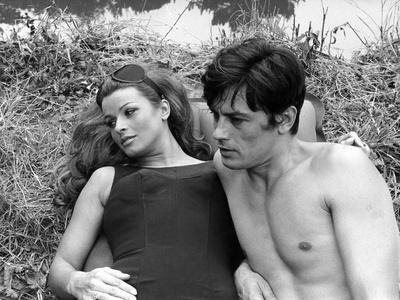
Alain Delon and Senta Berger make a gorgeous couple in Diabolically Yours, 1967.

Gorgeous Senta Berger and handsome Alain Delon.

"Do I still look devastatingly handsome?"

The 1967 French thriller Diabolically Yours was the last movie of acclaimed director Julien Duvivier, who died in October of 1967, just two months before Diabolically Yours was released. Diabolically Yours stars French actor Alain Delon and Austrian-German actress Senta Berger, and together they make a gorgeous screen couple.

Diabolically Yours follows Delon as he wakes up in the hospital after a car crash. Delon has amnesia, and when Berger arrives at the hospital and says she’s his wife, he doesn’t remember her. (Don’t worry ladies, the crash didn’t affect Delon’s handsome face.) Berger takes Delon back to their fantastically huge house, and he tries to recover his memory. But is everything as straightforward as it seems? Who exactly is Kim the butler, who seems fixated on Berger? (Kim is perfectly played by Peter Mosbacher.) And what about Delon’s friend and doctor Frederic, who is always hanging around? (Expertly essayed by Sergio Fantoni.)

The performances in the movie are all excellent. Delon can convey so much emotion with just a glance, and Fantoni and Mosbacher give their supporting roles just the right touch of creepiness. Senta Berger is excellent, and she looks gorgeous in all the many costumes she wears throughout the film. The costume designer did a terrific job, as both Berger and Delon look fantastic—notice how Delon’s robe matches his blue eyes. Delon always looks handsome, of course, and he looks very sharp in the scenes where he’s wearing all black. Delon and Berger look so good together that I could watch a movie called Alain Delon and Senta Berger Watch Paint Dry in 1967.

I don’t want to give away too much of the plot, but after watching the movie, I wondered if it might have been improved if the big reveals at the end had instead been revealed to the audience at the beginning of the movie? Obviously, you’d have to change the structure of the movie, but I think you could still create suspense and tension doing so.

Diabolically Yours was released in France at the end of 1967, just two months after his iconic performance in Le Samourai. Diabolically Yours isn’t a masterpiece on the level of Le Samourai, but it’s still an entertaining and stylish film.

Wednesday, July 27, 2022

Book Review: We Were Dreamers: An Immigrant Superhero Origin Story, by Simu Liu (2022)


The cover of We Were Dreamers: An Immigrant Superhero Origin Story, by Simu Liu, 2022, plus a handsome headshot of Liu. 

The excellent cast of the CBC sitcom Kim's Convenience. From left to right, Simu Liu, Jean Yoon, Paul Sun-Hyung Lee, Andrea Bang, Andrew Phung, and Nicole Power.

Actor Simu Liu has rocketed to fame over the past few years, thanks to his role as Jung Kim on the CBC hit TV show Kim’s Convenience, and his groundbreaking lead role as Shang-Chi in 2021’s Shang-Chi and the Legend of the Ten Rings. Liu is now the author of a memoir, We Were Dreamers: An Immigrant Superhero Origin Story, which tells the story of his parents, who were born in China and immigrated to Canada in the early 1990’s.

Liu’s parents were both engineers, and they placed high expectations on him to follow a similar career path. However, from an early age, Liu had the feeling that he might be better suited to a more creative career. Much of We Were Dreamers focuses on Liu’s relationship with his parents, which turned abusive turning his teenage years.

Liu is an excellent writer, and he is honest about his own shortcomings as he chronicles his journey through a private high school and on to college, where he majors in business with the hopes of becoming an accountant. But the acting bug bites, and when Liu is fired from his accounting job in 2012, he jumps into acting, working as an extra, stock photo model, and stuntman—anything to gain experience.

Getting cast in Kim’s Convenience in 2016 was Liu’s big break as an actor. I would have liked more tidbits about Kim’s Convenience, as the show was my introduction to Liu, but he makes it clear that while he appreciated the show, he had his eyes set on making it big in Hollywood. Even after the success of Kim’s Convenience on Netflix, it was a struggle for Liu to break into American movies. That all changed in the summer of 2019, when Liu was cast as Shang-Chi, the first Asian superhero in Marvel’s Cinematic Universe.

Unfortunately, Kim’s Convenience fizzled out, and the show was canceled in 2021, due in part to the departure of Ins Choi, who wrote the play that the show was based upon. Cast members, including Liu, were vocal about how the show minimized their creative input, and criticized the shows’ lack of Asian writers. It was an unfortunate ending for a show that was groundbreaking, and in the beginning, quite funny and touching. But the last two seasons of the show were marred by a decision to lean into typical sitcom cheesiness, and as Liu writes, “story lines that didn’t carry past a singular episode.” (p.258) One of my pet peeves during the final two seasons was how Janet’s character seemed to change arbitrarily from week to week, for seemingly no reason. 

We Were Dreamers is an excellent book, as Liu details the struggles of being an Asian-American actor at a time when Asian representation in the US media is still shockingly low. I wish Liu wrote more about Kim’s Convenience, and I wish he wrote more about how his relationship with his parents has changed and improved over the years, but those are small quibbles. For anyone interested in Simu Liu’s rapid rise to stardom, or about what it’s like to be the child of immigrants, We Were Dreamers is a must-read.

Wednesday, June 29, 2022

Book Review: The Short Stories of F. Scott Fitzgerald: A New Collection, Edited by Matthew J. Bruccoli (1989)


Paperback cover of The Short Stories of F. Scott Fitzgerald: A New Collection, edited by Matthew J. Bruccoli, 1989. (Photo by Mark C. Taylor)

F. Scott Fitzgerald at his desk, 1920's.

F. Scott Fitzgerald is best known today for his novels The Great Gatsby and Tender Is the Night, but he was also a prolific short story writer, publishing around 160 short stories. Only 45 of those stories were collected in books during Fitzgerald’s lifetime. The Short Stories of F. Scott Fitzgerald: A New Collection, edited by Fitzgerald scholar Matthew J. Bruccoli, and first published in 1989, attempted to put together a definitive collection of Fitzgerald’s best short stories.

The Short Stories of F. Scott Fitzgerald essentially replaced the 1951 collection The Stories of F. Scott Fitzgerald. The 1989 collection has the advantage of length: it contains 43 stories, compared to 28 in the 1951 collection. One can always quibble with an editor’s selections, but Bruccoli did a fantastic job of collecting Fitzgerald’s most important stories, while also highlighting the breadth and scope of Fitzgerald’s short stories.

Fitzgerald’s stories show the optimism and disillusion of one man, emblematic of his generation. Fitzgerald’s life was a touchstone for many of the momentous events of his lifetime. Born in 1896, just before the dawn of the American century, Fitzgerald served in World War I, (although he didn’t see combat) spent a good chunk of the 1920’s in Paris and made his first foray to Hollywood just as silent pictures were ending. His wife Zelda’s mental health collapsed just months after the stock market crash. Fitzgerald’s stories of the 1930’s often took a darker tone as his alcoholism worsened and his cynicism deepened.

Fitzgerald writes so movingly of loss, and the yearning for the past. The last three paragraphs of “The Last of the Belles” are a beautiful example of his evocative style. In the story, the narrator is searching for the Army camp where he was stationed a decade earlier during World War I, but he can find no trace of it:

“I tried to sight on a vaguely familiar clump of trees, but it was growing darker now and I couldn’t be quite sure they were the right trees…No. Upon consideration they didn’t look like the right trees. All I could be sure of was this place that had once been so full of life and effort was gone, as if it had never existed, and that in another month Ailie would be gone, and the South would be empty for me forever.” (p.463)

Fitzgerald’s main themes of love, class, and money reverberate through many of his stories, but in this collection the reader can get a sense of Fitzgerald’s range as an author. Yes, he wrote about beautiful, privileged people searching for love, but he wrote about many other things too. Fitzgerald’s sense of humor is on display in “The Jelly-Bean,” “The Diamond as Big as the Ritz,” “Financing Finnegan” and the Pat Hobby story “’Boil Some Water—Lots of It.’” He examines the South in “The Last of the Belles,” “The Jelly-Bean,” and “The Ice Palace.” There are short stories about Catholicism, (“Absolution”) college football, (“The Bowl”) and Hollywood (“Crazy Sunday,” “Last Kiss”).

Fitzgerald would be so proud if he could hold this collection of his short stories in his hands. It’s 775 pages of his best writing, a summation of more than 20 years as a professional author. Fitzgerald sweated over these stories, working hard to capture his times on paper. He was a writer blessed with a remarkable gift: the ability to write perceptively about his own time, yet his writing transcends his own time as his words echo down the generations to us all these years later. In every story, no matter how contrived the plots may sometimes be, there are sentences and phrases that will take your breath away and will remind you of the power and beauty of the written word.

Some of my own favorite stories in this volume are:

“The Ice Palace”

“May Day”

“The Diamond as Big as the Ritz”

“Winter Dreams”

“The Sensible Thing”

“The Last of the Belles”

“The Swimmers”

“Babylon Revisited”

“Crazy Sunday”

“Afternoon of an Author”

Tuesday, June 28, 2022

Book Review: The Twilight World, a novel by Werner Herzog, translated by Michael Hofmann (2022)

Hardcover edition of Werner Herzog's novel The Twilight World, 2022.
 
The German film director Werner Herzog.


The German film director Werner Herzog is one of the great cult figures in 21st century pop culture. An acclaimed director, both for his narrative films and his documentaries, Herzog is known in pop culture for his deadpan speaking voice and his bleak outlook on life. There is something mystical and otherworldly about Werner Herzog: he pulled Joaquin Phoenix out of a car crash. Herzog was once wounded by a bullet from an air-rifle during an interview, but he continued the interview.

Herzog has always been drawn to extreme circumstances in his films, so it’s not surprising that his first novel, The Twilight World, translated from German to English by Michael Hofmann, is about survival in the most extreme conditions. The Twilight World is about Japanese Lieutenant Hiroo Onoda, who fought a guerilla war on the Philippine island of Lubang from 1945 until 1974. Onoda and three other Japanese soldiers hid in the jungle hills after the Japanese retreat from the island. Onoda was the last survivor of the four soldiers. When Herzog was directing an opera in Japan in 1997, he turned down an invitation to meet the Emperor of Japan. “My goodness, I have no idea what I would talk about with the Emperor. It would be nothing but banalities.” “Well, if not the Emperor, whom would he like to meet?” Herzog instantly replied, “Onoda.” Of course.

You can’t quite imagine Werner Herzog making small talk at a gala with the Emperor, can you? I suppose Herzog might suffer through such an event. But it would be a form of torture for him. You might see him standing out on a balcony in his tuxedo and go over to him and say, “What a beautiful event.” Herzog smiles and nods, mutters “Thank you” through clenched teeth. It’s a beautiful spring evening, and you venture forth a comment on the pleasant weather. Herzog says, “Uh huh” in a noncommittal tone. Inside his head, Herzog is thinking “There is nothing more insufferable to me than the self-congratulatory world of entertainment. Why did I even agree to attend this meaningless social charade? And this person who is standing before me, talking about the weather…don’t they realize the brutality of this nature they are so effusively praising? At any moment, a gust of wind could come along and cause them to lose their balance and fall over the low railing of this balcony and they would be squashed like a tiny bug on the sidewalk.”

The Twilight World is a fascinating tale. I do not know enough about Onoda’s story to know how much is true and what was invented by Herzog. But does it really matter? The tale itself is so unbelievable that it sounds like a wild fiction concocted by a deranged novelist.

When I read about The Twilight World, I knew I wanted to experience it. Fortunately, Herzog himself narrates the English version of the audiobook, so I could have his distinctive voice and cadences seeping directly into my ear. I’ve been a fan of Herzog’s since the late 1990’s, when I watched several of his films for my high-school German class. You must admire someone who is enough of a lunatic to haul a steamship over a mountain for the sake of a film. Herzog’s low-key intensity behind the camera was amplified by the brilliant, intense German actor Klaus Kinski, who delivered stunning performances in films like Aguirre, the Wrath of God and Fitzcarraldo. If you are a fan of Herzog’s, he will guide you into the jungle once again in The Twilight World.