Showing posts with label andrew roberts. Show all posts

Saturday, December 31, 2016

The Best Books I Read in 2016


Miles Gone By: A Literary Autobiography, by William F. Buckley, Jr., 2004.


The Storm of War: A New History of the Second World War, by Andrew Roberts, 2011.

The Fire Next Time, by James Baldwin, 1963.

Survival in Auschwitz, by Primo Levi, originally published in 1947, first English translation published in 1958.

Wilson, by A. Scott Berg, 2013.

King of the Night: The Life of Johnny Carson, by Laurence Leamer, 1989.

Radical Chic & Mau-Mauing the Flak Catchers, by Tom Wolfe, 1970.

The Right Stuff, by Tom Wolfe, 1979.

The Bonfire of the Vanities, by Tom Wolfe, 1987.
I read 33 books in 2016, most of which I reviewed on this blog. Here are my favorites that I read this year. The links will take you to the full reviews of these books.

Miles Gone By: A Literary Autobiography, by William F. Buckley, Jr. 2004. WFB makes the list for a second year in a row. Miles Gone By isn’t a strict autobiography; rather, it’s a collection of autobiographical writings from throughout Buckley’s long career. Miles Gone By is really about the man behind the politics, and partisans of either stripe can enjoy Buckley’s wit, joie de vivre, impressive vocabulary, and generous spirit, all of which are on full display. It’s a marvelous read, and time spent in the company of the witty, passionate, intelligent Buckley is always time well spent.  

The Storm of War: A New History of the Second World War, by Andrew Roberts, 2011. Roberts also makes the list for a second year in a row, for his superb overview of World War II. Roberts brings the conflict to life, and he’s an equally good writer on military or political matters. His chapter on the Holocaust is superb and haunting. Roberts is also very strong on the Eastern front, and convincingly makes the argument that it was Russia who bled the Nazis dry. The Storm of War captures the global scope and sweep of World War II while still reminding us of the stark tragedies that each one of the 50 million deaths in that conflict represents.

The Fire Next Time, by James Baldwin, 1963. Baldwin’s searing look at race in America is still relevant today, more than fifty years after it was written.

Survival in Auschwitz, by Primo Levi, 1947. For anyone wanting to understand more about the Holocaust, Levi’s eloquent memoir is a superb place to start. Levi was a prisoner in Auschwitz for more than a year, and in Auschwitz, he saw mankind at its worst. Levi summed up the entire experience of the Holocaust with this anecdote:

“Driven by thirst, I eyed a fine icicle outside the window, within hand’s reach. I opened the window and broke off the icicle but at once a large, heavy guard prowling outside brutally snatched it away from me. ‘Warum?’ I asked him in my poor German. ‘Hier ist kein warum’ (there is no why here), he replied, pushing me inside with a shove.” (p.29)

Wilson, by A. Scott Berg, 2013. An excellent cradle to grave biography of our 28th President. Berg paints a vivid picture of one of our most accomplished presidents. Wilson’s writings are quoted from liberally, so the reader gets a vivid sense of his personality. 

King of the Night: The Life of Johnny Carson, by Laurence Leamer, 1989. A slight change of pace from the books listed above. This summer I attempted to learn all that I could about the enigmatic Johnny Carson. While Carson’s off-camera life was sometimes quite messy, (he was married four times) on screen he was the personification of cool, and he always seemed to have the perfect quip at hand. Leamer’s diligently researched biography is a superb portrait of the Tonight Show host.

Radical Chic and Mau-Mauing the Flak Catchers, by Tom Wolfe, 1970. My new favorite author, Tom Wolfe, makes the list again, this time for three different books! Radical Chic describes a party that Leonard Bernstein threw for the Black Panthers at his thirteen-room, two-story, penthouse duplex. Wolfe’s writing is as sharp as a knife throughout the essay: “God, what a flood of taboo thoughts runs through one’s head at these Radical Chic events…But it’s delicious. It is as if one’s nerve endings were on red alert to the most intimate nuances of status.” Wolfe is always on red alert to the most intimate nuances of status! That’s his calling card! This is right up his alley! 

The Right Stuff, by Tom Wolfe, 1979. Wolfe’s chronicle of the early U.S. space program is an engaging look at the Mercury 7 astronauts. Along the way, Wolfe explores the mythic “right stuff” that test pilots and astronauts must have to remain cool under pressure. The sections where Wolfe re-creates the astronaut’s Mercury flights are superb. One of the main figures in the book is the late John Glenn, who was the most media friendly of the Mercury 7, and was also a strict moralizer who sometimes clashed with the other astronauts. 

The Bonfire of the Vanities, by Tom Wolfe, 1987. Wolfe’s first novel, Bonfire was a massive study of New York City, specifically the justice system, the one part where different strata of society interacted. Wolfe captures the zeitgeist of the 1980’s in all its money-lusting glory with the character of Sherman McCoy, a wealthy bond trader. It’s a marvelous book, nearly 700 pages long, with 2,343 exclamation points.

Sunday, June 26, 2016

Book Review: The Storm of War: A New History of the Second World War by Andrew Roberts (2011)


The Storm of War: A New History of the Second World War, by Andrew Roberts, published in the UK in 2009 and in the US in 2011.


British historian Andrew Roberts.
Andrew Roberts’ 2011 book The Storm of War: A New History of the Second World War is a superb and fascinating look at the deadliest conflict in human history. I previously read Roberts’ excellent 2014 biography of Napoleon Bonaparte, Napoleon: A Life, which I reviewed here. Roberts has a knack for choosing the telling historical detail that gets his point across in an entertaining way, and although he writes about very broad subjects, he never gets bogged down in historical minutiae.

I read The Storm of War because I realized recently, as I was teaching World War II to my 10th grade World History students, that I had never read an overview of the war that examined all of the different fronts. So I picked up The Storm of War, in large part because I enjoyed Roberts’ biography of Napoleon so much. 

The Storm of War is an excellent read, as Roberts summarizes the military history of the war, while also examining the political currents that informed the actions of the major players. Roberts focuses more on the European theater than the Pacific, but for a British historian, that’s quite understandable. 

Roberts isn’t afraid to add his two cents when he feels it’s called for. Joseph Goebbels is described as “a man who fully deserves the cliché ‘evil genius,’” (p.23) and General Hans Krebs was “straight out of Nazi central casting.” (p.560) I enjoyed these little asides, as it added more color to the book.

Roberts is perhaps strongest in his writing on the Eastern front of the European theater, and he proves that Germany’s losses on the Eastern front doomed their war effort. Part of Germany’s losing the war was simple arithmetic. As Roberts writes, “In 1941 the USSR had more soldiers and more tanks than, and the same number of aircraft as, the whole of the rest of the world’s armed forces combined.” (p.139) When Hitler launched his invasion of Russia in June of 1941, the Wehrmacht was in much better shape than the Red Army, largely due to Stalin’s disastrous purge of the Red Army leadership in the late 1930’s, but the numbers were never going to be in Germany’s favor. The Russians were simply able to absorb a seemingly infinite amount of casualties and yet still keep reinforcing their troops. Stalin should not have been taken so much by surprise at the German invasion, since “…Stalin received no fewer than eighty warnings of Hitler’s intentions over the previous eight months.” (p.155) 

The chapter about the battle of Stalingrad is superb and haunting. The criticism that Roberts hands out to Stalin is well deserved, as he points out “During the battle of Stalingrad, the NKVD shot around 13,500 Russian soldiers-the size of an entire fully manned division-for treachery, cowardice, desertion, drunkenness and ‘anti-Soviet agitation.’” (p.326) For the average Russian soldier there was simply no alternative than to fight the Germans tooth and nail, street by street in places like Stalingrad.

Roberts puts Russia’s huge sacrifice in context, as he writes, “…between D-Day and VE Day {June 6, 1944 to May 8, 1945} the Russians suffered more than 2 million casualties, three times that of the British, Americans, Canadians and French fighting forces put together. It is worth considering whether democracies could ever have tolerated that level of sacrifice, or whether-as seems likely-it required the whole horrific apparatus of the NKVD and domestic terror to keep the Soviet Union in the war.” (p.520) That’s a sobering thought, but it’s certainly true, and it’s frightening to think how the war would have gone if Hitler had not made the disastrous decision to invade Russia and had instead been able to use the entire force of the Wehrmacht to repel the D-Day invasion. 

One thing I enjoyed about Roberts’ writing is that while he is by no means writing an alternate history of World War II, he is able to show how the Allies’ victory was by no means preordained, and he isn’t afraid to briefly explore alternate paths of action the main players could have taken. 

Examining these other paths of action inevitably means taking a look at how Adolf Hitler made decisions, since he made most of his decisions unilaterally, with a minimum of input from anyone else, usually to the detriment of the German war effort. Roberts also shows how Hitler’s Nazism led him to make decisions that ultimately undermined Germany’s chances of success. It would have been more beneficial for Germany to enlist the Slavic people of Eastern Europe to fight with Germany against the Russians, rather than make them victims of a horrific genocide, but that simply wasn’t how Hitler’s mind worked. 

Roberts relates some interesting anecdotes about the way Hitler’s mind did work, as he writes of Hitler at the Berghof: “Staggeringly beautiful scenery clearly had an effect on Hitler that was opposite to how most other people reacted: rather than softening and humanizing him it hardened his heart and filled him with power-lust.” (p.147) 

We also learn that Hitler had an amazing memory for random military facts, which I was not previously aware of:

 “Instances when Hitler displayed his technical interest in weaponry during the war are legion. When not asking pointed questions at his Führer-conferences with senior OKW figures and military commanders, he liked nothing better than showing off his detailed knowledge. Subjects upon which he would dilate included the horsepower needed for wheeled tractors to pull heavy field howitzers (85 hp); gearshift problems in the Tiger tank; the ricochet hazards associated with the 15cm anti-tank gun…” (p.50-1)

In another instance, “…when {Franz} Halder remarked that the Russians boasted 10,000 tanks, the statement ‘unleashed a more than quarter-hour retort from Hitler, in which he cited from memory the Russians’ annual production for the last twenty years.’” (p.140) Sounds like a fascinating guy.

During a war in which technology produced frightening advances in the ways in which men can kill each other, sometimes old-fashioned technology still played an important part, as during the battle of Berlin when “{German} Officers were reduced to telephoning numbers taken at random from the Berlin telephone directory, the Soviet advance being plotted by how many times the calls were answered in Russian rather than German.” (p.551)

One of Roberts’ wittiest lines comes late in the book, as he makes a reference to a famous line from Oscar Wilde’s play The Importance of Being Earnest, writing of Hermann Göring: “Since the Reichsmarschall was unquestioningly loyal to Hitler until almost the very end, his fidelity as a Nazi mattered more to the Führer than his competence as an air commander. Furthermore, after Rudolf Hess’s flight to Scotland, to lose one deputy Führer might be considered unfortunate, but to lose two might look like carelessness.” (p.587) If you can make people laugh when writing about Nazis, so much the better. 

The Storm of War is a marvelous book, one that captures the global scope and sweep of World War II while still reminding us of the stark tragedies that each one of the 50 million deaths in that conflict represent.

Wednesday, January 28, 2015

Book Review: Napoleon: A Life, by Andrew Roberts (2014)


Cover of Napoleon: A Life, by Andrew Roberts, 2014.


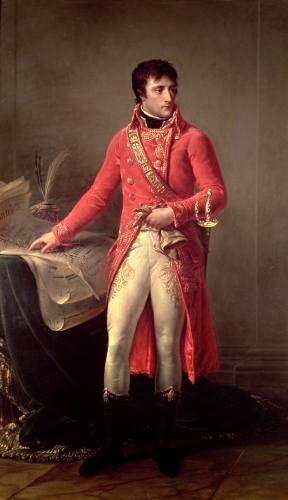
First Consul Bonaparte, painting by Antoine-Jean Gros, 1802.

Historian and author Andrew Roberts.
Napoleon Bonaparte died on May 5, 1821. More than 70,500 days have passed since his death, and yet more than 70,500 books have been published with Napoleon’s name in the title. What is it about Napoleon that future generations have continued to find so fascinating? In his 2014 book Napoleon: A Life, Andrew Roberts chronicles Napoleon’s life from cradle to grave and gives us lots of insight as to what made Napoleon such an interesting figure. Roberts’ epic biography is an amazing piece of work. By the end of the book you come to feel as though you know Napoleon. Roberts is the first biographer of Napoleon’s to use his 33,000 surviving letters, which have been published over the last few years for the first time. Roberts does an excellent job of showing how compartmentalized Napoleon’s mind was, and how he was able to focus on so many different things. The term “micromanager” might well have been coined to describe Napoleon, as he penned letters on topics ranging from military strategy to settling disputes between stage-hands of the Paris Opera. 

Roberts peels away the layers of myth attached to Napoleon’s life, so he becomes more than just the stiff figure from historical paintings, he actually feels like a real person. Napoleon must have had an extraordinary charisma in person, as it seems as though everyone who met him was greatly charmed by him. Even Frederick Maitland, the British captain who accepted Napoleon’s surrender and who ferried him to exile on St. Helena, had kind words to say about him, writing of him: “…to such an extent did he possess the power of pleasing that there are few people who could have sat at the same table as him for nearly a month, as I did, without feeling a sensation of pity, allied perhaps to regret, that a man possessed of so many fascinating qualities, and who had held so high a station in life, should be reduced to the situation in which I saw him.” (Roberts, p.777) 

In Napoleon: A Life, we get to see all the different sides of Napoleon. We see the egotistical conqueror, but we also glimpse Napoleon’s sarcastic sense of humor and his indefatigable work ethic. Roberts has crafted a book that is a pleasure to read, and all 810 pages are gripping. Every military campaign that Napoleon embarked upon could easily fill an entire book by itself, but Roberts does an excellent job of bringing us the essentials. Roberts has visited nearly every battlefield that Napoleon fought on, and this depth of research makes the book rich and vibrant. 

If you want to read a biography about a truly fascinating man, pick up Napoleon: A Life.