Showing posts with label documentaries. Show all posts

Thursday, June 27, 2019

Movie Review: Belanger, a Documentary Directed by Dominic Dastoli (2018)


My signed 1981 Topps card of Mark Belanger, and the DVD of Belanger, directed by Dominic Dastoli, 2018.


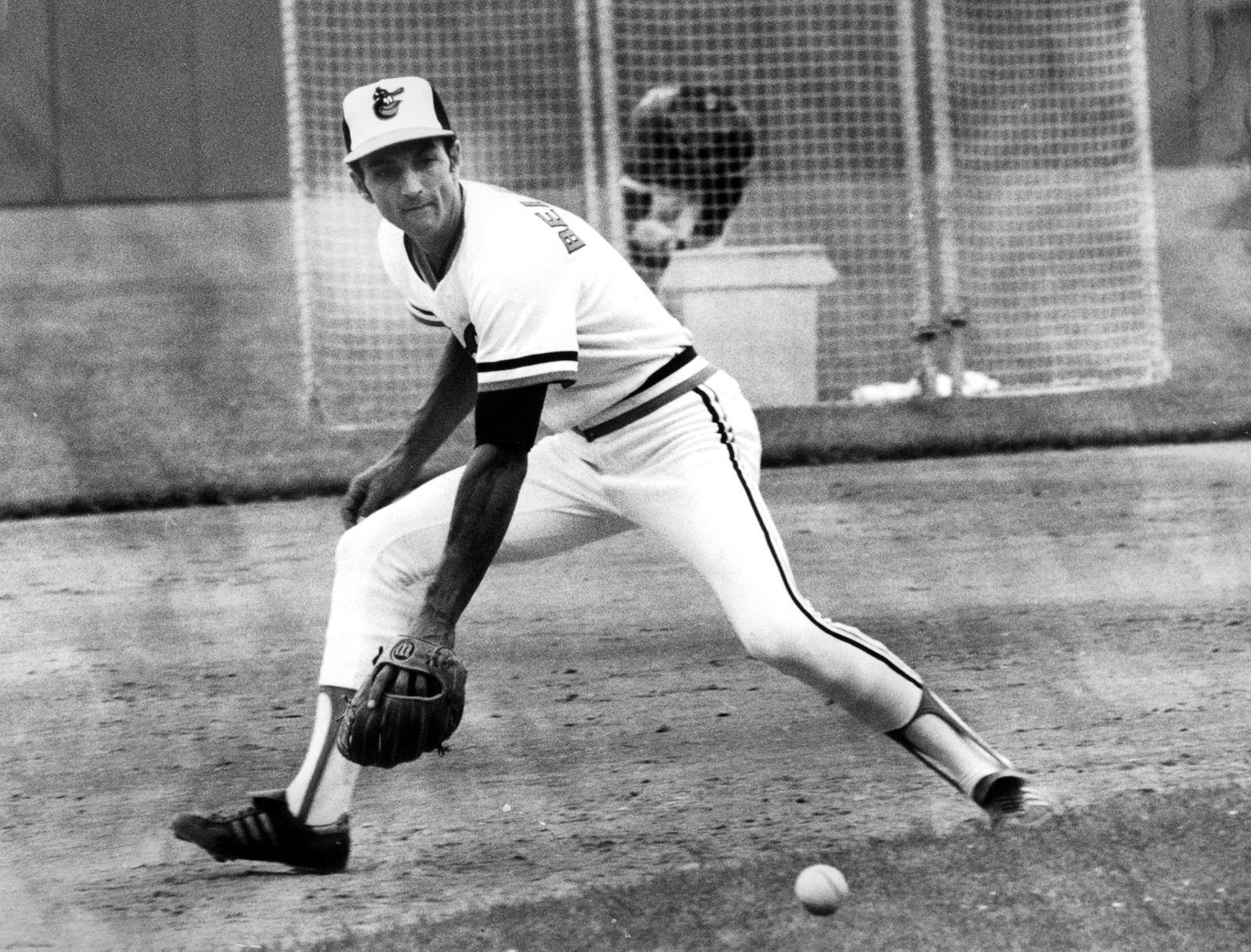
Mark "the Blade" Belanger, about to scoop up another ground ball.
Mark Belanger was the ultimate “good field, no hit” shortstop. Belanger played for the Baltimore Orioles from 1965 until 1981, and one season for the Los Angeles Dodgers in 1982, winning 8 Gold Gloves and accumulating a career batting average of just .228. I’m too young to have seen Belanger play, but because I collected baseball cards from the 1970’s and 1980’s, he was a player I was aware of. I can’t really tell you why I was aware of Mark Belanger when I was a little kid, but my head was full of random details about old baseball players. Sure, I knew superstars from the 1970’s like Reggie Jackson, Willie Stargell, and Jim Palmer, but I also knew random 70’s players like Billy North, John Milner, Mike Lum, and Kurt Bevacqua. I’m sure part of the reason I liked Mark Belanger was because we have the same first name, and he has a cool-sounding last name. What little information I could glean from my early 1980’s Topps cards of Mark Belanger told me two things: 

1. He had played for the Orioles for a really long time
2. He was not a very good hitter
But hitting statistics only told part of Mark Belanger’s story, and for him it was definitely the less interesting part of his story. Sabermetric fielding stats paint a picture of Belanger as one of the finest defensive shortstops ever. Baseball-Reference ranks Belanger second all-time in defensive WAR, just ahead of his longtime infield mate, third baseman Brooks Robinson. In a statistic called Total Zone Runs, which I’m not smart enough to attempt to explain, Belanger ranks as the second best defensive shortstop since 1953, behind Ozzie Smith. Belanger’s 8 Gold Gloves at shortstop still rank as the fourth most at the position. 

I wrote a little about Belanger in my review of Jeff Katz’s book Split Season: 1981. Katz’s book focused on Belanger because he was one of the union player representatives who were most involved in the ongoing negotiations between the players and the owners. It made me more intrigued about Belanger, and in my recent internet sleuthing, I discovered that a documentary about Belanger premiered in 2018. Titled simply Belanger, the film was directed by Dominic Dastoli. Running 70 minutes, the film explores the story of Belanger’s life. It begins with Belanger’s boyhood in Pittsfield, Massachusetts, where he played baseball on a farm field. Belanger achieved high school stardom on both the baseball and basketball fields, and he was courted by college basketball coaches, as well as major league baseball teams. Belanger signed with the Baltimore Orioles just after he graduated from high school in 1962. 

Belanger’s path to the major leagues was blocked by the Orioles’ excellent shortstop, future Hall of Famer Luis Aparicio. Belanger earned September call-ups in 1965 and 1966, but he was not on the roster for the Orioles’ upset of the Dodgers in the 1966 World Series. Once Aparicio was traded to the Chicago White Sox after the 1967 season, Belanger became the Orioles’ regular shortstop. 

Belanger hit for the highest batting average of his career in 1969, when he hit .287, well above the American League’s cumulative batting average of .246. In the film, Boog Powell attributes Belanger’s success with the bat that season to Charley Lau, the Orioles’ hitting coach. Unfortunately, the Orioles let Lau go after the 1969 season. 

Belanger became an integral part of the Orioles’ lineup during their three consecutive trips to World Series, from 1969-1971. These Oriole teams are often mentioned in discussions of the greatest baseball teams ever, as they averaged 106 wins a year. The Orioles lost to the “Miracle Mets” in 1969, and were defeated by the Pittsburgh Pirates in 1971, but they beat the Cincinnati Reds in 1970. Belanger batted just .105 in the 1970 World Series, but he and Brooks Robinson combined to make the left side of the infield impenetrable. 

Belanger features interviews with several of Belanger’s teammates, like Jim Palmer, Rick Dempsey, and Davey Johnson. Brooks Robinson is seen once at the very beginning of the film, and I wish we had heard more from Robinson, as he and Belanger were one of the finest fielding third base and shortstop duos ever. Johnson says of Belanger in the film, “Everything he did was meticulous.” This extended from his fielding work at shortstop to his post-playing days working for the players’ union. Johnson also informs us that Belanger never wore a protective cup when he played! That’s a sign of the confidence Belanger must have had in his own fielding prowess. (Belanger not wearing a cup is confirmed by Tony Kubek in George F. Will's book about baseball, Men at Work.) Rick Dempsey says that he never saw a ground ball go between Belanger’s legs. Even allowing for old baseball player exaggeration, that’s a pretty remarkable statement to make. 

Fortunately, Belanger features enough footage of “the Blade” in action for the viewer to get a sense of how excellent Belanger was in the field. Every motion of Belanger’s was graceful, whether he was ranging left or right, and his powerful and accurate throwing arm fired bullets to first base. One of the plays that I was most impressed by was a catch Belanger made in the 1979 World Series. Willie Stargell hit a pop fly, and Belanger caught it in left field—he’s out at normal left field depth, calling off the left fielder to make the catch.

As a kid, I had a book that was called You Are the Manager, or something like that. You’d read about a situation confronting a manager, and then see if the manager did what you thought they should have done. One of the situations in the book was “Who do you play at shortstop for the Orioles in the 1979 World Series?” The choices were slick-fielding but poor hitting Mark Belanger, or poor fielding but good hitting Kiko Garcia. As a kid, I probably went with Garcia because of his bat. Now, I’d stick with Belanger and his stellar defense. Kiko Garcia wasn’t actually that great a hitter—in 1979 he hit .247, with 5 home runs. Granted, Belanger hit .167 with zero home runs, but still, it’s not like Garcia was a .300 hitter or a power threat. 

At the very end of the 1981 season, Belanger started to lose playing time to a hotshot young shortstop the Orioles had just called up. His name was Cal Ripken Jr., and he would revolutionize the position of shortstop. There had been good-hitting shortstops before, but very few had combined hitting and fielding excellence the way Ripken did. There’s certainly no shame in losing your job to someone as talented as Cal Ripken Jr. Belanger was a free agent after the 1981 season, and the Orioles made it clear they had no interest in bringing him back. Belanger had also publicly criticized manager Earl Weaver in September, which may have helped to sow the seeds for his departure. The Orioles might also have been sick of having two players who were highly involved in the players’ union, as they also traded outspoken union representative Doug DeCinces during the 1981-82 off-season. 

Belanger ended up signing a one-year contract with the Los Angeles Dodgers. He played sparingly, starting just 12 games for the Dodgers in 1982. He retired at the end of the season. 

Belanger features interviews with family members, and the film presents us with a picture of the man he was off the field as well. When Curt Flood was challenging baseball’s reserve clause, Belanger was one of the few active players to publicly support his case. Belanger’s interest in the players’ union led to him becoming a union representative, and after his retirement, the first former player hired by the players’ union. As Expos pitcher Steve Rogers says in the film, “He spent his life defending.”

Mark Belanger was tall, (6’2”) thin, (175 pounds) and darkly handsome. (He looks better on film—his baseball cards don’t really do him justice.) He was a devoted father to his two sons, and he took his work seriously, whether it was fielding ground balls or protecting the rights of his fellow baseball players. Unfortunately, Belanger was also a longtime smoker who died from lung cancer at age 54 in 1998. In a sad footnote to the film, Belanger’s son Rob, who speaks eloquently throughout the film about his Dad, died of prostate cancer in 2016 at the age of 47. 

The older I get, the more fascinated I am by baseball players like Mark Belanger. He wasn’t a Hall of Famer, and he only made one All-Star team, but he still made an impact on the sport. Belanger does an excellent job of telling his story.

Friday, July 6, 2018

Movie Review: Elvis Presley: The Searcher, Directed by Thom Zimny (2018)


Promo image for Elvis Presley: The Searcher, directed by Thom Zimny, 2018.


Elvis Presley, recording what became known as the "Comeback Special," June, 1968.
Elvis Presley: The Searcher, an HBO documentary directed by Thom Zimny, is the documentary that Elvis Presley needs and deserves. I think all too often, Presley’s true talents get obscured by his status as a cultural icon. The focus throughout The Searcher is on Presley’s music, which is the reason he became such an icon in the first place. 

The Searcher also takes you inside Elvis’ private life, but it doesn’t dwell there. If you want stories about Elvis’ odd behavior, like shooting guns at television sets, or flying to Washington, D.C. on the spur of the moment to meet President Richard Nixon, you’ll have to look elsewhere. 

The documentary uses Presley’s 1968 “Comeback Special” as a framing device, and Zimny puts forth the theory that the Comeback Special is the closest we ever get to the “real” Elvis Presley. I think that’s a good idea, and it works well. However, despite the fact that The Searcher spends time exploring Elvis’s love for gospel music, it doesn’t include any clips of the excellent gospel medley he performed on the Comeback Special. 

Something I really enjoyed about The Searcher is that we never actually see the talking heads who provide narration. That keeps the focus squarely on Elvis himself, and it means the talking heads never become a distraction. And the people chosen to provide commentary do an excellent job at contextualizing Elvis’ career. They include: Bruce Springsteen, Tom Petty, and Priscilla Presley, among many others. 

There’s maybe a little too much material that deals with the theme, “Elvis was really good friends with black people,” but I understand why it’s there, given that cultural appropriation is such a huge topic in the arts these days. While Elvis certainly took a lot of inspiration from African American music, whether you’re talking about gospel or rhythm and blues, he mixed all of those influences together in his own special way, and it always came out sounding like Elvis. As he told Sun secretary Marion Keisker, when she asked him who he sounded like, “I don’t sound like nobody.”

There are small quibbles I had throughout the film, but ultimately they are minor next to the impact of the documentary as a whole. But the quibbles aren’t so small I won’t mention them. Why didn’t we get to see any footage from Elvis’ 1957 films Loving You and Jailhouse Rock? While I agree that King Creole was probably Elvis’s finest film, Loving You and Jailhouse Rock were two excellent movies filled with some really great songs. The performance of “Jailhouse Rock” is in some ways an early music video, as it presents us with creative visuals paired to the lyrics, and it’s one of the best examples of Elvis dancing in a movie. 

No details are given on Ann-Margret’s relationship with Elvis during the filming of Viva Las Vegas. That isn’t surprising, given Priscilla Presley’s involvement with the documentary. Priscilla doesn’t want to change the narrative that Elvis was being a perfect boyfriend in Hollywood while hiding her away at Graceland. 

The documentary shields us from the worst of Elvis, and that’s understandable. There are no clips of him from the TV special Elvis in Concert, filmed in June of 1977 on what would prove to be Elvis’s last tour. Elvis in Concert was broadcast on CBS less than two months after his death, but has never been officially released by Presley’s estate. I do think The Searcher would have benefitted from a couple more film clips from Presley’s really crappy movies to show how bad they were. As examples of how bad his movies got, we get clips of “Wooden Heart,” from G.I. Blues, which was a Number One single in the U.K., and “Bossa Nova Baby,” from Fun in Acapulco, which was a Top Ten hit in the U.S. Sure, they are cheesy songs, but they’re nowhere near as ridiculous as Elvis singing “Old MacDonald” on the back of a truck full of animals in Double Trouble. Oddly enough, there’s no mention at all in The Searcher of “Can’t Help Falling in Love,” which has become one of Elvis’ signature songs.

It must have been tremendously isolating to have been Elvis Presley. But, he also chose to isolate himself. At one point in The Searcher, someone is talking about Elvis performing in Las Vegas and how Elvis would never see the sunlight. Well, that was Elvis’ choice. I’m pretty sure he could have gotten up earlier, gone outside, and then done his two shows for the night. Also, someone says that the audiences in Las Vegas were too fancy for him. I would disagree with that: just watch the footage of Elvis singing “Love Me Tender,” going through the audience and kissing women in Elvis: That’s the Way It Is. The audiences seem pretty thrilled to see Elvis. 

That’s enough of my quibbles and nitpicking. What I really enjoyed about The Searcher is how it presents Elvis as a singer and a musician. That’s really what he was; he just happened to be a singer and musician who made it very, very big. One of the most interesting anecdotes in the film is from one of the musicians who worked with Presley in the 1970’s. He said that Presley had a hard time singing “Burning Love,” because he wasn’t in the right frame of mind to sing the upbeat song. It’s hard to believe, since it was such a great song and one of the last rock and roll songs Elvis ever sang. But the song that spoke to him more was the beautiful ballad “Separate Ways,” recorded the day before “Burning Love.” At the time, Elvis was dealing with his separation from Priscilla, and “Separate Ways” was his way of addressing the pain he felt. It made me realize how Elvis really had to feel the lyrics he was singing to give a great performance. Of course, there were many times in his career when he wasn’t feeling the lyrics of the song he was singing (see: all those crappy movies) but those songs didn’t end up being great performances. It’s easy to criticize Elvis for not singing more rock and roll his last few years, but that’s just not where he was at that time. Finally realizing this made me cut Elvis a little more slack for the last few years. 

The Searcher doesn’t shed any new light on Elvis’ death. However, in interviews promoting The Searcher, Priscilla Presley has put forth her own theory that Elvis committed suicide. It really shocks me that Priscilla would say that, since she has worked for decades to build and maintain the Elvis Presley brand worldwide, and suicide wouldn’t seem to be part of the Elvis Presley brand. I do think Elvis Presley was severely depressed the last few years of his life. I think his aversion to the recording studio during his final years shows that he wasn’t feeling well. After a week of recording sessions in December of 1973, Elvis only entered a recording studio once more during his lifetime—in March, 1975. Elvis’ 1976 recording sessions were done with RCA’s mobile unit in the Jungle Room at Graceland. Elvis was probably depressed and needed a break from the treadmill of touring that his life had become. But I just can’t imagine him choosing suicide. Elvis was also deeply religious, and I don’t know how he would have justified suicide with his religious beliefs. Of course, no one will ever know for sure. 

The villain of The Searcher is “Colonel” Tom Parker, Elvis’ huckster manager. Long a figure of criticism among Elvis fans, Parker’s management of Presley from 1955 until 1960 was actually pretty shrewd. Parker negotiated a $40,000 buyout of Elvis’ Sun Records contract by RCA Victor, and also masterminded Elvis’ entry into the movies. When Elvis entered the U.S. Army for a two-year stint, Parker didn’t want Elvis to record during those two years. It was a huge gamble, as pretty much everyone at the time thought that rock and roll was merely a fad, and there was no guarantee that anyone would want to buy an Elvis Presley record two years in the future. It turned out to be a shrewd move, as Presley’s absence from music caused a pent-up demand for new product upon Presley’s return to civilian life in 1960.

From 1961 on, Parker’s management of Elvis was pretty much a disaster. Parker’s theory seemed to be, keep repeating what worked until it no longer makes money. So, during the 1960’s Elvis turned out three mediocre movies a year, with soundtracks to match, and when he returned to live performances at the end of the decade, the 1970’s turned into a never-ending tour of U.S. cities. Apart from five shows in Canada in 1957, Presley never performed outside of the United States. The reason for this? Parker was an illegal alien from the Netherlands who didn’t have a passport. Parker was afraid that if he left the United States, he might never have been allowed back in. (In retrospect, that might have been the best thing for Elvis’ career.) Presley needed challenges to keep himself fresh and on top of his game, and touring foreign countries would have certainly provided him with new challenges. 

The Searcher also made me think about just how revolutionary Elvis Presley must have seemed in 1956. His name was weird—who had ever heard of someone named Elvis? He looked weird—who wore sideburns that long? He moved weird—what was he doing with his hips on stage? However unlikely a star Elvis Presley may have seemed in 1956, his influence on popular music continues to be deeply felt more than sixty years later.