|
| My signed 1981 Topps card of Mark Belanger, and the DVD of Belanger, directed by Dominic Dastoli, 2018. |
 |
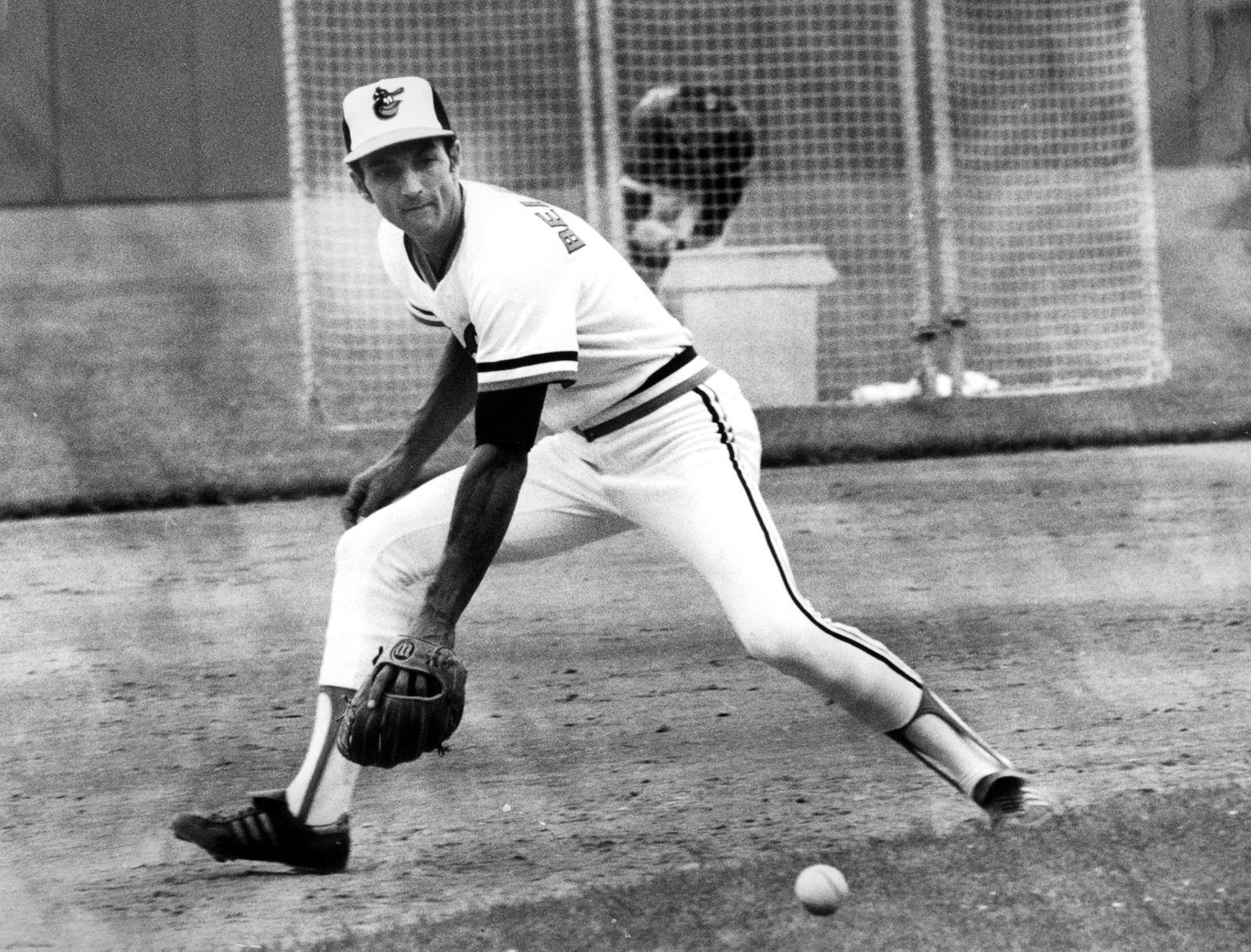
| Mark "the Blade" Belanger, about to scoop up another ground ball. |
Mark Belanger was the ultimate “good field, no hit”
shortstop. Belanger played for the Baltimore Orioles from 1965 until 1981, and
one season for the Los Angeles Dodgers in 1982, winning 8 Gold Gloves and
accumulating a career batting average of just .228. I’m too young to have seen
Belanger play, but because I collected baseball cards from the 1970’s and
1980’s, he was a player I was aware of. I can’t really tell you why I was aware
of Mark Belanger when I was a little kid, but my head was full of random
details about old baseball players. Sure, I knew superstars from the 1970’s
like Reggie Jackson, Willie Stargell, and Jim Palmer, but I also knew random
70’s players like Billy North, John Milner, Mike Lum, and Kurt Bevacqua. I’m
sure part of the reason I liked Mark Belanger was because we have the same
first name, and he has a cool-sounding last name. What little information I
could glean from my early 1980’s Topps cards of Mark Belanger told me two
things:
1. He had played for the Orioles for a really long time
2. He was not a very good hitter
But hitting statistics only told part of Mark Belanger’s
story, and for him it was definitely the less interesting part of his story.
Sabermetric fielding stats paint a picture of Belanger as one of the finest
defensive shortstops ever. Baseball-Reference ranks Belanger second all-time in
defensive WAR, just ahead of his longtime infield mate, third baseman Brooks
Robinson. In a statistic called Total Zone Runs, which I’m not smart enough to
attempt to explain, Belanger ranks as the second best defensive shortstop since
1953, behind Ozzie Smith. Belanger’s 8 Gold Gloves at shortstop still rank as
the fourth most at the position.
I wrote a little about Belanger in
my review of Jeff Katz’s
book Split Season: 1981. Katz’s book
focused on Belanger because he was one of the union player representatives who
were most involved in the ongoing negotiations between the players and the
owners. It made me more intrigued about Belanger, and in my recent internet
sleuthing, I discovered that a documentary about Belanger premiered in 2018.
Titled simply
Belanger, the film was
directed by Dominic Dastoli. Running 70 minutes, the film explores the story of
Belanger’s life. It begins with Belanger’s boyhood in Pittsfield,
Massachusetts, where he played baseball on a farm field. Belanger achieved high
school stardom on both the baseball and basketball fields, and he was courted
by college basketball coaches, as well as major league baseball teams. Belanger
signed with the Baltimore Orioles just after he graduated from high school in
1962.
Belanger’s path to the major leagues was blocked by the
Orioles’ excellent shortstop, future Hall of Famer Luis Aparicio. Belanger
earned September call-ups in 1965 and 1966, but he was not on the roster for
the Orioles’ upset of the Dodgers in the 1966 World Series. Once Aparicio was
traded to the Chicago White Sox after the 1967 season, Belanger became the
Orioles’ regular shortstop.
Belanger hit for the highest batting average of his career
in 1969, when he hit .287, well above the American League’s cumulative batting
average of .246. In the film, Boog Powell attributes Belanger’s success with
the bat that season to Charley Lau, the Orioles’ hitting coach. Unfortunately,
the Orioles let Lau go after the 1969 season.
Belanger became an integral part of the Orioles’ lineup
during their three consecutive trips to World Series, from 1969-1971. These
Oriole teams are often mentioned in discussions of the greatest baseball teams
ever, as they averaged 106 wins a year. The Orioles lost to the “Miracle Mets”
in 1969, and were defeated by the Pittsburgh Pirates in 1971, but they beat the
Cincinnati Reds in 1970. Belanger batted just .105 in the 1970 World Series,
but he and Brooks Robinson combined to make the left side of the infield impenetrable.
Belanger features
interviews with several of Belanger’s teammates, like Jim Palmer, Rick Dempsey,
and Davey Johnson. Brooks Robinson is seen once at the very beginning of the
film, and I wish we had heard more from Robinson, as he and Belanger were one
of the finest fielding third base and shortstop duos ever. Johnson says of
Belanger in the film, “Everything he did was meticulous.” This extended from
his fielding work at shortstop to his post-playing days working for the players’
union. Johnson also informs us that Belanger never wore a protective cup when
he played! That’s a sign of the confidence Belanger must have had in his own
fielding prowess. (Belanger not wearing a cup is confirmed by Tony Kubek in George F. Will's book about baseball, Men at Work.) Rick Dempsey says that he never saw a ground ball go between
Belanger’s legs. Even allowing for old baseball player exaggeration, that’s a
pretty remarkable statement to make.
Fortunately, Belanger features
enough footage of “the Blade” in action for the viewer to get a sense of how
excellent Belanger was in the field. Every motion of Belanger’s was graceful,
whether he was ranging left or right, and his powerful and accurate throwing
arm fired bullets to first base. One of the plays that I was most impressed by
was a catch Belanger made in the 1979 World Series. Willie Stargell hit a pop fly,
and Belanger caught it in left field—he’s out at normal left field depth,
calling off the left fielder to make the catch.
As a kid, I had a book that was called You Are the Manager, or something like that. You’d read about a
situation confronting a manager, and then see if the manager did what you
thought they should have done. One of the situations in the book was “Who do
you play at shortstop for the Orioles in the 1979 World Series?” The choices
were slick-fielding but poor hitting Mark Belanger, or poor fielding but good
hitting Kiko Garcia. As a kid, I probably went with Garcia because of his bat.
Now, I’d stick with Belanger and his stellar defense. Kiko Garcia wasn’t actually
that great a hitter—in 1979 he hit .247, with 5 home runs. Granted, Belanger
hit .167 with zero home runs, but still, it’s not like Garcia was a .300 hitter
or a power threat.
At the very end of the 1981 season, Belanger started to lose
playing time to a hotshot young shortstop the Orioles had just called up. His
name was Cal Ripken Jr., and he would revolutionize the position of shortstop.
There had been good-hitting shortstops before, but very few had combined
hitting and fielding excellence the way Ripken did. There’s certainly no shame
in losing your job to someone as talented as Cal Ripken Jr. Belanger was a free
agent after the 1981 season, and the Orioles made it clear they had no interest
in bringing him back. Belanger had also publicly criticized manager Earl Weaver
in September, which may have helped to sow the seeds for his departure. The
Orioles might also have been sick of having two players who were highly
involved in the players’ union, as they also traded outspoken union representative
Doug DeCinces during the 1981-82 off-season.
Belanger ended up signing a one-year contract with the Los
Angeles Dodgers. He played sparingly, starting just 12 games for the Dodgers in
1982. He retired at the end of the season.
Belanger features
interviews with family members, and the film presents us with a picture of the
man he was off the field as well. When Curt Flood was challenging baseball’s
reserve clause, Belanger was one of the few active players to publicly support
his case. Belanger’s interest in the players’ union led to him becoming a union
representative, and after his retirement, the first former player hired by the
players’ union. As Expos pitcher Steve Rogers says in the film, “He spent his
life defending.”
Mark Belanger was tall, (6’2”) thin, (175 pounds) and darkly
handsome. (He looks better on film—his baseball cards don’t really do him
justice.) He was a devoted father to his two sons, and he took his work
seriously, whether it was fielding ground balls or protecting the rights of his
fellow baseball players. Unfortunately, Belanger was also a longtime smoker who
died from lung cancer at age 54 in 1998. In a sad footnote to the film, Belanger’s
son Rob, who speaks eloquently throughout the film about his Dad, died of
prostate cancer in 2016 at the age of 47.
The older I get, the more fascinated I am by baseball
players like Mark Belanger. He wasn’t a Hall of Famer, and he only made one
All-Star team, but he still made an impact on the sport. Belanger does an excellent job of telling his story.