Showing posts with label mark belanger. Show all posts

Tuesday, August 26, 2025

Book Review: The Last Manager: How Earl Weaver Tricked, Tormented, and Reinvented Baseball by John W. Miller (2025)


Earl Weaver was one of the most successful managers in baseball history. Helming the Baltimore Orioles from 1968-1982, (plus a brief comeback in 1985-86) Weaver led the Orioles to 6 playoff appearances and 4 World Series, including a World Championship in 1970.  

Weaver was a feisty, combative field general, and he delighted in baiting umpires. He was also ahead of his time in embracing data to inform his in-game decision making. John W. Miller’s 2025 biography of Weaver, titled The Last Manager, is an entertaining look at Weaver’s life and career. I’d recommend it to all baseball fans.  

Miller adeptly traces Weaver’s path through baseball, as he grew up in St. Louis, and signed with his hometown Cardinals out of high school. Weaver never made the major leagues as a player, topping out at double A ball. Weaver was a second baseman, and he played well during spring training in 1952, but player/manager Eddie Stanky chose himself to be the backup infielder over Weaver. But there was more going on than just Stanky’s selfishness. Weaver’s path to the majors was blocked by the Cardinals’ All-Star second baseman, Red Schoendienst. Weaver’s only hope was to be a backup infielder. Weaver became a player/manager himself, and worked his way up the Baltimore Orioles’ chain, finally getting to the major leagues as a first-base coach in 1968. When manager Hank Bauer was fired on July 11th, Weaver found himself at the helm of a major league squad for the first time.  

Weaver had the immense good fortune to take over a team that was just two seasons removed from winning the World Series. Under Weaver’s first three full seasons as manager, the Orioles won over 100 games each season and went to three World Series. Simply put, the 1969-71 Baltimore Orioles were one of the great baseball dynasties. Those teams featured a terrific infield of third baseman Brooks Robinson, shortstop Mark Belanger, second baseman Davey Johnson, and Boog Powell at first base. The offense was led by slugger Frank Robinson, and the pitching staff was anchored by stars Jim Palmer, Dave McNally, and Mike Cuellar. The Orioles won the 1970 World Series against the Cincinnati Reds but lost in 1969 to the “Miracle Mets” and in 1971 to the Pittsburgh Pirates.  

One of my only criticisms of the book is that Miller sometimes glosses over details. About the 1969 World Series, he writes: “What happened next has been well chronicled...The Mets won the next four games and took the World Series.” (p.130) I don’t need thirty pages recounting the 1969 World Series, but I’d like a little more detail, please.  

Weaver’s view of baseball was summed up by his famous axiom that the three things you need to succeed in baseball are “pitching, defense, and the three-run homer.” That certainly worked well for the Baltimore Orioles during Weaver’s tenure. Baseball Reference ranks Ozzie Smith at the top of their Defensive WAR list. After Smith come three Orioles: Mark Belanger, Brooks Robinson, and Cal Ripken, Jr. The Orioles also had amazing starting pitching as well. It’s no coincidence that the Birds’ best string of baseball, 1966-1983, coincided exactly with the career of Jim Palmer. Palmer captured 3 Cy Young Awards, and won 20 games an incredible 8 times, on his way to a career total of 268 wins. Besides Palmer, the Orioles had a long list of starting pitchers who had great success for the team. To name just a few: Dave McNally, Mike Cuellar, Pat Dobson, Mike Torrez, Dennis Martinez, Scott McGregor, Mike Flanagan, Mike Boddicker, Steve Stone, and Storm Davis.  

Weaver was generally disdainful of traditional baseball theory, which often stressed sacrifice bunts, stolen bases, and moving the runner over. Of course, the Orioles still did these things, but under Weaver they bunted less and less often. Weaver said, “If you play for one run, that’s all you’re going to get.” Rather than scrap for one run, Weaver was content to wait for a big inning. Weaver was ahead of his time, as sabermetric statistics have been widely embraced, and they largely follow Weaver’s precepts. The emphasis now is getting walks and hitting home runs, not scratching out a run from a single, stolen base, and sacrifice fly.  

“The Earl of Baltimore,” as he was called, was also ahead of his time in looking for favorable hitter-pitcher matchups, often making frequent use of platoons and pinch-hitters. That strategy worked well during Weaver’s time, when teams didn’t carry as many relief pitchers as they do now. Weaver’s starting pitchers were also effective enough that they didn’t need to rely on very many relief pitchers. These days, with teams carrying 12 or 13 pitchers, there’s simply no room on the roster for players who are mainly used as pinch-hitters.  

As a baseball fan growing up in the 1980’s, I was too young to have memories of Weaver during his glory years. Even though he retired at the end of the 1986 season, Weaver still made two appearances on the 1987 Topps set, one of the most iconic baseball card sets of my youth. Weaver got his own manager card, and he was also pictured on the Orioles team leaders card as well. I also knew Earl Weaver from the computer game Earl Weaver Baseball, which was a favorite of mine growing up. I didn’t play entire seasons, but I loved the feature that allowed you to play with All-Star teams from the past. The Last Manager has a chapter devoted to the development of the computer game, which was very entertaining to read. 

Upon finishing The Last Manager, I thought more about Earl Weaver and his legacy. Weaver was a winning manager, but was he actually a good manager? Sure, he got the most talent possible out of his teams. But in some of the fundamental tests of managing people, I’d give Weaver a failing grade. Weaver never became close with his players. I suspect some of this came from his years running the minor league spring training camp for the Orioles. Weaver’s rationale was that you don’t become close to players, because one day you’re going to have to tell a player that he’s being sent down to the minor leagues, or traded. He had to tell many, many players this news during those spring training camps. I understand where that impulse of not getting close to anyone comes from. But part of being a good manager of people anywhere is, you have to get to know the people you are managing. Jim Palmer said of Weaver’s relationship with players “He just never got to know them.” Miller does write that Weaver learned he couldn’t yell at Eddie Murray, because Murray was extremely sensitive to criticism. I’ll give Weaver some points for that. But the volatile Weaver yelled at most of his other players. There are other ways to handle professional athletes. Bud Grant, the famous Minnesota Vikings head coach, was a contemporary of Weaver’s who didn’t yell at his players. Grant said, and I’m paraphrasing here, “These guys have been yelled at since they were kids. They don’t need me yelling at them.”  

After finishing the book, I also struggled to come up with nice things that Earl Weaver did for people. There certainly weren’t very many that are chronicled in The Last Manager. While I admire Weaver’s ability to win baseball games, and as entertaining as he was, I certainly wouldn’t want to have played for him.  

Friday, September 29, 2023

Brooks Robinson 1937-2023

Brooks Robinson doing what he did best: tracking down a baseball.

Baltimore
Orioles third baseman Brooks Robinson passed away earlier this week at the age of 86. Robinson was the finest fielding third baseman in baseball history, and the terrific plays he made during the 1970 World Series cemented his reputation as an amazing fielder. Indeed, Baseball Reference ranks Robinson 3
rd in defensive WAR with 39.1, behind only Ozzie Smith and Robinson’s longtime teammate, shortstop Mark Belanger.  

Robinson was no slouch with the bat, either, as he tallied 2,848 hits, 268 home runs, and 1,357 RBI’s. He was among the top 10 in extra base hits six times, and he finished his career with 818 extra base hits. Robinson led the AL in RBI’s in 1964, the year he won the MVP award. He won 16 Gold Gloves, capturing the award every year from 1960 to 1975.  


The Orioles became a powerhouse team during the second half of Robinson’s career, and he helped lead the team to 4 World Series appearances from 1966-1971. Brooks hit .303 in 39 postseason games. Robinson wreaked havoc against my Minnesota Twins in the first 2 ACLS, hitting .500 in 1969, and .583 in 1970. Brooks hit .429 in the 1970 World Series, and that combined with his amazing fielding, won him the World Series MVP. I learned from an article on MLB the other day that Robinson’s .485 average over the 1970 postseason is the highest for any player for a single postseason, with a minimum of 30 at-bats. 


I never had the good fortune to meet Brooks Robinson, but everything I’ve heard about him makes it sound like he was a fantastic person. Kind, humble, and genuine. I did meet Robinson’s Orioles teammate Jim Palmer at a baseball card show in 2012. Palmer was everything you’d expect him to be, nice, funny, and charming. It was towards the end of Palmer’s signing time, so there wasn’t a line. Palmer saw I had a signed 8x10 of Brooks, and he said, “I see you’ve got Brooksie there.” I told him the photo was only $10, so I had to get it. The guy who was selling it had it priced so cheaply because the photo wasn’t great quality. Palmer joked, “It looks okay to me, but don’t tell Brooksie I said that.” He picked up the other photos I had bought and flipped through those. When he got to Steve Carlton, he said “I pitched against him when I was with Aberdeen. He was a skinny, 19-year-old kid. Well, I guess I was just 18.” He said something about how Steve wasn’t throwing with his whole body yet. It was very cool to have Jim Palmer take a minute to chat with me.  


Brooks Robinson was also a representative for the MLB Players Association, and for many years he and Mark Belanger were the Orioles’ team reps for the union. Belanger went on to be one of the four key union representatives during the 1981 baseball strike, and after his retirement he worked for the union until his death in 1998.  


Brooks Robinson was an amazing baseball player, and his legacy will continue to live on. He’s an integral part of the fabric of the game.  

Thursday, June 27, 2019

Movie Review: Belanger, a Documentary Directed by Dominic Dastoli (2018)


My signed 1981 Topps card of Mark Belanger, and the DVD of Belanger, directed by Dominic Dastoli, 2018.


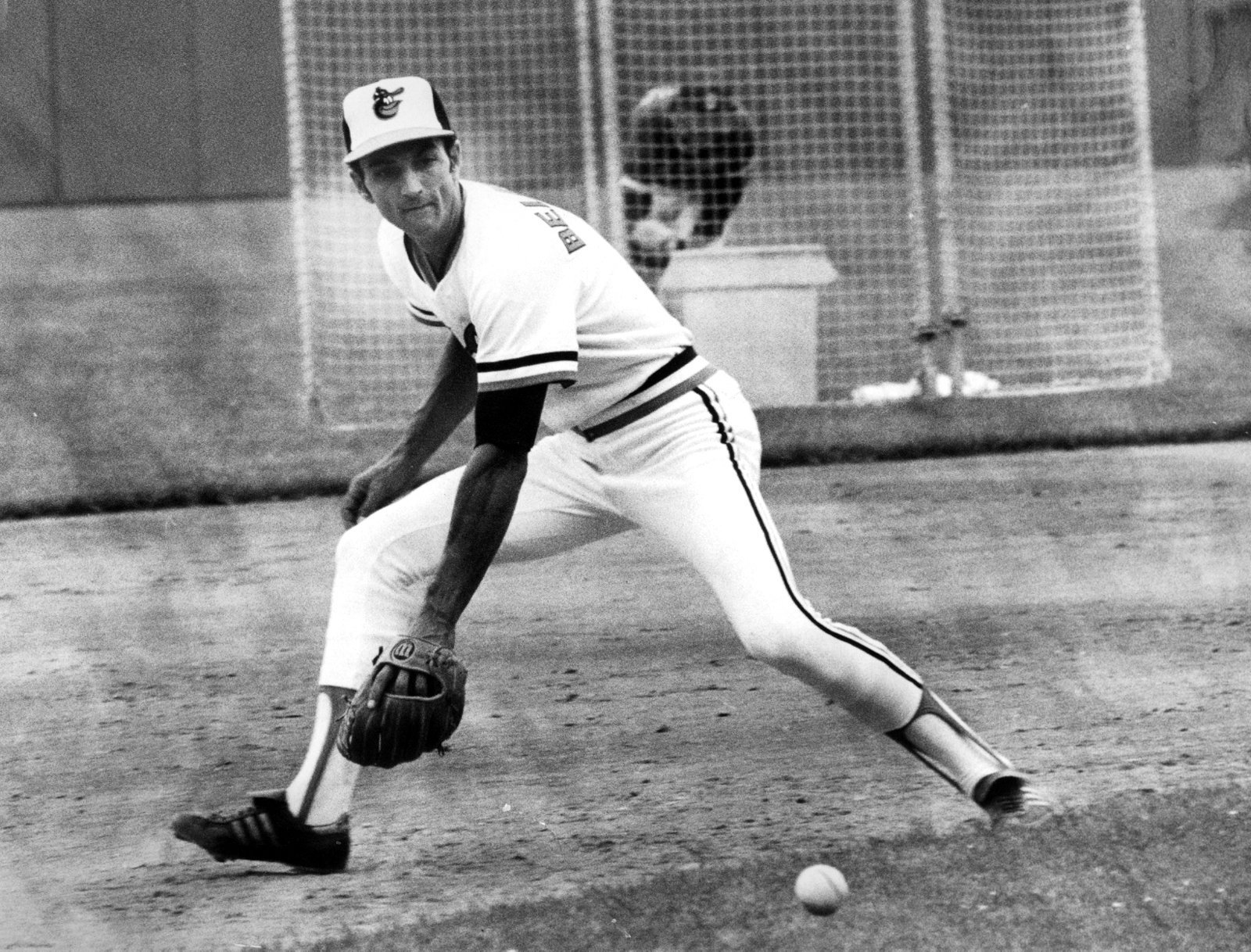
Mark "the Blade" Belanger, about to scoop up another ground ball.
Mark Belanger was the ultimate “good field, no hit” shortstop. Belanger played for the Baltimore Orioles from 1965 until 1981, and one season for the Los Angeles Dodgers in 1982, winning 8 Gold Gloves and accumulating a career batting average of just .228. I’m too young to have seen Belanger play, but because I collected baseball cards from the 1970’s and 1980’s, he was a player I was aware of. I can’t really tell you why I was aware of Mark Belanger when I was a little kid, but my head was full of random details about old baseball players. Sure, I knew superstars from the 1970’s like Reggie Jackson, Willie Stargell, and Jim Palmer, but I also knew random 70’s players like Billy North, John Milner, Mike Lum, and Kurt Bevacqua. I’m sure part of the reason I liked Mark Belanger was because we have the same first name, and he has a cool-sounding last name. What little information I could glean from my early 1980’s Topps cards of Mark Belanger told me two things: 

1. He had played for the Orioles for a really long time
2. He was not a very good hitter
But hitting statistics only told part of Mark Belanger’s story, and for him it was definitely the less interesting part of his story. Sabermetric fielding stats paint a picture of Belanger as one of the finest defensive shortstops ever. Baseball-Reference ranks Belanger second all-time in defensive WAR, just ahead of his longtime infield mate, third baseman Brooks Robinson. In a statistic called Total Zone Runs, which I’m not smart enough to attempt to explain, Belanger ranks as the second best defensive shortstop since 1953, behind Ozzie Smith. Belanger’s 8 Gold Gloves at shortstop still rank as the fourth most at the position. 

I wrote a little about Belanger in my review of Jeff Katz’s book Split Season: 1981. Katz’s book focused on Belanger because he was one of the union player representatives who were most involved in the ongoing negotiations between the players and the owners. It made me more intrigued about Belanger, and in my recent internet sleuthing, I discovered that a documentary about Belanger premiered in 2018. Titled simply Belanger, the film was directed by Dominic Dastoli. Running 70 minutes, the film explores the story of Belanger’s life. It begins with Belanger’s boyhood in Pittsfield, Massachusetts, where he played baseball on a farm field. Belanger achieved high school stardom on both the baseball and basketball fields, and he was courted by college basketball coaches, as well as major league baseball teams. Belanger signed with the Baltimore Orioles just after he graduated from high school in 1962. 

Belanger’s path to the major leagues was blocked by the Orioles’ excellent shortstop, future Hall of Famer Luis Aparicio. Belanger earned September call-ups in 1965 and 1966, but he was not on the roster for the Orioles’ upset of the Dodgers in the 1966 World Series. Once Aparicio was traded to the Chicago White Sox after the 1967 season, Belanger became the Orioles’ regular shortstop. 

Belanger hit for the highest batting average of his career in 1969, when he hit .287, well above the American League’s cumulative batting average of .246. In the film, Boog Powell attributes Belanger’s success with the bat that season to Charley Lau, the Orioles’ hitting coach. Unfortunately, the Orioles let Lau go after the 1969 season. 

Belanger became an integral part of the Orioles’ lineup during their three consecutive trips to World Series, from 1969-1971. These Oriole teams are often mentioned in discussions of the greatest baseball teams ever, as they averaged 106 wins a year. The Orioles lost to the “Miracle Mets” in 1969, and were defeated by the Pittsburgh Pirates in 1971, but they beat the Cincinnati Reds in 1970. Belanger batted just .105 in the 1970 World Series, but he and Brooks Robinson combined to make the left side of the infield impenetrable. 

Belanger features interviews with several of Belanger’s teammates, like Jim Palmer, Rick Dempsey, and Davey Johnson. Brooks Robinson is seen once at the very beginning of the film, and I wish we had heard more from Robinson, as he and Belanger were one of the finest fielding third base and shortstop duos ever. Johnson says of Belanger in the film, “Everything he did was meticulous.” This extended from his fielding work at shortstop to his post-playing days working for the players’ union. Johnson also informs us that Belanger never wore a protective cup when he played! That’s a sign of the confidence Belanger must have had in his own fielding prowess. (Belanger not wearing a cup is confirmed by Tony Kubek in George F. Will's book about baseball, Men at Work.) Rick Dempsey says that he never saw a ground ball go between Belanger’s legs. Even allowing for old baseball player exaggeration, that’s a pretty remarkable statement to make. 

Fortunately, Belanger features enough footage of “the Blade” in action for the viewer to get a sense of how excellent Belanger was in the field. Every motion of Belanger’s was graceful, whether he was ranging left or right, and his powerful and accurate throwing arm fired bullets to first base. One of the plays that I was most impressed by was a catch Belanger made in the 1979 World Series. Willie Stargell hit a pop fly, and Belanger caught it in left fieldhe’s out at normal left field depth, calling off the left fielder to make the catch.

As a kid, I had a book that was called You Are the Manager, or something like that. You’d read about a situation confronting a manager, and then see if the manager did what you thought they should have done. One of the situations in the book was “Who do you play at shortstop for the Orioles in the 1979 World Series?” The choices were slick-fielding but poor hitting Mark Belanger, or poor fielding but good hitting Kiko Garcia. As a kid, I probably went with Garcia because of his bat. Now, I’d stick with Belanger and his stellar defense. Kiko Garcia wasn’t actually that great a hitterin 1979 he hit .247, with 5 home runs. Granted, Belanger hit .167 with zero home runs, but still, it’s not like Garcia was a .300 hitter or a power threat. 

At the very end of the 1981 season, Belanger started to lose playing time to a hotshot young shortstop the Orioles had just called up. His name was Cal Ripken Jr., and he would revolutionize the position of shortstop. There had been good-hitting shortstops before, but very few had combined hitting and fielding excellence the way Ripken did. There’s certainly no shame in losing your job to someone as talented as Cal Ripken Jr. Belanger was a free agent after the 1981 season, and the Orioles made it clear they had no interest in bringing him back. Belanger had also publicly criticized manager Earl Weaver in September, which may have helped to sow the seeds for his departure. The Orioles might also have been sick of having two players who were highly involved in the players’ union, as they also traded outspoken union representative Doug DeCinces during the 1981-82 off-season. 

Belanger ended up signing a one-year contract with the Los Angeles Dodgers. He played sparingly, starting just 12 games for the Dodgers in 1982. He retired at the end of the season. 

Belanger features interviews with family members, and the film presents us with a picture of the man he was off the field as well. When Curt Flood was challenging baseball’s reserve clause, Belanger was one of the few active players to publicly support his case. Belanger’s interest in the players’ union led to him becoming a union representative, and after his retirement, the first former player hired by the players’ union. As Expos pitcher Steve Rogers says in the film, “He spent his life defending.”

Mark Belanger was tall, (6’2”) thin, (175 pounds) and darkly handsome. (He looks better on filmhis baseball cards don’t really do him justice.) He was a devoted father to his two sons, and he took his work seriously, whether it was fielding ground balls or protecting the rights of his fellow baseball players. Unfortunately, Belanger was also a longtime smoker who died from lung cancer at age 54 in 1998. In a sad footnote to the film, Belanger’s son Rob, who speaks eloquently throughout the film about his Dad, died of prostate cancer in 2016 at the age of 47. 

The older I get, the more fascinated I am by baseball players like Mark Belanger. He wasn’t a Hall of Famer, and he only made one All-Star team, but he still made an impact on the sport. Belanger does an excellent job of telling his story.