|
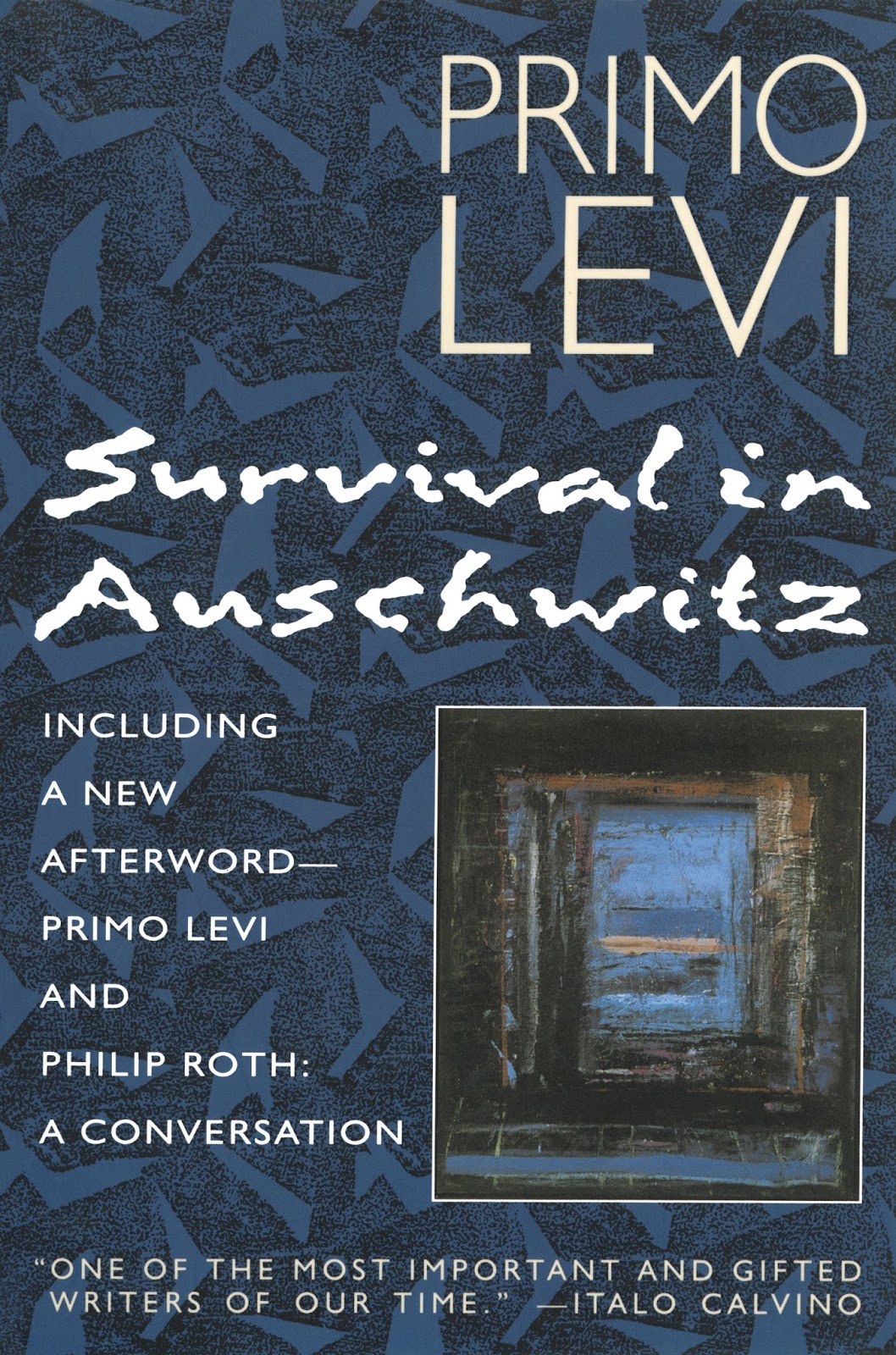
| 1996 paperback reissue of Survival in Auschwitz, by Primo Levi. First published in Italian as If This is a Man, 1947, and first translated into English in 1958. |
 |
| The Italian writer and chemist Primo Levi, 1919-1987. |
One of the best classes I took in college was an English
class called “Literature of the Holocaust.” We read a variety of genres, mostly
written by Holocaust survivors. Primo Levi was one of the writers who I was
most struck by in that class. Levi was an Italian chemist from Turin who spent
more than a year in the concentration camp at Auschwitz. Levi’s first book about
his experiences during the Holocaust was titled If This is a Man, and was published in Italian in 1947, making it
one of the earliest books written by a Holocaust survivor. If This is a Man was published in English in 1958 as Survival in Auschwitz. Levi’s book
slowly acquired a growing audience over the years, and in 1963 he published his
second book, The Truce, known in the
United States as The Reawakening, which
chronicles Levi’s long journey home after the liberation of Auschwitz. Levi
published several more books during his lifetime, retiring from his work as a
chemist in 1977 to devote himself to writing full time. Levi died in 1987 due
to injuries from a fall from his third-story apartment. There has been debate
among Levi’s biographers as to whether his death should be considered a suicide
or accidental.
In Auschwitz, Levi saw mankind at its worst, and in Survival in Auschwitz he presents us
with an unvarnished look at the atrocities committed by the Third Reich. Levi
summed up the entire experience of the Holocaust with this anecdote:
“Driven by thirst, I eyed a fine icicle outside the window,
within hand’s reach. I opened the window and broke off the icicle but at once a
large, heavy guard prowling outside brutally snatched it away from me. ‘Warum?’
I asked him in my poor German. ‘Hier ist kein warum’ (there is no why here), he
replied, pushing me inside with a shove.” (p.29)
“There is no why here” would have been a fitting motto for
the gates of the death camps. Levi also writes of a fellow inmate who had
written on the bottom of his soup bowl, “Ne pas chercher a comprendre,” French
for “Do not try to understand.” (p.103)
Levi has some eloquent passages about how time moves in the
camp. “When one waits time moves smoothly without need to intervene and drive
it forward, while when one works, every minute moves painfully and has to be
laboriously driven away.” (p.104) After finishing a day’s work, Levi writes, “We
have bored our way through all the minutes of the day, this very day which
seemed invincible and eternal this morning; now it lies dead and is immediately
forgotten; already it is no longer a day, it has left no trace in anybody’s
memory.” (p.133)
Levi knows that luck played a large role in why he survived
Auschwitz and others did not. His training as a chemist helped him, as he was
part of a small group selected to work in a laboratory that supplied labor for
the German company IG Farben. This allowed Levi to work inside during the
winter of 1944-1945. Levi’s tales of constantly having to repair parts of the
factory after it had been bombed by the Allies make clear the Sisyphean nature
of his labor. As Auschwitz was being evacuated by the Germans, Levi was in the
camp hospital, which meant that he was not part of the brutal forced marches
that killed many prisoners. The Germans simply left invalids like Levi behind,
and he was able to survive until the camp was liberated by the Russians on
January 27, 1945.
Survival in Auschwitz is
an essential book for anyone who wants to get an idea of what life inside
Auschwitz was like, told by an astute observer of the human condition. The
current edition of Survival in Auschwitz also
features as an afterword a 1986 interview with Levi, conducted by Philip Roth.
Roth’s interview reveals to the reader Primo Levi’s proud humanity.