Friday, May 11, 2018

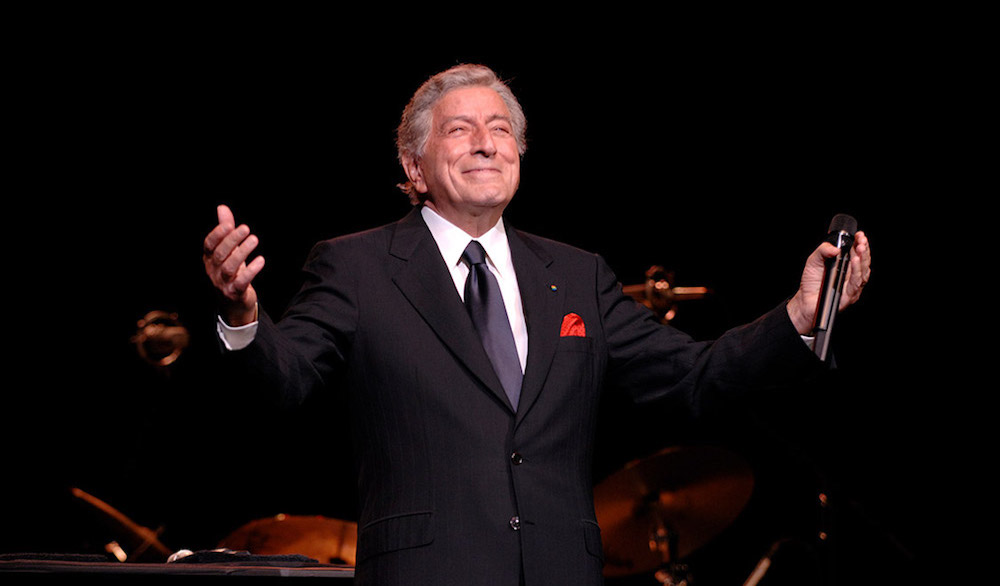
Concert Review: Tony Bennett at the State Theatre

State Theatre marquee for Tony Bennett, May 10, 2018. (Photo by Mark C. Taylor)


The one and only Tony Bennett.
Last night I saw Tony Bennett at the State Theatre in Minneapolis. At the age of 91, Bennett still has a terrific voice and he can still powerfully belt out songs. Bennett is the only star I can think of from the pre-rock and roll era who is still out there touring and sounding great. 

Bennett was backed by just piano, guitar, bass, and drums and his vocals were superbly jazzy. This is clearly a man who still loves what he does. Bennett has always brought an exuberant energy to his performances, and last night was no exception. The passion on his face shone through, even from where I was sitting in the upper balcony. 

Bennett’s voice is lower and has more vibrato than it did it his younger years, but on songs like “This is All I Ask,” that vibrato just adds to the emotional content of the lyrics. And you can tell it’s still Tony Bennett after he sings two notesthere’s nobody who sounds quite like Tony does. Bennett reached all the way back to 1951 for his very first hit record, “Because of You,” which spent ten weeks at number one. 

The song “I’m Old Fashioned” might as well be Tony Bennett’s theme song. After achieving great success on the singles and album charts during the 1950’s and 1960’s, Bennett had a lower profile during the 1970’s, as the hits stopped coming. But rather than change with the times, Bennett relied on what worked for himjazzy renditions of songs from the Great American Songbook. In the early 1990’s he mounted one of the most successful comebacks of any pre-rock vocalist. Bennett earned a gold record for his 1992 tribute to Frank Sinatra, Perfectly Frank, and a platinum record for 1994’s MTV Unplugged, which also won him a Grammy for Album of the Year. Bennett’s comeback with a new, younger generation was sealed. Additional success has followed, as 2011’s Duets II and 2014’s Cheek to Cheek, recorded with Lady Gaga, both reached number one on the Billboard album charts. That’s an astonishing achievement for an octogenarian jazz singer. 

Bennett didn’t make a lot of small talk during the concert, but he’s very demonstrative, throwing his arms open wide or hugging his arms as he basks in the applause after a song. He’s also supportive of his musicians, as he often walks over to them during a solo and offers exclamations of encouragement. 

For the final song of the evening, Bennett put his microphone down and offered up a lovely, and still very audible, version of “Fly Me to the Moon.” It was beautiful and heartfelt, and it also meant that the last words he sang to the audience were “I love you,” which seemed very fitting for this energetic entertainer.

Setlist:
Watch What Happens
They All Laughed
This is All I Ask
I Got Rhythm
Solitude
I’m Old Fashioned
It Amazes Me
Steppin’ Out with My Baby
But Beautiful
Our Love is Here to Stay
The Way You Look Tonight
Because of You/Cold, Cold Heart/Rags to Riches/Who Can I Turn to?
Just in Time
Boulevard of Broken Dreams
The Good Life
How Do You Keep the Music Playing?
The Shadow of Your Smile
One for My Baby (And One More For the Road)
For Once in My Life
I Left My Heart in San Francisco
Who Cares (So Long as You Care For Me)
Fly Me to the Moon-last song

Thursday, May 3, 2018

Movie Review: Chappaquiddick, starring Jason Clarke and Kate Mara, directed by John Curran (2017)

Jason Clarke as Ted Kennedy and Kate Mara as Mary Jo Kopechne in Chappaquiddick, directed by John Curran.

Director John Curran’s film Chappaquiddick examines the 1969 car accident that took the life of Mary Jo Kopechne and derailed the Presidential aspirations of Ted Kennedy. Chappaquiddick is an excellent film that does not overly sensationalize its subject matter and does not present any far-fetched theory about what actually transpired. The Chappaquiddick incident has been the subject of other works of art as well, including Joyce Carol Oates’ 1992 novella Black Water, which I reviewed here. 

We will never know the truth of exactly what happened when Ted’s car went off of Dike Bridge, but Chappaquiddick presents us with a version of the story that feels true. As the film opens, Kennedy (superbly played by Jason Clarke) is leaving Washington, D.C. to race in the Edgartown Regatta that Friday afternoon. After the regatta, there will be a party at a cottage on Chappaquiddick Island for the “Boiler Room Girls,” a group of women who worked for Bobby Kennedy’s 1968 Presidential campaign. Among these women is the 28-year-old Mary Jo Kopechne, portrayed by Kata Mara. Kopechne is single and serious about her political work. 

In the film, Ted and Mary Jo leave the party to talkabout Bobby, about politics, about Ted not trying to claim the Presidential nomination at the previous year’s Democratic Party Convention in Chicago. This conversation is speculation on the filmmaker’s part but it feels plausible. Then the crucial moment occurs. As Ted comes to a fork in the road, and is startled by a police car driven by an off-duty deputy sheriff, Mary Jo says, “We should go back to the party.” Ted replies, “We should go to the beach.” And then the accident happens, as Kennedy’s car goes off the bridge, flips over and lands on its roof in Poucha Pond. Somehow Kennedy was able to escape, but Mary Jo was not able to. 

The film shows Kennedy going back to the party and enlisting the aid of his friends Joe Gargan (Ed Helms) and Paul Markham (Jim Gaffigan). The three drive to the scene of the accident, and Gargan and Markham attempt to rescue Mary Jo from the car, but are unsuccessful. They tell Ted he must report the accident, and he promises to. However, when they encounter Ted the next morning as he is about to sit down to breakfast, he admits that he hasn’t reported the accident. Finally, as his car is being dragged out of the pond, he calls the police. 

Chappaquiddick then shows the damage control that went on, as Gargan shepherds everyone at the cottage out before the police realize that there was a party at which a dozen people were present. Kennedy is allowed to sit in the police station and write out a statement that left many questions unanswered. But the police chief doesn’t interrogate or arrest Ted. 

Throughout the movie, we observe how Ted’s status as a Senator, and as a Kennedy, protects him from the worst-case scenarios. He isn’t arrested, he isn’t charged with vehicular manslaughter, and when he pleads guilty to the crime of leaving the scene of an accident, he receives the minimum sentence, which is suspended, meaning that he won’t have to go to jail. One wonders how the authorities would have handled Kennedy’s case had it occurred in a state other than Massachusetts.

One of the most telling lines in the movie is when one of the Boiler Room Girls learns of the accident from Gargan and bluntly says “How can we help the Senator?” That shows how far people were willing to go to protect Kennedy from anything that might damage him. 

The film then shows us the discussions of the inner circle of Kennedy confidants, which included former Secretary of Defense Robert McNamara and longtime JFK speechwriter Ted Sorensen. There is much deliberation about what Ted should say publicly and much concern over how the story can be spun in the most beneficial way. There are moments of the movie that are darkly humorous, as when Ted wants to wear a neck brace to Kopechne’s funeral. Gargan tries to wrestle the brace off of Kennedy and shouts at him, “You are not a victim!” 

The biggest historical inaccuracy in Chappaquiddick is the portrayal of Joe Kennedy, Sr. Played by Bruce Dern, who has always done a great job of playing jerks, (see the 1974 version of The Great Gatsby) Joe is depicted as being very harsh to Ted. This is the filmmaker’s way of showing the intense familial obligations that Ted Kennedy was underhe had to live up to the legacy of all his brothersJoe Jr., who died in WWII, and also Jack and Bobby. Even Jack had to live up to the legacy of Joe Jr., as it was assumed Joe Jr. would be the family politicianJack was thinking about going into journalism before Joe Jr. was killed. The film shows Ted calling his father late at night after the accident, and Joe Sr. telling Ted just one word“alibi.” That simply did not happen. Joe had suffered a severe stroke in 1961, which limited his ability to communicate. He certainly couldn’t say “alibi,” or tell Ted “I’ll never be proud of you,” as he does in the film. For all of Ted’s failings, after Bobby’s death he had become the de facto patriarch of the Kennedy family and Joe knew that. 

In the Boston Globe, Jenna Russell points out this inaccuracy, and she writes of Joe Sr.’s real reaction to Chappaquiddick: “(In fact, Joe’s nurse Rita Dallas later said the patriarch — crippled by a stroke, and nearing death — took Ted’s hand and held it to his chest when he learned of the accident.)” (“How Much of Chappaquiddick is Actually True?” by Jenna Russell, April 4, 2018)

Ted considered resigning from the Senate, but ultimately ended up giving a nationally televised speech a week after the accident where he asked the people of Massachusetts if he should continue in office or not. It was a self-pitying speech, similar in some ways to Richard Nixon’s famous “Checkers” speech from 1952, in which Nixon, then the Republican candidate for Vice President, and facing a scandal over a campaign fund, urged the public to say if he should stay on the ticket or not. (Spoiler alert: Nixon stayed on the ticket.) 

In true Nixonian fashion, Ted said in the speech that he had been diagnosed with a concussion and was suffering from shock, but did not seek to use those medical issues as an excuse for his behavior. It’s a perfect rhetorical tactic, to mention a shortcoming and then say that you don’t want to use that shortcoming as an excuse. 

Ultimately, the voters of Massachusetts re-elected Kennedy in 1970. Kennedy’s percentage of the vote was down from the 74% that he won in 1964, but he still beat his opponent handily, 62% to 37%. Kennedy would serve in the Senate until his death in 2009. Ted eventually became a much more effective Senator than either Jack or Bobby had been. And while Ted’s career included many significant legislative accomplishments, Chappaquiddick will always cast a shadow over his life.

Friday, April 27, 2018

Concert Review: Robyn Hitchcock at the Turf Club

Me and Robyn Hitchcock, at the Turf Club, April 25, 2018. (Photo by a kind stranger.)

On Wednesday night I saw Robyn Hitchcock at the Turf Club in Saint Paul. I reviewed Robyn’s 2017 show at the Turf Club here. Opening for Robyn was Nashville-based singer-songwriter Tristen, who was accompanied by Buddy Hughen on guitar. I’d never heard of Tristen before, but I liked her voice, even if I couldn’t understand all of the lyrics, which wasn’t her fault. I’ve long wondered why live sound systems aren’t better at making vocals intelligible. I enjoyed Tristen’s set, and she’s now on my list of artists I need to listen to.

Robyn performed with a band, which is the first time I’ve seen him with a band since the very first time I saw him live, which was back in 2009 at the Varsity. His current backing band is called the LA Squires, and features Luther Russell on guitar, Tony Buchen on bass, and Mark Sheppard on drums. It was fun to hear Robyn with a band again, as I think it gives his songs more variety. Playing with a band also allowed Hitchcock to play songs like “Goodnight Oslo” and “Adventure Rocket Ship” which sounds better played by a band. The setlist was a full range of Hitchcock’s music, spanning his career from the Soft Boys to his most recent album, 2017’s self-titled disc. A highlight for me was the humorous rocker “Viva Sea-Tac,” an ode to the Seattle-Tacoma area. Chorus: “And the Space Needle points to the sky/the Space Needle’s such a nice guy.” Robyn also reached back to 1979 for “I Wanna Destroy You,” which is now being used to sell Subway sandwiches. (No joke.)

Hitchcock closed the evening with a lovely solo version of “I Often Dream of Trains,” which is one of my favorite songs of his, followed by David Bowie’s “All the Young Dudes,” sung with Tristen, and the very funky “Grooving on an Inner Plane.” As with Hitchcock’s show last year, there were fewer surrealistic digressions in between songs, which was too bad. Also, Robyn didn’t say anything about the Foshay Tower, which is one of his favorite buildings. Fun fact: the Foshay was the tallest building west of the Mississippi River when it was completed in 1929.

As usual, Robyn signed autographs for fans, and I finally got my picture taken with him, so I can cross that off my bucket list. Robyn’s partner Emma Swift was in charge of the merchandise table, so I chatted briefly with her, and bought a very cool Robyn Hitchcock shirt. It was an excellent evening.

Setlist:
In the Abyss
Sometimes I Wish I Was a Pretty Girl
Kingdom of Love
Goodnight Oslo
Viva Sea-Tac
New York Doll
I Pray When I’m Drunk
Adventure Rocket Ship
Madonna of the Wasps
Airscape
Sayonara Judge
I Wanna Destroy You
Mad Shelley’s Letterbox
Encore:
I Often Dream of Trains-solo
All the Young Dudes-with Tristen
Grooving on an Inner Plane

Friday, April 20, 2018

Book Review: The Cooperstown Casebook, by Jay Jaffe (2017)

Baseball writer Jay Jaffe, and his 2017 book The Cooperstown Casebook.


Chick Hafey, who was elected to the Hall of Fame in 1971.
Being a baseball fan means enjoying a sport that has a long history full of great players and colorful characters. Of course, you can be a baseball fan and not dive deeply into the history of the game, but it seems as though most of us afflicted with a passion for baseball feel very connected to the great players of yesterday. It seems quite natural for most of us to wonder things like, how good would Walter Johnson be if he were pitching in 2018? Would Mike Trout have terrorized pitching during the 1920’s? What would Mickey Mantle’s career have looked like with good knees? 

One of the most hotly debated issues throughout baseball history is: who should be in the Hall of Fame? It’s a question that I’ve spent a lot of time thinking about, which is why I was excited to read Jay Jaffe’s 2017 book The Cooperstown Casebook: Who’s in the Baseball Hall of Fame, Who Should Be In, and Who Should Pack Their Plaques. As a young boy, I had several books that presented short biographies and stats about the members of the Hall of Fame. I devoured those books, but I didn’t spend much time thinking about why those players were in the Hall of Fame. I knew that great players like Hank Aaron and Babe Ruth were in the Hall of Fame, but I also knew that Chick Hafey was in the Hall of Fame as well. Hafey’s biggest claims to fame were collecting the very first hit in an All-Star Game, winning the 1931 batting title by .0002, and being one of the first players to wear glasses. As an adult, I look at Hafey’s career and come to the conclusion that while he was an excellent player for several years, ultimately his resume is a little thin for the Hall of Fame. 

In 82 years, the Hall of Fame voting process has not changed much. The various iterations of the Veterans Committee have changed considerably, but the basic premise behind the non-Veterans Committee selectionswriters vote for retired players, if you get more than 75% of the vote, you’re inremains the same. 

For all of the controversies surrounding the Hall of Fame, I would argue that the BBWAA writers have done a pretty darn good job. You could argue that their job isn’t actually that hardit’s pretty easy to say that Mickey Mantle is a Hall of Famer and Placido Polanco is not. Of course, there are more difficult decisions the writers have to make about players who are on the bubblerecent candidates like Steve Garvey, Dale Murphy, and Dave Parker, who spent fifteen years on the ballot without getting elected. (Or just think about all of the ink that was spilled over Jack Morris during his time on the ballot.) Still, their track record is pretty good. Nearly all of the truly awful Hall of Fame selections have come from the various versions of the Veterans Committee. Jesse Haines? Travis Jackson? Ray Schalk? Rick Ferrell? Freddie Lindstrom? All Veterans Committee selections. Of course, the Veterans Committee has also made some excellent selections of players who were unjustly overlooked by the writers, like Johnny Mize, Goose Goslin, Ron Santo, and one of this year’s inductees, Alan Trammell. 

Jay Jaffe has been thinking about who should be in the Hall of Fame for a long time, and he’s developed a metric, called the Jaffe WAR Score, or JAWS for short, that tries to assess whether or not a player meets the standard for his position for the Hall of Fame. In The Cooperstown Casebook Jaffe goes through every player who has been inducted to the Hall of Fame, and assess whether or not they meet the standard. Jaffe’s knowledge about these players runs very deep, and unless you’re a baseball historian yourself, you’ll definitely learn something new. 

The subtitle makes the book sound more opinionated and controversial than it really is. Jaffe is pretty even-handed, and he’s certainly not disparaging of those players he feels were unworthy of induction. And there’s usually some reason that helps explain why those players were inducted. Chick Hafey was inducted in 1971 by the Veterans Committee, which was headed at that time by Frankie Frisch, himself a Hall of Fame second baseman. Who did Frisch play for? Why, the New York Giants from 1919 to 1926, and then the Saint Louis Cardinals from 1927 to 1937. Say, who did Chick Hafey play for? The Cardinals from 1924 to 1931, and the Reds from 1932 to 1935, and also in 1937. Coincidence? Not likely, as Hafey was just one of several Cardinals and Giants players who were teammates of Frisch’s to be inducted during his tenure on the VC. So there’s a reason Hafey was inducted, even if it wasn’t a good reason. 

Jaffe’s writing style is straightforward, and his analysis throughout the book is solid. The Cooperstown Casebook is a deep dive, and as such will probably only appeal to serious Hall of Fame fanatics. That being said, it is an excellent addition to the literature on the Hall of Fame, and one that is sorely needed, as new statistics and metrics to evaluate players gain more and more prominence as baseball fans continue to argue and debate over who deserves the sport’s greatest honor.