Showing posts with label Paul McCartney. Show all posts

Tuesday, January 21, 2020

Concert Review: Peter Asher at the Dakota Jazz Club: "A Musical Memoir of the 1960's and Beyond"

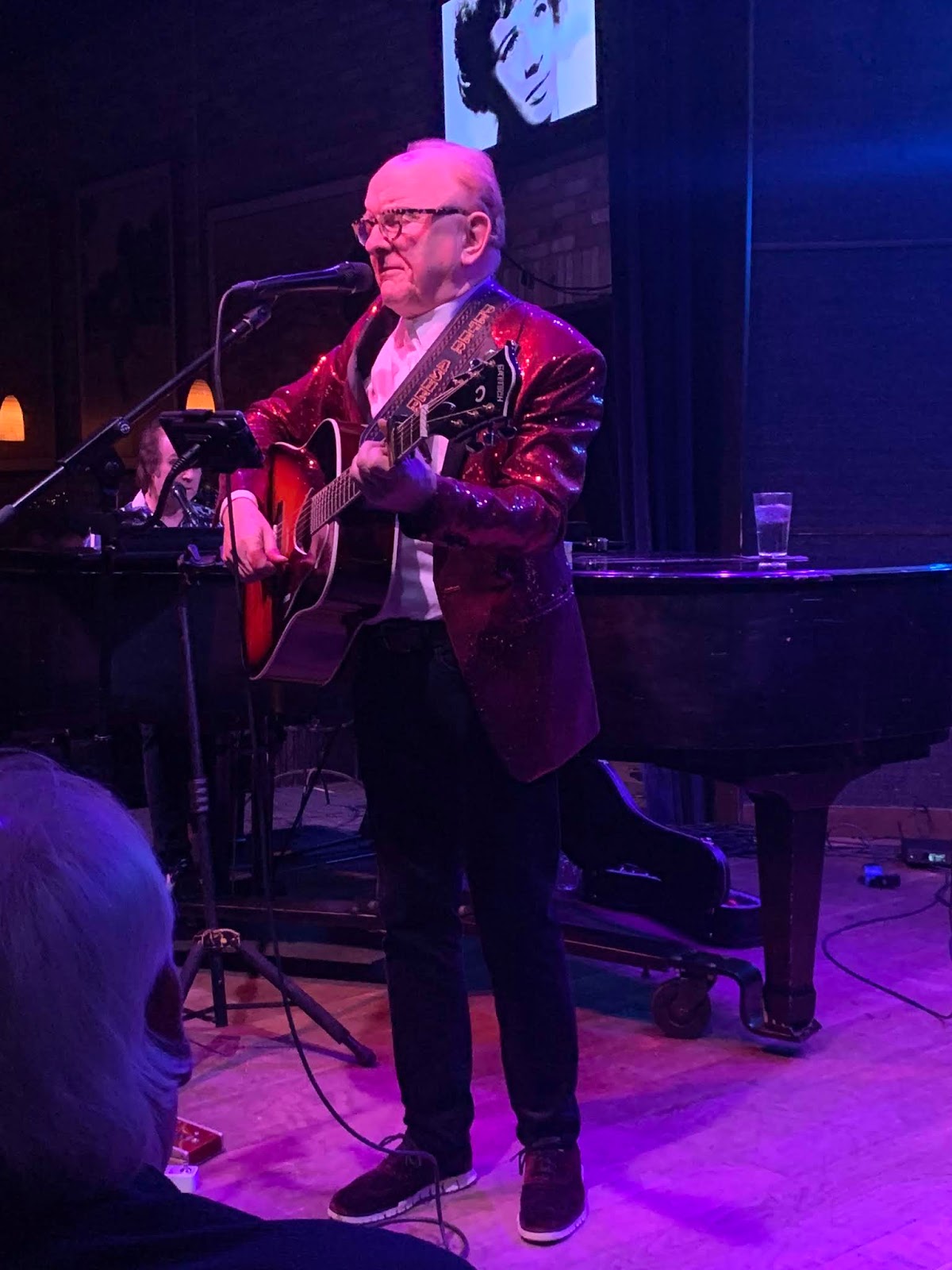
Peter Asher at the Dakota Jazz Club, Minneapolis, January 14, 2020. (Photo taken by my better half.)


Peter Asher and Gordon Waller, 1960's.
Last week my wife and I saw Peter Asher at the Dakota Jazz Club in Minneapolis. He was performing his show, “A Musical Memoir of the 60’s and Beyond.” I’ve seen Asher perform this show twice before, once in 2012 and again in 2017. I also saw Asher perform at the Dakota with Albert Lee last summer. (However, I missed seeing him and Lee open for Leo Kottke at the Guthrie in November.) 

For those of you who aren’t familiar with Peter Asher, I’ll give you a brief rundown on his musical career. Asher was part of a successful pop duo, Peter & Gordon, with his schoolmate Gordon Waller. Peter & Gordon scored 10 Top 40 singles in the US, including the number one smash “A World Without Love,” and the top ten hits “I Go to Pieces” and “Lady Godiva.” After Peter & Gordon split up, Asher moved into record production, becoming head of A&R at the Beatles’ Apple Records. Asher discovered a talented young American singer/songwriter. Asher became this guy’s manager and produced his first album for Apple Records. His name? James Taylor. Asher also managed Linda Ronstadt, and has been one of the most in-demand record producers since the 1970’s. He has twice won the Grammy Award for Producer of the Year. 

Asher may not be a household name himself, but he has connections with anyone who’s anyone in music. In his show, he tells his life story, and how he went from child actor to pop star to mega-producer. Peter & Gordon mixed many different musical influences, and they were originally envisioned as a sort of folk duo. But while recording their first album, they came in with “A World Without Love,” a Lennon/McCartney song that the Beatles weren’t going to record. How did this unknown vocal duo score such a coup? Well, Paul McCartney, the song’s author, happened to be dating Jane Asher, an up-and-coming young actress who happened to be Peter’s sister. Asher had heard McCartney play the song and asked him if he and Gordon could record it. McCartney said sure, and after some badgering by Asher, finished off the bridge of the song “in something like seven minutes,” according to Asher. “A World Without Love” went to Number One in both the UK and the US, and it was the first British Invasion single by a group other than the Beatles to hit the top spot in the US. 

Asher was involved in many other Beatle-related adventures during the 1960’s, including the Indica bookstore and art gallery. Asher helped organize a show at the Indica art gallery in November of 1966. It was a show by a Japanese American artist named Yoko Ono. And, of course, it was at a party for the opening of this exhibit that Yoko met a certain Beatle named John. 

If you’ve listened to Asher’s radio show From Me to You, on the Beatles’ Sirius XM channel, you know that Peter Asher is a highly engaging storyteller, and his tales are full of British self-deprecating humor. I’ve listened to Asher’s show a lot, partly because I’m a huge Beatles fan, and because my 5-year-old son only wants to listen to the Beatles every time he’s in the car. Asher even addresses his physical appearance in the 1960’s being an influence on Austin Powers’ signature look. (Red hair, thick Buddy Holly glasses, bad teeth.) I also appreciated that at the end of the show Asher made a plug for contemporary musiche basically said, there’s still lots of good music being made today. I appreciated hearing that coming from a 75-year-old who has been in the music industry since 1964. The point of his show isn’t to tell us about how wonderful everything was back in the day, and how everything now is just crap. 

On a slight digression, I think it’s amazing how much the music and culture of the 1960’s is still with us today, 50 years after that decade ended. Sure, that’s partly due to the continuing influence of the Baby Boomer generation on pop culture. But think about how prevalent the Beatles, the Rolling Stones, and Bob Dylan, to name just three artists, are in pop culture today. Now think about going back 50 years into the past, and if the same thing were happening then. It would be as if the musical stars of the 1910’s were still household names in the 1960’s. That wasn’t the case. It’s remarkable that this music has lasted for so long. Obviously, it’s a testament to the quality of that music, but I think it’s fascinating how this music and culture has survived and thrived through the decades. 

Back to the show! Asher performed with Jeff Alan Ross on piano and Jennifer Jo Oberle on bass guitar. They did a great job of making the songs sound good. I didn’t miss not having drums at all. Ross, a former touring member of Badfinger, got a solo spot when he sang the group’s lovely song “Day After Day.” Oberle soloed on “Blue Bayou,” the Roy Orbison song that Linda Ronstadt had a big hit with, and she did a great job, offering up a soulful vocal. 

If you go see Peter Asher, be warned that there’s a lot of talking in between the songs, and he doesn’t really play that many songs during the evening. Still, you’ll get to hear some great Peter & Gordon songs and some fantastic stories. The show we saw was the last one of the tour, and Asher held court for about 2 ½ hours!

Saturday, August 3, 2019

Concert Review: Peter Asher and Albert Lee at the Dakota Jazz Club

Peter Asher


Albert Lee
On Wednesday night, I saw Peter Asher and Albert Lee at the Dakota Jazz Club in Minneapolis. I’ve seen Peter Asher a couple of times before, and I’ve always enjoyed hearing his music and his stories. Peter was half of the 1960’s British Invasion duo Peter and Gordon, and he later became a top record producer, working with James Taylor and Linda Ronstadt, among many, many others. Peter and Gordon have always been one of my favorite British Invasion groups. I was less familiar with Albert Lee. My Mom had seen Lee at the Dakota before, and she was very impressed with his guitar playing. 

Together, Peter and Albert put on a very fun show. Both of them are big fans of the Everly Brothers, and Albert played guitar with the Everlys for more than twenty years. They opened the show with two Everly Brothers songs, “Bye Bye Love” and “Crying in the Rain.” Of course, the songs provided opportunities for Peter and Albert to weave together the stories of their musical lives. Asher related how he introduced James Taylor to Carole King, and convinced King that she should perform her own songs when she opened for Taylor at the Troubadour in Los Angeles. That story led into the next song, “Handy Man,” Taylor’s cover of the Jimmy Jones hit. Asher encouraged us all to sing along on the “Come-a, come-a” backing vocals, which was fun. 

Asher and Lee then traded off songs performed by the “British Elvis,” Cliff Richard, and the actual Elvis, with Asher singing Cliff’s 1961 hit “A Girl Like You,” and Lee singing “That’s All Right,” Elvis’ first record. Lee also provided excellent guitar solos on “That’s All Right.” Lee then sang “Sweet Little Lisa,” a song he played the guitar solo on for Dave Edmunds’ 1979 LP Repeat When Necessary. (That album featured Rockpile, with the wonderful Nick Lowe on bass.)

Other highlights of the evening included Peter and Gordon’s hit single “I Go to Pieces,” written by Del Shannon, and a lovely version of Buddy Holly’s “Well All Right.” Asher remarked that the style of glasses he wore in the 1960’s was an homage to Holly’s own black framed glasses. 

Lee performed his version of the Green Day hit “Good Riddance (Time of Your Life)” which Lee knew originally only through Glen Campbell’s cover version! The evening ended with a performance of Peter and Gordon’s biggest hit, “A World Without Love,” which topped the charts in both the United States and the UK. Written by Paul McCartney, the song didn’t quite seem to fit with what the Beatles were doing, so Peter persuaded Paul to give the song to Peter and Gordon as their first single. Asher also had to badger McCartney to write a bridge to the song, which Asher says Paul did “in something ridiculous like seven minutes.” And just how did Peter Asher have such access to Paul McCartney? Well, Paul was dating Peter’s sister, the actress Jane Asher, and the Asher’s let Paul live in the third floor of their family home! So it’s because of that connection that Peter Asher became the first person besides John Lennon and Paul McCartney, to hear “I Want to Hold Your Hand,” which was written on the Asher’s piano! 

The encore songs were Peter and Gordon’s last Top Ten hit, the cheeky and silly “Lady Godiva,” and the eternally gorgeous “Let It Be Me,” another song made famous by the Everly Brothers. All in all, it was a fun evening of music and stories from two musicians who have crossed paths with many of rock music’s greatest figures.

Saturday, June 22, 2019

Album Review: Paul McCartney and Wings Red Rose Speedway (1973)

Album cover for Red Rose Speedway by Paul McCartney and Wings, 1973.


Paul McCartney rocking the coolest sweater ever.
When the Beatles were tossing around ideas for the film and album that eventually became Let It Be, Paul McCartney put forth the suggestion that they should play some unannounced live gigs at small venues. None of the other Beatles were that enthusiastic about Paul’s suggestion, and eventually the recording sessions culminated with the famous “rooftop concert” on January 30, 1969. It was still a great ending to the sessions, but I can’t help but wonder what would have happened had the Beatles taken up Paul’s suggestion and hit the road for some gigs. It certainly would have provided the group with fantastic publicitynot that they were ever lacking for publicity. 

McCartney formed his band Wings in 1971, and the following year he did exactly what he had wanted the Beatles to do, packing the group up in a van and showing up unannounced at colleges and universities. Wings played 11 concerts in February of 1972, with nary a Beatles song to be heard. Although Paul did sing “Long Tall Sally,” which was a staple of the Beatles’ live repertoire, and was the last song they sang at Candlestick Park in 1966. Paul’s reluctance to play any Beatles songs shows that he wanted to establish his own identity outside of his former band. I suspect that if McCartney had played lots of Beatles songs in concert with Wings, it would have seemed to him to be a tacit admission that his best work was already behind him. 

Paul’s decision to not play any Beatles songs wasn’t unusual for solo performances by the former Beatles during the 1970’s. John Lennon only gave two full concerts during his lifetime, and the only Beatles song that he sang at those 1972 shows was “Come Together.” George Harrison sang four Beatles songs during his 1974 US tour, and one of those, “In My Life,” was a Lennon/McCartney song. (George got a lot of criticism for changing the lyrics of the song to “I love God more.”) 

Wings released three singles during 1972, but no albums. First was the political “Give Ireland Back to the Irish,” which is included as a bonus track on the 2018 reissue of Wild Life. This was followed by “Mary Had a Little Lamb.” Yep, that “Mary Had a Little Lamb.” While the single peaked at number 9 in the UK, it did nothing to assuage the growing critical consensus that McCartney’s music was trite and inconsequential. Much better was the third single of the year, the rocking “Hi Hi Hi” and the languid “C Moon.” “Hi Hi Hi” was predictably banned by the BBC for drug references and also for the lyric that the BBC heard as “get you ready for my body gun.” As McCartney has said, the actual lyric is “get you ready for my polygon.” So, there you go. 

Red Rose Speedway, released on April 30, 1973 in the US and on May 4th in the UK, was more commercially successful than Wild Life, peaking at number 5 in the UK and topping the charts in the US. Wild Life and Red Rose Speedway were both reissued in December of 2018 as part of the ongoing Paul McCartney Archive Collection series. I’ll be reviewing the two-disc version of Red Rose Speedway.

I think Red Rose Speedway is a stronger record overall than Wild Life. The first track, “Big Barn Bed” is a slight song, but it has the polish that the songs on Wild Life lacked. The big hit single from Red Rose Speedway was Paul’s gushy ballad “My Love,” which topped the charts in the US. It’s a catchy song that sticks in your head, but for McCartney’s detractors it was the kind of big ballad that screamed “middle of the road” rather than “rock star.” “Get on the Right Thing” has a good groove and some excellent vocals from Paul. “One More Kiss” is a nice tune with a country feel. “Little Lamb Dragonfly” is an interesting song, although I’m not really sure what it’s about. Some people think it’s about Paul’s decision to become a vegetarian, and some people think it’s a message to John Lennon. I quite like “Single Pigeon,” even though it’s a silly title for a song. “When the Night” is one of my favorites from the album. Paul’s singing on it is great, and it has a New Orleans/Fats Domino vibe to it. Parts of the melody sound a bit like “Tomorrow,” from Wild Life. 

Like all of McCartney’s solo albums to this point, Red Rose Speedway still has some moments of weird idiosyncrasies, like “Loup (1st Indian on the Moon)” a four-minute long tune that mainly consists of chanting and some odd synths. 

An eleven-minute long medley of four songs closes the album, inviting the inevitable comparisons to Abbey Road. The first song is called “Hold Me Tight,” but it bears no resemblance to the 1963 song of the same name that Paul sang on With the Beatles. The song finds Paul imploring someone to “hug-a me right,” which doesn’t exactly bring confidence in the lyrical content to follow. “Lazy Dynamite” isn’t much better. “Hands of Love” is at least a catchier song. “Power Cut” is fine, if unmemorable. There’s really no reason for these four songs to be strung together as a medley, and the segues between them aren’t that interesting. 

Red Rose Speedway is a more polished album than Wild Life, and I just enjoy listening to Red Rose Speedway more than Wild Life. The difference between the albums is highlighted in the CD packaging for the 2018 reissues, as Red Rose Speedway has a slick, glossy texture, whereas Wild Life has a low-key matte finish. The artwork in the booklet of Red Rose Speedway is very reminiscent of Pop Art, with Marilyn Monroe, missiles, and pin-ups vying for our attentionit looks like it could have come from a Roxy Music album. The back cover of the CD even reproduces the original LP’s Braille message of “We love ya baby,” apparently a message for Stevie Wonder. 

Red Rose Speedway was originally meant to be a double album, and many of those songs that didn’t make the cut are found on disc two. We also get the other 1972 singles, so you can hear “Mary Had a Little Lamb” for yourself. And then you can groove to “Hi Hi Hi” and “C Moon” and wonder how the same man who did a version of the simplest nursery rhyme could go from that to picking up a girl at the station with a bootleg in her hand. Also included is “Live and Let Die,” released just a month after Red Rose Speedway. There’s also a very cool alternate take of “Live and Let Die,” which is fun to hear. Another song of note is “I Lie Around” the B-side of “Live and Let Die,” which marks Denny Laine’s first lead vocal on a Wings recording. We also get to hear Linda McCartney sing on “Seaside Woman,” a song that was recorded during the sessions for Red Rose Speedway but not released until 1977, when it was released as a single credited to “Suzy and the Red Stripes.” Unlikely as it might seem, the song actually made it to number 59 in the US charts. “Mama’s Little Girl” is one of the better songs that was cut from the album. There’s also a cover version of a 1950’s song, “Tragedy,” which was a hit for Thomas Wayne and the DeLons and also the Fleetwoods. 

The Wings lineup for Red Rose Speedway was Paul, Linda, Denny Laine on guitar, Henry McCullough on lead guitar, and Denny Seiwall on drums. As the group was rehearsing new material during the summer of 1973, McCullough and Seiwall left the band. The trio of Paul, Linda, and Denny Laine went to Lagos, Nigeria, to record Wings’ most successful album: Band on the Run, released just seven months after Red Rose Speedway.

Friday, June 21, 2019

Album Review: Paul McCartney and Wings Wild Life (1971)

Album cover of Wild Life, by Wings, 1971.


Paul and Linda McCartney, 1971.
When the Beatles split up in 1970, expectations for Paul McCartney’s solo career were sky-high. But Paul and John Lennon both issued minimalist albums for their proper solo debuts: McCartney, and John Lennon/Plastic Ono Band. It was left to George Harrison to issue the solo album that most fit the mood of the times: the epic, sprawling, triple-disc All Things Must Pass. 

Rock critics probably expected McCartney to make a solo album that was a major statement. What they got instead was the lo-fi weirdness of McCartney, Ram, and Wild Life. McCartney had been a homemade affair, with all the instruments played by Paul. Ram, credited to Paul and his wife Linda, featured a full band and a slightly more polished sound. McCartney’s third solo album, Wild Life, was released in December of 1971, less than seven months after Ram, and was credited to his new band, Wings.

Wait, Paul McCartney was starting a band? After he was just in the Beatles, the greatest band of all-time? Okay, weird. Who was in this new band? A group of rock superstars? Nope, guitarist Denny Laine, and Denny Seiwall on drums. Oh, and Paul’s wife Linda on keyboards and backing vocals. He’s starting a band with his wife? Well, John Lennon was doing the same thing. As I’ve said before, it took guts/stupidity to start a band with a spouse who’s not a professional musician, and Paul and Linda suffered the slings and arrows of the rock critics. 

It’s clear from interviews that it was important to McCartney’s identity to be in a band, rather than just be Paul McCartney, solo artist. Of course, to some degree Wings would inevitably always be “Paul McCartney’s backing band,” but I suspect that being in a band lessened the psychological pressure on McCartney to live up to the huge expectations of making music after the Beatles. 

Wild Life and Red Rose Speedway were both reissued in December of 2018 as part of the ongoing Paul McCartney Archive Collection series. I’ll be reviewing the two-disc version of Wild Life.
Wild Life was a pretty inauspicious debut for Wings, and in my opinion it’s a much weaker album than the superb Ram. Part of the charm of Ram is that even the tossed-off songs, like “Monkberry Moon Delight,” are still awesome, whereas on Wild Life the tossed-off songs just sound, well, tossed-off. Wild Life is a pretty slight album, starting off with the jam “Mumbo” and the repetitive “Bip Bop.” Then we get a cover of “Love is Strange.” While Paul has issued cover albums, it’s extremely rare for him to feature covers in the middle of an album of original material. Like the rest of the album, “Love is Strange” is loose and jammy. 

My two favorite songs on Wild Life are “Tomorrow” and “Dear Friend,” on side two of the album. “Tomorrow” is a very simple song, but it’s catchy as hell, and would be my pick for a single, had one been issued to support Wild Life. (Some copies of “Love is Strange” were issued as a promo single, but the single was never actually released.) “Tomorrow” is a great example of Paul McCartney’s melodic genius, how he can take clichéd lyrics and still turn them into a catchy pop ditty, seemingly at a moment’s notice. 

“Dear Friend” is a stark, haunting piano ballad. Most critics interpreted it at the time as being a response to John Lennon’s venomous song about Paul, “How Do You Sleep?” issued on his Imagine album in September of 1971. However, “Dear Friend” was actually recorded during the Ram sessions, before “How Do You Sleep?” was released. “Dear Friend” has just two verses, and no real chorus or bridge, and it clocks in just shy of six minutes. It’s another example of a song being simple, but still very effective, and quite emotional. “Dear Friend” also features superb vocals from Paul. 

The second disc of Wild Life collects a bunch of previously unreleased home recordings, as well as assorted and sundry rarities. For me, the most interesting home recordings were the two versions of “Dear Friend.” Also of interest is Wings’ 1972 single “Give Ireland Back to the Irish,” which was never issued on an album at the time. The song is McCartney’s response to the events of Bloody Sunday, when British soldiers killed 13 protestors during a march. The song is a rare example of a direct political statement from McCartney. The song was duly banned by the BBC. You can compare and contrast “Give Ireland Back to the Irish” with John Lennon’s own song about Bloody Sunday, “The Luck of the Irish,” which appeared on his 1972 album Some Time in New York City. (Be warned: Yoko sings on it.) 

In my next review, I’ll examine Paul McCartney’s next album, 1973’s Red Rose Speedway.