Showing posts with label tim mccarver. Show all posts

Tuesday, January 28, 2025

Bob Uecker 1934-2025


The Pop Fly Pop Shop print of Bob Uecker, art by Daniel Jacob Horine, 2024.

Bob Uecker was one of a kind.
Uecker’s career in pro baseball began in 1956, when he was signed by his hometown team, the Milwaukee Braves. Uecker spent 6 seasons in the minor leagues before finally getting a shot in the big leagues in 1962. Uecker actually flashed some power in the minors, hitting 19 home runs in 1956, 15 in 1957, 22 in 1958, and 14 in 1961. In the majors, Uecker was that least glamorous of baseball players, a backup catcher. At the beginning of the 1964 season, Uecker was traded to the St. Louis Cardinals, where he was the backup for Tim McCarver. Can you imagine playing on a team where your two main catchers were Tim McCarver and Bob Uecker? That must have been a very talkative, very funny bench. 
 

Bob Uecker's 1965 Topps baseball card. 

The 1964 Cardinals ended up winning the World Series, even though Uecker didn’t see any postseason action. Uecker’s 1965 Topps baseball card noted that “his funny-man antics keeps teammates loose.” Little did Topps know how right they were. On the front of his 1965 Topps card, Uecker is pictured with a huge grin on his face, batting left-handed. Bob fooled the Topps photographer, as Uecker was actually a right-handed hitter.  

St. Louis Cardinals team photo, 1965, with Uecker and Bob Gibson holding hands. Steve Carlton is on the far left, sitting down. 

Uecker and his battery mate Bob Gibson pulled a very funny practical joke on the Cardinals. For a team photo, Uecker and Gibson were sitting next to each other in the front row, holding hands with huge smiles on their faces. According to Uecker, the Cardinals fined both him and Gibson. And of course, they had to retake the photo. But if you look at that team photo, take a look at the player sitting on the far left of Uecker and Gibson’s row: it’s young Steve Carlton.  

Carlton was a rookie in 1965, and Uecker caught 5 games that Carlton pitched in. Uecker was behind the plate for Steve Carlton’s first major league start, on June 14, 1965. Pitching against the Pirates, Lefty’s career as a starter began inauspiciously, as he gave up a home run to the leadoff batter, Bob Bailey. But he settled down after that. However, manager Red Schoendienst took Carlton out of the game after he had pitched 4 1/3 innings, with the game tied at 2, meaning Carlton had no chance to get his first major league win. If Carlton had gotten just two more outs, he would have nabbed the win, as the Cardinals scored 2 runs in the bottom of the fifth inning to take the lead, and they ended up winning, 5-2.  

After the 1965 season, the Cardinals dealt Uecker, along with Dick Groat and Bill White, to the Phillies. It wasn’t a great trade for the Cardinals, who got Pat Corrales, Alex Johnson, and Art Mahaffey in return, none of whom did much of anything for the Cardinals. Despite being a lifetime .200 hitter, Uecker went 3 for 10 against Steve Carlton, giving him an even .300 average. Uecker had 2 RBI’s and 1 strikeout against Lefty. But it does seem fitting that Lefty also got Uecker to ground into a double play.  

Bob Uecker hit only 14 home runs in his major league career, but 3 of those home runs were off of Hall of Famers: Uecker took Sandy Koufax, Gaylord Perry, and Fergie Jenkins deep. That’s a pretty impressive feat.  

Of course, Bob Uecker’s greatest fame came after his playing days were over. Uecker was a frequent guest on “The Tonight Show,” and he cracked Johnny Carson up with his baseball stories. Uecker was a master of self-deprecating wit, and Carson nicknamed him “Mr. Baseball.” Uecker became the radio announcer for the Milwaukee Brewers, and stayed in the job for more than fifty years, a truly remarkable run. 

When I was a kid growing up in the 1980’s, Bob Uecker was a ubiquitous presence in baseball pop culture. I knew Uecker from his frequent Miller Lite beer commercials, his role on the TV show “Mr. Belvedere,” from hosting VHS tapes of funny baseball clips, and of course his role as announcer Harry Doyle in the movie Major League. Uecker’s classic delivery of “Juuuuuust a bit outside” was frequently quoted by me and my Dad when I was growing up.  

There was no one quite like Bob Uecker. Who else had made a career out of making fun of his own major league baseball career? No one did it like Uecker did. When I was about 10 or 11 years old, I was gleefully reading Uecker’s humorous autobiography The Catcher in the Wry. When adults asked me what I was reading, I responded with “The Catcher in the Wry,” not understanding why every adult seemed so impressed that I was reading Bob Uecker’s autobiography. I do recall seeming surprised that so many adults had heard of Bob Uecker’s autobiography. That’s a story that I’m sure Uecker would have appreciated.  

A few months ago, the Pop Fly Pop Shop, which features the art of Daniel Jacob Horine, came out with a print honoring Bob Uecker. I went back and forth a bit, thinking if I should buy it or not. But I decided to buy it, and I’m so glad I did, because Bob Uecker just makes me smile. The art piece is a really nice tribute to Uecker and his sense of humor.  

Bob Uecker is a great example of the adage “If life gives you lemons, make lemonade.” Life made Bob Uecker a career .200 hitter in the major leagues. Life also made Bob Uecker a funny, warm person who was able to share his talents and his love of baseball with millions of people over the decades. He was special, and he will be missed by many baseball fans.  

Friday, February 17, 2023

Tim McCarver, 1941-2023

My signed photo of Tim McCarver and Steve Carlton. I never got to meet Tim McCarver, so I'm pleased I bought this in 2022. (Photo by Mark C. Taylor)

Catcher and longtime MLB baseball broadcaster Tim McCarver passed away yesterday at the age of 81.
I’ve grown up hearing Tim McCarver’s voice on baseball games, and it’s hard to imagine baseball without him. I also felt a connection to McCarver because he was the “personal catcher” in the late 1970’s for my favorite baseball player, Steve Carlton. 
 

As a kid, I remember my dad was not a big fan of McCarver’s commentary, as he felt that McCarver simply talked too much. (My father was not alone in this viewpoint.) I didn’t disagree with my dad, but I eventually grew to like McCarver’s commentary, in part simply because of his ubiquity. He was always there, for every World Series and All-Star Game. By the time McCarver left the Fox network after the 2013 season, I found myself missing McCarver’s Southern accent and incisive insights. I didn’t really realize how much I liked McCarver until he was gone. I don’t think McCarver and Joe Buck were a great broadcast team—to me, it never felt like they actually knew each other outside of the broadcast booth. I blame Joe Buck’s robotic stiffness, as I can’t imagine how anyone wouldn’t get along with the friendly and garrulous McCarver. I don’t hate Joe Buck, but I don’t really like him, either. There’s nothing really wrong with Joe Buck, but there’s nothing really right with Joe Buck, either. Joe Buck just does every sport and does a B- job at every sport.  


Back to Tim McCarver. I’m very glad that I read William C. Kashatus’ excellent 2022 biography of McCarver and Steve Carlton, Lefty & Tim: How Steve Carlton and Tim McCarver Became Baseball’s Best Battery, as it gave me a greater appreciation for Tim McCarver’s baseball career. McCarver was an extremely gifted athlete, and he had football scholarship offers from many colleges, including Notre Dame, but he turned them down to sign with the St. Louis Cardinals. McCarver graduated from high school in June of 1959, and on September 10, 1959, he made his major league debut. He turned 18 a month later. By 1963, McCarver was in the big leagues to stay. In 1964, McCarver was the regular catcher for the pennant-winning Cardinals, and he hit .478 in the World Series, as the Cards beat the Yankees in 7 games.  


Not known for his speed, McCarver is the only catcher to ever lead the league in triples, as he slugged 13 in 1966. He appeared in two more World Series with the Cardinals, in 1967 and 1968, and finished runner-up to teammate Orlando Cepeda in the 1967 NL MVP vote.  


McCarver handled two of the greatest pitchers of all-time: Bob Gibson and Steve Carlton. McCarver has related stories of how Gibson forced McCarver to face his own prejudices, and they became great friends. McCarver was behind the plate for one of the greatest seasons by a pitcher ever: Bob Gibson’s 1968 season, when he hurled an unbelievable 1.12 ERA over 304 innings. McCarver was also behind the plate for part of Steve Carlton’s legendary 1972 season with the Phillies, when Carlton won an incredible 27 games for a team that only won 59 games. Gibson and Carlton’s success speaks to McCarver’s prowess as a handler of pitchers.  


In mid-1975 it looked like McCarver’s playing career was over when the Boston Red Sox released him. But the Phillies picked him up, and Timmy carved out a niche as a pinch-hitter and Steve Carlton’s personal catcher. The Phillies’ regular catcher was Bob Boone, a fantastic defensive catcher, but Carlton and Boone didn’t always see eye to eye on pitch calling. Boone had introduced Carlton to strength and martial arts coach Gus Hoefling after the 1975 season, and the strenuous workouts helped improve Carlton’s performance on the mound. One of the best-known exercises called for Carlton to stick his left arm into a barrel of rice and try to work his hand down to the bottom of the barrel. 


With Hoefling’s workout routine, and his friend McCarver behind the plate, Carlton rejuvenated his career, winning 20 games in 1976, and three more Cy Young Awards in 1977, 1980, and 1982. McCarver retired after the 1979 season, and he made a seamless transition to the broadcast booth with the Phillies. But the Phillies did McCarver a favor and activated him as a player in late 1980 so he could become a four-decade player. As Carlton stopped talking to the press in the late 1970’s, McCarver also became Carlton’s “designated talker,” answering the questions from reporters that Carlton refused to.  


Tim McCarver leaves behind a long legacy in major league baseball, and he’ll be fondly remembered by those who appreciated his talents behind the plate and behind the microphone. 

Thursday, October 6, 2022

Book Review: Lefty & Tim: How Steve Carlton and Tim McCarver Became Baseball's Best Battery, by William C. Kashatus (2022)

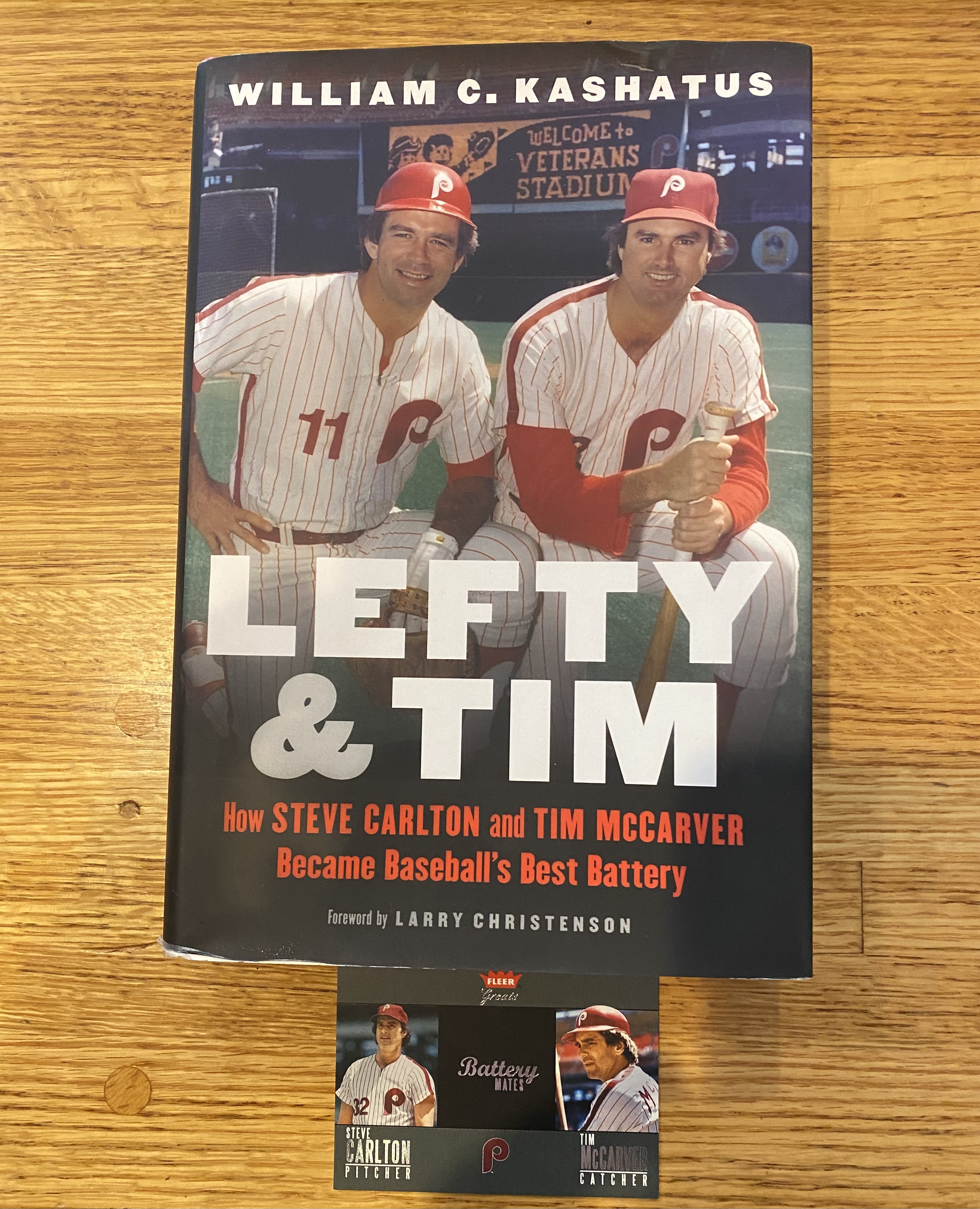
Cover of Lefty & Tim, by William C. Kashatus, 2022. With 2004 Fleer baseball card of Steve Carlton and Tim McCarver. (Photo by Mark C. Taylor)
 
Historian and author William C. Kashatus.


Steve Carlton was one of the best pitchers in baseball history. Carlton won 329 games, the 2nd highest total for a left-hander. He struck out 4,136 batters—a record for left-handers at the time he retired in 1988. Carlton was the first pitcher to win 4 Cy Young Awards, and he set a record for most strikeouts in a game when he fanned 19 Mets in 1969. Carlton, known by his nickname of “Lefty,” was a first ballot Hall of Famer, easily elected in 1994 when he was named on 95.82% of the ballots. Throughout his career, Carlton was known for his unorthodox training regimen, which included martial arts exercises, and for his silence with the media.  

William C. Kashatus’ 2022 book Lefty & Tim: How Steve Carlton and Tim McCarver Became Baseball’s Best Battery, examines the careers of Carlton and Tim McCarver, who became Carlton’s “personal catcher” with the Phillies from 1975-1979. The connection between McCarver and Carlton began in 1965 with the St. Louis Cardinals. Carlton was a rookie: 1964 was his first year in professional baseball. McCarver, only 3 years older than Carlton, was already well-established as a major leaguer. He had made his MLB debut at the tender age of 17 in 1959, and by 1963 he was the Cardinals’ starting catcher. McCarver was a hitting star of the 1964 World Series, appearing in all 7 games and hitting .478 as the Cardinals beat the New York Yankees.  


Carlton and McCarver were both stubborn men. Carlton wasn’t impressed by McCarver’s status, as he approached the catcher during spring training and said to him “Hey, you’ve gotta call for more breaking pitches when we’re behind in the count.” McCarver yelled at Carlton for having the gall to question his pitch calling. Carlton calmly walked away. The next day, McCarver apologized to Carlton for chewing him out. Carlton accepted McCarver’s apology and said, “I wasn’t listening anyway.” (Lefty & Tim, p.32-3)  


Despite this rocky beginning to their relationship, Carlton and McCarver soon became good friends, and McCarver was behind the plate during 1967, 1968, and 1969 as Carlton established himself as one of the best young pitchers in baseball. McCarver had another stubborn ace pitcher to deal with on the staff of the St. Louis Cardinals: Bob Gibson. McCarver and Gibson had clashed early on, but eventually came to a terrific understanding of one another, both as baseball players and as human beings. Gibson was also influential on Steve Carlton’s development as a pitcher. Gibson was no-nonsense on the mound. The mound was his office, and you didn’t mess with Gibson in his office. To Gibson, opposing hitters were the enemy. They were not to be fraternized with. Carlton developed the mental attitude to act the same as Gibson did on the mound.  


Carlton was known for his long silence with the media, so he might seem like an unlikely candidate for a biography. There have been two books written about Carlton’s amazing 1972 season, when he won 27 games for the last-place Philadelphia Phillies, but Kashatus takes a wider view of Carlton’s career. Kashatus got a lot of information from Carlton off the record, but ultimately, Lefty decided not to do any on the record interviews for the book. It’s a shame, because it would be fantastic to have Carlton’s story in his own words, but Kashatus did a terrific job of writing Lefty & Tim, even without the participation of one of the two subjects. (And besides, the garrulous McCarver, who did several interviews with Kashatus, probably did enough talking for two people.)  


Kashatus has done an excellent job of combing through the historical record to find good quotes from Carlton in the interviews he has done. The myth is that Steve Carlton never talked to the press, but that’s not true. Carlton gave plenty of interviews from 1965 until 1977, and even during his media silence from 1977 to 1986, Lefty still did the occasional interview here and there.  


Carlton began his career with an excellent fastball and curveball, and in 1969 he added a devastating slider. Carlton threw the slider from the same arm slot as his fastball, which meant that batters couldn’t tell which pitch was coming. Lefty’s slider broke down and in on right-handed batters, and down and away on left-handed batters. Standing 6 foot 4 and weighing 210 pounds in his prime, Carlton was strong enough to throw the slider without putting strain on his elbow.  


Lefty had one of the greatest seasons a starting pitcher has ever had in 1972, when he won 27 games and claimed his first Cy Young Award. But from 1973-1975, Carlton’s won-loss record was 44-47. But things were about to change. In mid-1975, the Phillies reacquired McCarver, after he was released by the Red Sox. The Phillies had one of baseball’s great defensive catchers in Bob Boone, but Boone and Carlton had different theories about pitch calling. Slowly, McCarver started to catch all of Carlton’s starts.  


Bob Boone had introduced Carlton to strength and martial arts coach Gus Hoefling, and the strenuous workouts helped improve Carlton’s performance on the mound. One of the best-known exercises called for Carlton to stick his left arm into a barrel of rice and try to work his hand down to the bottom of the barrel. Phillies starter Jim Lonborg, plagued by elbow problems, tried the rice workout and never had elbow issues again. Hoefling’s training also focused on the mental aspect of sports. One day, fellow starting pitcher Larry Christenson saw Carlton lying on the trainer’s table before a start with his eyes closed. Christenson asked Lefty what he was doing. Kashatus writes that Lefty’s response was that “he was visualizing the spin on his slider and how he was planning to throw it against the various batters in the opposing team’s lineup that night.” (p.186) 


After the 1975 season, Carlton’s lifetime record stood at 148-119, for a winning percentage of .554. From 1976 through the 1984 season, Carlton’s record was 165-88, for a winning percentage of .652. Carlton won 20 games 4 times from 1976-1982, and he won 3 more Cy Young Awards. The Phillies also turned into a powerhouse, making the playoffs 6 times from 1976-1983, culminating in the team winning their first World Series in 1980.  


Lefty & Tim will serve as the definitive book about how Steve Carlton became one of the most dominant pitchers of his era. Lefty & Tim also makes a compelling case for Tim McCarver’s reputation as a great handler of pitchers, and as a superbly intelligent student of baseball. Kashatus has interviewed many people close to Carlton and McCarver to create a comprehensive account of their baseball careers. If you’re a fan of either Steve Carlton or Tim McCarver, you should read Lefty & Tim.