Showing posts with label philadelphia phillies. Show all posts

Monday, December 9, 2024

2025 Classic Baseball Era Committee Results

Dick Allen, about to give a baseball a ride.

Dave Parker, with a hat full of stars.


Yesterday, Dave Parker and Dick Allen were elected to the Baseball Hall of Fame by the Classic Baseball Era Committee. 12 votes were needed for election, Parker received 14, and Allen received 13. Tommy John got 7 votes, and the other candidates, Ken Boyer, John Donaldson, Steve Garvey, Vic Harris, and Luis Tiant all received fewer than 5 votes. I’m disappointed that Tommy John didn’t get in, but I’m very happy about Parker and Allen being elected, and that my prediction was half correct.  

Allen and Parker were two of the best baseball players not in the Hall of Fame, and I think they make worthy additions to Cooperstown. Allen had come heartbreakingly close to induction, falling just one vote short of induction on two previous Veterans’ Committee ballots. Unfortunately, Allen passed away in December of 2020. Dave Parker is still with us, fortunately, and I’m so glad that he gets to enjoy the thrill of being a Hall of Famer.  

There have been various Veterans’ Committees in the history of the Baseball Hall of Fame. The Veterans’ Committee justly gets a bad rap for the many borderline candidates they elected during the 1960’s and 1970’s, and even into the 1980’s—Travis Jackson, George Kell, and Rick Ferrell, I’m looking at you! Since 2018, the Eras Committees have elected a number of outstanding players that the baseball writers totally whiffed on: Alan Trammell, Lee Smith, Ted Simmons, Gil Hodges, Minnie Minoso, Jim Kaat, Tony Oliva, Fred McGriff, and now Dick Allen and Dave Parker. You can quibble with Jack Morris and Harold Baines if you want to, but I think they’re worthy additions as well. This is proof that the Veterans’ Committee/Eras Committee is working the way it should: adding deserving players to the Hall of Fame that were overlooked by the writers.  

Now I need to write up my thoughts on the 2025 BBWAA ballot. I have a sneaking suspicion that Allen and Parker will be joined by at least one other inductee next July. (Spoiler alert: it’s Ichiro!)  

Tuesday, October 1, 2024

Pete Rose 1941-2024

Pete Rose, sliding in headfirst, as always.

Baseball’s Hit King, Pete Rose, died yesterday at the age of 83. Pete Rose was one of the greatest players in baseball history, as well as one of the most controversial. Rose has been the MLB hit leader for 39 years, and 
it’s safe to say that his record of 4,256 hits will stand for many more years. The controversy surrounding Rose will last for many more years too, as fans and historians will debate if he belongs in the Hall of Fame after his 1989 ban for betting on baseball.
 

As a player, Pete Rose obviously belongs in the Hall of Fame. His accomplishments are amazing. Rose was a 17-time All-Star (a fun Minnesota connection—his first All-Star appearance was at Metropolitan Stadium in 1965, and his last All-Star appearance was at the Metrodome in 1985) he made the All-Star team at 5 different positions, (second base, left field, right field, third base, and first base) a record that will be impossible to break. Has anyone else even matched Rose’s accomplishment of being an All-Star at 3 different infield positions? Rose was a 3-time batting champion, and he finished in the top ten of batting average 13 times. He was the 1963 NL Rookie of the Year, and the 1973 NL MVP. Rose was a .321 hitter in the postseason, and he appeared in 6 World Series, winning the 1975 World Series MVP. Rose led the league in runs scored 4 times, in hits 7 times, and in doubles 5 times. Not known as a power hitter, Rose is second all-time in doubles, with an incredible total of 746.  

As a person, Pete Rose falls short of the Hall of Fame. Rose bet on baseball, and while no one ever accused him of throwing a game or giving less than his full effort on the field, it’s still a cardinal sin in baseball. I think it’s ridiculous that Rose didn’t just come clean in 1989 and confess that he had bet on baseball. Instead, he lied about betting on baseball for 15 years, before finally admitting the truth in a 2004 book. As a kid, that always confused me. If Rose didn’t bet on baseball, then why did he accept the ban from baseball? If he didn’t bet on baseball, then why didn’t he fight the ban? It’s a bit like Richard Nixon accepting Gerald Ford’s pardon after he resigned in 1974. I’m not going to say I did anything wrong, but I’ll accept this pardon just in case I may have done something wrong.  

But Rose fooled a lot of people for a long time, and even a baseball writer as smart as Bill James was an apologist for Pete Rose. In his 2001 book The New Bill James Historical Abstract, James spent six pages attacking the Dowd Report and casting doubt on the evidence that Rose bet on baseball. Of course, read today, it makes James sound foolish. 

You can admire Pete Rose’s grit, his tenacity, his hustle, and still find him lacking as a human being. If Rose had truly reconstituted his life in 1989 and lived the rest of his life after his ban from baseball the way, say, Stan Musial lived his life, maybe Rose would have seen the ban lifted. But he didn’t live his life that way, because he was Pete Rose. How could he do anything wrong?  

I was born in 1981, the year that Rose passed Stan Musial for the National League hit record. (Back in the day, records for each league had more importance than they do today.) Rose was an icon from the moment I became a baseball fan. To anyone slightly older than I am, Pete Rose was a huge symbol of baseball. You could argue that Pete Rose and Reggie Jackson were the two most iconic baseball players of the 1970’s. They were opposites, Reggie the powerful home run slugger, Rose the dedicated contact and average hitter. But they both captured the media’s attention and became stars.  

Back in 2015, Rose applied for reinstatement, hoping that Rob Manfred would be more receptive to his case than Bud Selig ever was. Rose was wrong. Reading Manfred’s statement is illuminating of the kind of person Pete Rose was. In true Rose fashion, he told Manfred he didn’t currently bet on baseball, and then backtracked later in his interview to say he does still bet on baseball. 

Rose still generates conversation, 35 years after his ban from baseball. When I was in Cooperstown with my family this summer, Pete Rose was there, signing autographs. We talked to a guy who had eaten breakfast at the same place Rose did. He said that one morning, Pete was facing away from the door, and he figured Rose didn’t want people to bother him, but the next morning, he was sitting facing out to the restaurant, so this guy said hi to Pete and ended up having a nice conversation with him for 10 minutes about baseball. We had breakfast at that restaurant the next morning, but we didn’t see Pete there. We did see Rose at the Safe at Home memorabilia store in Cooperstown. I didn’t pay for an autograph, but we at least saw Pete, although the store had practically blockaded him, I assume to keep people like us from just looking at Pete for free. Rose looked good when I saw him. He looked like, well, how Pete Rose always did.  

I also had a conversation about Pete Rose with a guy who was staying at the same motel. Like most people, this guy thought Rose should be in the Hall of Fame. I’m torn, because I do believe that Rose deserves to be in the Hall of Fame as a player. But I also believe that Rose bet on baseball, and he accepted the ban, and he really didn’t do much to change his ways after 1989. I do think it’s a positive sign that people wanted Pete Rose back in baseball—people were not full of hatred and retribution towards Pete Rose. And even though I might seem harsh on Rose, there’s part of me that still likes him. He was a great player. He loved playing the game, and he played all-out, every single day. Pete Rose is so close to being the perfect role model. So close, and yet so far. Maybe that’s the moral of Pete Rose, that he was so talented, so gifted, but he had fatal flaws as well. He was human.  

Friday, February 17, 2023

Tim McCarver, 1941-2023

My signed photo of Tim McCarver and Steve Carlton. I never got to meet Tim McCarver, so I'm pleased I bought this in 2022. (Photo by Mark C. Taylor)

Catcher and longtime MLB baseball broadcaster Tim McCarver passed away yesterday at the age of 81.
I’ve grown up hearing Tim McCarver’s voice on baseball games, and it’s hard to imagine baseball without him. I also felt a connection to McCarver because he was the “personal catcher” in the late 1970’s for my favorite baseball player, Steve Carlton. 
 

As a kid, I remember my dad was not a big fan of McCarver’s commentary, as he felt that McCarver simply talked too much. (My father was not alone in this viewpoint.) I didn’t disagree with my dad, but I eventually grew to like McCarver’s commentary, in part simply because of his ubiquity. He was always there, for every World Series and All-Star Game. By the time McCarver left the Fox network after the 2013 season, I found myself missing McCarver’s Southern accent and incisive insights. I didn’t really realize how much I liked McCarver until he was gone. I don’t think McCarver and Joe Buck were a great broadcast team—to me, it never felt like they actually knew each other outside of the broadcast booth. I blame Joe Buck’s robotic stiffness, as I can’t imagine how anyone wouldn’t get along with the friendly and garrulous McCarver. I don’t hate Joe Buck, but I don’t really like him, either. There’s nothing really wrong with Joe Buck, but there’s nothing really right with Joe Buck, either. Joe Buck just does every sport and does a B- job at every sport.  


Back to Tim McCarver. I’m very glad that I read William C. Kashatus’ excellent 2022 biography of McCarver and Steve Carlton, Lefty & Tim: How Steve Carlton and Tim McCarver Became Baseball’s Best Battery, as it gave me a greater appreciation for Tim McCarver’s baseball career. McCarver was an extremely gifted athlete, and he had football scholarship offers from many colleges, including Notre Dame, but he turned them down to sign with the St. Louis Cardinals. McCarver graduated from high school in June of 1959, and on September 10, 1959, he made his major league debut. He turned 18 a month later. By 1963, McCarver was in the big leagues to stay. In 1964, McCarver was the regular catcher for the pennant-winning Cardinals, and he hit .478 in the World Series, as the Cards beat the Yankees in 7 games.  


Not known for his speed, McCarver is the only catcher to ever lead the league in triples, as he slugged 13 in 1966. He appeared in two more World Series with the Cardinals, in 1967 and 1968, and finished runner-up to teammate Orlando Cepeda in the 1967 NL MVP vote.  


McCarver handled two of the greatest pitchers of all-time: Bob Gibson and Steve Carlton. McCarver has related stories of how Gibson forced McCarver to face his own prejudices, and they became great friends. McCarver was behind the plate for one of the greatest seasons by a pitcher ever: Bob Gibson’s 1968 season, when he hurled an unbelievable 1.12 ERA over 304 innings. McCarver was also behind the plate for part of Steve Carlton’s legendary 1972 season with the Phillies, when Carlton won an incredible 27 games for a team that only won 59 games. Gibson and Carlton’s success speaks to McCarver’s prowess as a handler of pitchers.  


In mid-1975 it looked like McCarver’s playing career was over when the Boston Red Sox released him. But the Phillies picked him up, and Timmy carved out a niche as a pinch-hitter and Steve Carlton’s personal catcher. The Phillies’ regular catcher was Bob Boone, a fantastic defensive catcher, but Carlton and Boone didn’t always see eye to eye on pitch calling. Boone had introduced Carlton to strength and martial arts coach Gus Hoefling after the 1975 season, and the strenuous workouts helped improve Carlton’s performance on the mound. One of the best-known exercises called for Carlton to stick his left arm into a barrel of rice and try to work his hand down to the bottom of the barrel. 


With Hoefling’s workout routine, and his friend McCarver behind the plate, Carlton rejuvenated his career, winning 20 games in 1976, and three more Cy Young Awards in 1977, 1980, and 1982. McCarver retired after the 1979 season, and he made a seamless transition to the broadcast booth with the Phillies. But the Phillies did McCarver a favor and activated him as a player in late 1980 so he could become a four-decade player. As Carlton stopped talking to the press in the late 1970’s, McCarver also became Carlton’s “designated talker,” answering the questions from reporters that Carlton refused to.  


Tim McCarver leaves behind a long legacy in major league baseball, and he’ll be fondly remembered by those who appreciated his talents behind the plate and behind the microphone. 

Thursday, October 6, 2022

Book Review: Lefty & Tim: How Steve Carlton and Tim McCarver Became Baseball's Best Battery, by William C. Kashatus (2022)

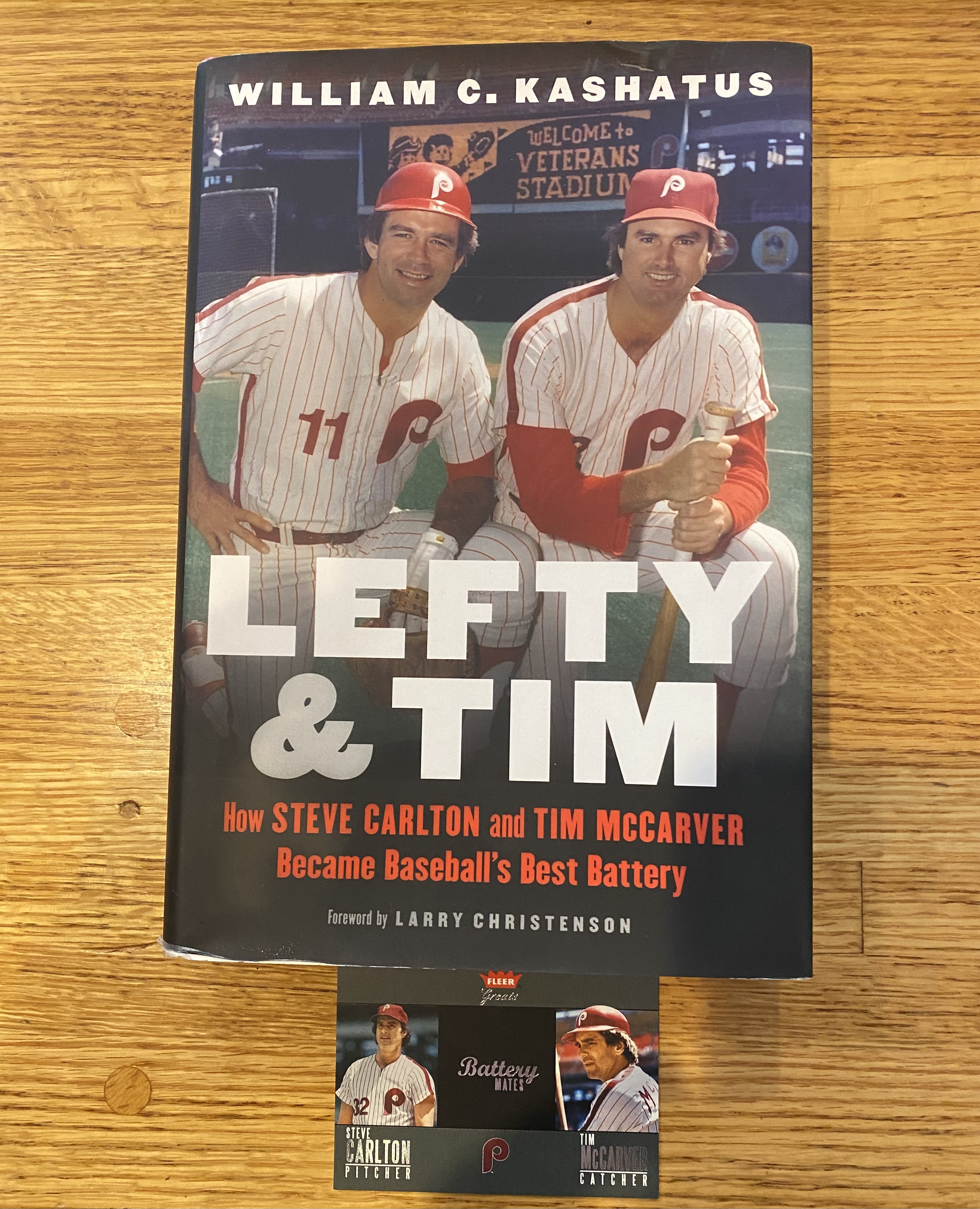
Cover of Lefty & Tim, by William C. Kashatus, 2022. With 2004 Fleer baseball card of Steve Carlton and Tim McCarver. (Photo by Mark C. Taylor)
 
Historian and author William C. Kashatus.


Steve Carlton was one of the best pitchers in baseball history. Carlton won 329 games, the 2nd highest total for a left-hander. He struck out 4,136 batters—a record for left-handers at the time he retired in 1988. Carlton was the first pitcher to win 4 Cy Young Awards, and he set a record for most strikeouts in a game when he fanned 19 Mets in 1969. Carlton, known by his nickname of “Lefty,” was a first ballot Hall of Famer, easily elected in 1994 when he was named on 95.82% of the ballots. Throughout his career, Carlton was known for his unorthodox training regimen, which included martial arts exercises, and for his silence with the media.  

William C. Kashatus’ 2022 book Lefty & Tim: How Steve Carlton and Tim McCarver Became Baseball’s Best Battery, examines the careers of Carlton and Tim McCarver, who became Carlton’s “personal catcher” with the Phillies from 1975-1979. The connection between McCarver and Carlton began in 1965 with the St. Louis Cardinals. Carlton was a rookie: 1964 was his first year in professional baseball. McCarver, only 3 years older than Carlton, was already well-established as a major leaguer. He had made his MLB debut at the tender age of 17 in 1959, and by 1963 he was the Cardinals’ starting catcher. McCarver was a hitting star of the 1964 World Series, appearing in all 7 games and hitting .478 as the Cardinals beat the New York Yankees.  


Carlton and McCarver were both stubborn men. Carlton wasn’t impressed by McCarver’s status, as he approached the catcher during spring training and said to him “Hey, you’ve gotta call for more breaking pitches when we’re behind in the count.” McCarver yelled at Carlton for having the gall to question his pitch calling. Carlton calmly walked away. The next day, McCarver apologized to Carlton for chewing him out. Carlton accepted McCarver’s apology and said, “I wasn’t listening anyway.” (Lefty & Tim, p.32-3)  


Despite this rocky beginning to their relationship, Carlton and McCarver soon became good friends, and McCarver was behind the plate during 1967, 1968, and 1969 as Carlton established himself as one of the best young pitchers in baseball. McCarver had another stubborn ace pitcher to deal with on the staff of the St. Louis Cardinals: Bob Gibson. McCarver and Gibson had clashed early on, but eventually came to a terrific understanding of one another, both as baseball players and as human beings. Gibson was also influential on Steve Carlton’s development as a pitcher. Gibson was no-nonsense on the mound. The mound was his office, and you didn’t mess with Gibson in his office. To Gibson, opposing hitters were the enemy. They were not to be fraternized with. Carlton developed the mental attitude to act the same as Gibson did on the mound.  


Carlton was known for his long silence with the media, so he might seem like an unlikely candidate for a biography. There have been two books written about Carlton’s amazing 1972 season, when he won 27 games for the last-place Philadelphia Phillies, but Kashatus takes a wider view of Carlton’s career. Kashatus got a lot of information from Carlton off the record, but ultimately, Lefty decided not to do any on the record interviews for the book. It’s a shame, because it would be fantastic to have Carlton’s story in his own words, but Kashatus did a terrific job of writing Lefty & Tim, even without the participation of one of the two subjects. (And besides, the garrulous McCarver, who did several interviews with Kashatus, probably did enough talking for two people.)  


Kashatus has done an excellent job of combing through the historical record to find good quotes from Carlton in the interviews he has done. The myth is that Steve Carlton never talked to the press, but that’s not true. Carlton gave plenty of interviews from 1965 until 1977, and even during his media silence from 1977 to 1986, Lefty still did the occasional interview here and there.  


Carlton began his career with an excellent fastball and curveball, and in 1969 he added a devastating slider. Carlton threw the slider from the same arm slot as his fastball, which meant that batters couldn’t tell which pitch was coming. Lefty’s slider broke down and in on right-handed batters, and down and away on left-handed batters. Standing 6 foot 4 and weighing 210 pounds in his prime, Carlton was strong enough to throw the slider without putting strain on his elbow.  


Lefty had one of the greatest seasons a starting pitcher has ever had in 1972, when he won 27 games and claimed his first Cy Young Award. But from 1973-1975, Carlton’s won-loss record was 44-47. But things were about to change. In mid-1975, the Phillies reacquired McCarver, after he was released by the Red Sox. The Phillies had one of baseball’s great defensive catchers in Bob Boone, but Boone and Carlton had different theories about pitch calling. Slowly, McCarver started to catch all of Carlton’s starts.  


Bob Boone had introduced Carlton to strength and martial arts coach Gus Hoefling, and the strenuous workouts helped improve Carlton’s performance on the mound. One of the best-known exercises called for Carlton to stick his left arm into a barrel of rice and try to work his hand down to the bottom of the barrel. Phillies starter Jim Lonborg, plagued by elbow problems, tried the rice workout and never had elbow issues again. Hoefling’s training also focused on the mental aspect of sports. One day, fellow starting pitcher Larry Christenson saw Carlton lying on the trainer’s table before a start with his eyes closed. Christenson asked Lefty what he was doing. Kashatus writes that Lefty’s response was that “he was visualizing the spin on his slider and how he was planning to throw it against the various batters in the opposing team’s lineup that night.” (p.186) 


After the 1975 season, Carlton’s lifetime record stood at 148-119, for a winning percentage of .554. From 1976 through the 1984 season, Carlton’s record was 165-88, for a winning percentage of .652. Carlton won 20 games 4 times from 1976-1982, and he won 3 more Cy Young Awards. The Phillies also turned into a powerhouse, making the playoffs 6 times from 1976-1983, culminating in the team winning their first World Series in 1980.  


Lefty & Tim will serve as the definitive book about how Steve Carlton became one of the most dominant pitchers of his era. Lefty & Tim also makes a compelling case for Tim McCarver’s reputation as a great handler of pitchers, and as a superbly intelligent student of baseball. Kashatus has interviewed many people close to Carlton and McCarver to create a comprehensive account of their baseball careers. If you’re a fan of either Steve Carlton or Tim McCarver, you should read Lefty & Tim.