Showing posts with label books about baseball. Show all posts

Monday, January 12, 2026

Book Review: The Natural, by Bernard Malamud (1952)


Bernard Malamud’s 1952 novel The Natural, about baseball player Roy Hobbs and his magical bat Wonderboy, is a very different piece of art from the 1984 movie starring Robert Redford. While the movie is ultimately a heroic story of triumph and success, Malamud’s novel is a bleak satire of America.  

A friend of mine had read The Natural shortly after reading The Great Gatsby, and it struck him at the time that both novels were about the emptiness of the American Dream. I read The Natural last spring, and shortly after finishing it, I re-read The Great Gatsby, and I agree, there are definitely similarities between the two novels. I don’t know that Malamud was specifically influenced by Fitzgerald, but certainly both authors were approaching their material from a similar philosophical standpoint.  

The Natural is really a myth, a fable, a story that exists on a heightened plane of realityThat’s the charm of the novel, but it also makes it hard to relate to the characters. I never felt much affinity for the Roy Hobbs of the novel, as he is an inarticulate lunkhead 

As a baseball fan, it’s always fun to read novels that are set in the baseball world. Although Roy Hobbs’ stunning success at baseball is unrealistic. But we are in a fable, after all. And perhaps the fable-like setting is the reason for this huge error: Malamud describes the fictional New York Knights, a National League team, playing a night game in Chicago against the Cubs. A night game at Wrigley Field in 1952? No way that could happen! As every baseball fan knows, Wrigley Field was the last major league baseball stadium to have lights—the first night game at Wrigley didn’t happen until 1988. But maybe The Natural exists in a reality where Wrigley Field added lights in the 1940’s, like every other baseball stadium.  

The Natural is a bleak novel, and it holds out little hope for heroes. Perhaps that’s the point Malamud is making—that we should not try to make our sports figures heroes or models for living. As the great pitcher Bob Gibson once said, “Why do I have to be an example for your kid? You be an example for your own kid.” Great advice. Certainly, the Roy Hobbs of the novel is not someone to emulate.  

Malamud’s novel is a fascinating look at America seen through the lens of its national pastime.  

Wednesday, June 19, 2019

Book Review: Split Season: 1981, by Jeff Katz (2015)

Cover of Split Season: 1981, by Jeff Katz, 2015.


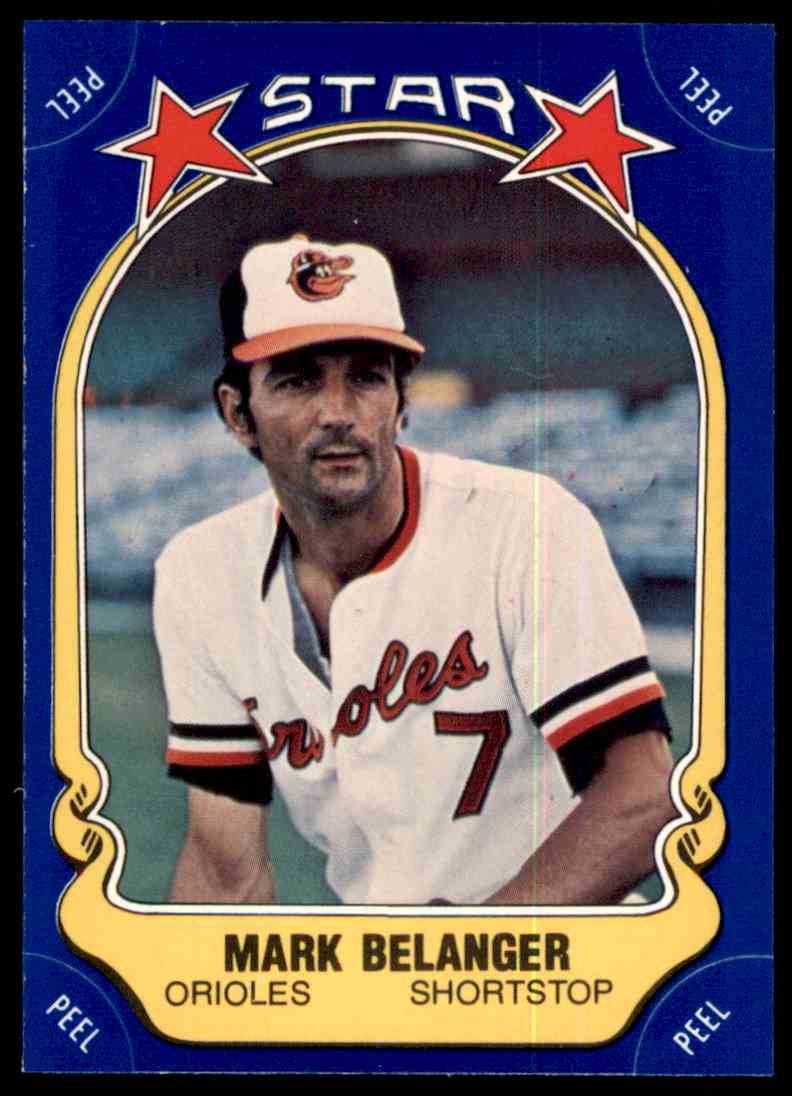
Mark Belanger's 1981 Fleer Star Sticker card. Belanger was a union representative and very involved in the protracted negotiations during the strike. He was also one of the best fielding, and worst hitting, shortstops of all time.

My favorite baseball player, Steve Carlton, had an excellent year in 1981, going 13-4 with a 2.42 ERA and winning his only Gold Glove.
1981 was a difficult year for baseball, as a strike by the players wiped out almost two months of the season. As someone who was born in 1981, it’s always annoyed me that because most teams played around 107 games that year, the stats from my birth year look so paltry. Mike Schmidt led the majors in RBIs with 91no pitcher won more than 14 games. As a kid flipping through my baseball cards, I would compare players’ stats from 1981 to what they did in other years and inevitably I’d end up disappointed. No one had their best season in 1981. I suppose the silver lining is that the strike was settled in time for the postseason, so there was actually a World Series the year I was born.

Jeff Katz’s 2015 book Split Season: 1981Fernandomania, the Bronx Zoo, and the Strike that Saved Baseball examines the year in question in great detail. Katz does a fine job recapping the highlights and lowlights of the season. A limitation of the book is that the details of the strike are very complicated and not that interesting. And that’s coming from a baseball fan, so I can’t imagine that many people who aren’t hardcore baseball fans would read this book. Basically, the key issue was that the owners wanted compensation for teams who lost players who signed as free agents with other teams. The players’ union saw that as an attempt to fundamentally weaken the free agent system. The strike was ultimately settled with the owners winning a small concession from the players as a complicated compensation system was adopted. 

When the strike was settled and the 1981 season continued, the dubious decision was made to split the season in two halves: before the strike and after the strike. The teams who were leading their divisions when the strike began were guaranteed a playoff spot, and they would play the winner of the second half of the season. Not surprisingly, with nothing to play for, none of the first half winners also won the second half. This harebrained scheme also ensured that the two teams in the National League with the best records, the St. Louis Cardinals and the Cincinnati Reds, didn’t make the playoffs, because they didn’t win either half of the season. 

Katz is insightful when writing about the four players who were deeply involved in the ongoing negotiations between the players and the owners: catcher Bob Boone, pitcher Steve Rogers, third baseman Doug DeCinces, and shortstop Mark Belanger. Katz interviewed Rogers and DeCinces for his book, and he paints interesting portraits of these four athletes. 

Mark Belanger in particular comes off as a really interesting person. As a baseball player, Belanger is famous for being perhaps the ne plus ultra of a “good field, no hit” shortstop. Belanger played in more than 2,000 games over 18 years, and ended up with a batting average of just .228. However, Belanger won 8 Gold Gloves for fielding excellence, and sabermetric stats paint a picture of him as one of the finest defensive shortstops ever. Baseball-Reference ranks Belanger second all-time in defensive WAR, just ahead of his longtime infield mate, third baseman Brooks Robinson. In a statistic called Total Zone Runs, which I’m not smart enough to attempt to explain, Belanger ranks as the second best defensive shortstop since 1953, behind Ozzie Smith. 

Belanger’s playing career ended after the 1982 season, and after he retired he worked for the players’ union. He died from lung cancer in 1998, at the age of 54. In the 2001 edition of The New Bill James Historical Baseball Abstract, James writes of Belanger’s time working for the union: “He had three books on his desk: a baseball encyclopedia, Marvin Miller’s autobiography, and Don Baylor, by Don Baylor.” (p.624) I don’t know how Bill James knew this, but it’s a fun fact. The first two books make sense to me, but Don Baylor’s autobiography? It seems like a very random choice. However, Belanger and Baylor were teammates on the Orioles from 1970 to 1975, so maybe Belanger enjoyed revisiting his own glory days with the Orioles. I read Don Baylor’s autobiography when I was a little kid and I remember enjoying it, although I couldn’t tell you anything specific about it. It’s never been one of the top three books on my desk.

Katz presents the strike as something of a black and white struggle. It’s very clear he’s on the player’s side, rather than the owners. There’s nothing really wrong with that, but for Katz there cannot be a greedy player or a sympathetic owner, which robs the book of complexity. 

Katz’s book would have improved with stronger editing. Some examples of awkward phrasing and sloppy writing are the following:

“{Bowie} Kuhn came from an immigrant background. Alice Waring Roberts’s family arrived in 1634, sailing from England to Maryland.” (p.23) Well, yes, we’re all immigrants, unless you’re Native American, but did Alice Waring Roberts’s arrival 292 years before Bowie Kuhn’s birth really have much of an impact on how he saw himself?

Katz describes Ted Simmons’ status as a “ten and five” man, meaning that he had been in the majors for ten years, and spent the last five years with the same team. As the St. Louis Cardinals wanted to trade Simmons to the Milwaukee Brewers, Katz writes that Simmons “had control of the situation.” (p.39) What Katz doesn’t tell us is that as a “ten and five” man, Simmons had the right to veto any attempt by the Cardinals to trade him. To understand the control Simmons had in that situation, you need to know that fact, which Katz doesn’t provide. 

There are other passages that are much sharper, such as Katz writing that Cliff Johnson “looked like a giant walrus in cleats.” (p.59) Katz also does well chronicling the larger-than-life personalities of Billy Martin and George Steinbrenner: “Like Steinbrenner, Martin was unaware of irony.” (p.80) So true!

Unfortunately, Split Season: 1981 commits what I consider to be a fundamental error for a non-fiction book: there are no footnotes or endnotes. There’s a bibliography, but there’s no way to tell where quoted material comes from. I really don’t understand why major publishers allow non-fiction books to be published without footnotes or endnotes. I know, the majority of people don’t care, but the omission severely limits the usefulness of a book as a historical document.

Saturday, December 27, 2014

Book Review: Hustle: The Myth, Life, and Lies of Pete Rose, by Michael Sokolove (1990)


Cover of Hustle, by Michael Sokolove, updated 2005 edition.


Pete Rose, after breaking Ty Cobb's all-time hit record. Padres first baseman Steve Garvey is behind him.

Pete Rose during his brief tenure as a Montreal Expo, 1984. Seeing him in an Expos uniform is just weird.
Pete Rose is a jerk who bet on baseball. That’s the conclusion I’m left with at the end of Michael Sokolove’s excellent 1990 book Hustle: The Myth, Life, and Lies of Pete Rose. Although Sokolove’s book is nearly twenty five years old, and appeared just a year after Rose was handed down a lifetime ban from baseball, it’s still an impressive piece of journalism. Sokolove did his homework, as he interviewed 112 people in the course of writing Hustle, and the book thoroughly covers Rose’s life and career. Hustle was reissued in 2005 with a new introduction, which covers Rose’s 2004 admission that he did bet on baseball.  Sokolove writes of Rose’s behavior in 2004, “In the broadcast interviews he gave to promote the book, he could barely bring himself to express what sounded like true remorse. Sometimes he complained that he just wasn’t very good at saying he was sorry-a trait common in people who actually aren’t sorry.” (p.7) 

I recently read Kostya Kennedy’s excellent 2014 book on Rose, Pete Rose: An American Dilemma, and while Kennedy’s book takes Rose’s story up to date, Sokolove’s Hustle is a more in-depth look at Rose’s gambling on baseball. Hustle is essential reading for any baseball fan. 

Sokolove is tough on Rose, but the book is by no means a hatchet job. With that being said, I don’t know how anyone could read Hustle and still be on Rose’s side. Looking back, it’s rather ridiculous that Rose kept denying he bet on baseball until finally admitting it in 2004. 

One of the best chapters in Hustle is “Playing the Press,” which details how Rose was able to keep sportswriters writing positive stories about him until the gambling scandal broke in 1989. Rose’s friendliness with sportswriters might have been a reason why sportswriters never wrote about Rose’s gambling problem until after the scandal began to break. Sportswriters loved Pete Rose, and even a baseball writer as smart as Bill James was an apologist for Pete Rose. In his 2001 book The New Bill James Historical Abstract, James spends six pages attacking the Dowd Report and casting doubt on the evidence that Rose bet on baseball. Of course, read today, it makes James sound foolish. It also makes it clear that James didn’t read Hustle.

Sokolove also details that major league baseball knew that Rose had a gambling problem long before 1989. Baseball had been investigating Rose since the early 1970’s, and while their investigation didn’t show that Rose was betting on baseball, it was clear that he was a big racetrack gambler. As Sokolove writes, “Before Rose was even halfway to Cobb’s hit record, the office of baseball commissioner Bowie Kuhn had identified him as a problem gambler-and a probable violator of the game’s rules against gambling ‘associations.’” (p.199) For whatever reason, major league baseball didn’t want to touch Pete Rose, perhaps because of his standing as one of the most popular players in the game. However, Bowie Kuhn, commissioner of baseball from 1969-1984, was very tough on star players connected to gambling, as he handed down a three month suspension to pitcher Denny McLain in 1970 for associating with gamblers. Kuhn also handed out lifetime bans to living legends Willie Mays in 1980 and Mickey Mantle in 1983 for merely being greeters at casinos. Mantle and Mays were both reinstated by new commissioner Peter Ueberroth in 1985, perhaps the most popular decision any commissioner has ever made. So why wasn’t Kuhn tougher on Rose? If baseball was willing to act against Denny McLain, who was coming off of back to back Cy Young Awards, why didn’t baseball act against Pete Rose? There’s no easy answer to that question.

Throughout Hustle, Sokolove details the many ways in which Pete Rose didn’t expect the rules of life to apply to him. Rose lived a selfish life, with little regard for what the consequences might be. When those consequences never came, Rose was further emboldened in his bad behavior. One of the most shocking revelations of Hustle was the fact that Rose would never fully repay his gambling debts. When he began losing too much, he merely moved on to another bookie. Rose was lucky he never ended up with a broken hand from an irate bookie. Sokolove writes about Rose: “Rose continues to rail against the Dowd Report and major league baseball’s treatment of him because he truly believes he was treated unfairly. He wasn’t. He was treated, for the first time, like an adult, which was so unfamiliar to him that he mistook it for unfairness.” (p.291)

 Sokolove also understands the contradiction of Pete Rose, and other athletes: that a man can be a great baseball player and at the same time be a terrible human being. Rose went to jail in 1990 for income tax evasion, and Sokolove writes in the afterword of the book, “What Pete Rose leaves to the game he loved, his legacy, is not romance but a disquieting reality: A man can belong both in the Hall of Fame and in federal prison.” (p.292) 

I used to be more ambivalent about Pete Rose. I was 8 years old when he was banned from baseball. I knew that he was a great player, but I didn’t really have an opinion on whether or not he bet on baseball. As I got older, I assumed he probably had because why else would he have accepted the lifetime ban? When I was in college, around 1999 or 2000, I remember reading an article on Sports Illustrated’s website about the Dowd Report, and wanting the evidence that Rose had bet on baseball to be more compelling. Then when Rose finally admitted in 2004 that he did bet on baseball, I was disappointed in him for lying for so long. I remember watching Rose on “The Tonight Show” in 2004 and thinking to myself, “He just doesn’t understand that he did anything wrong, he doesn’t get it.” I softened a little on Rose when I watched his stupid reality show, “Hits and Mrs.” in 2013. But reading Hustle has made up my mind firmly on Pete Rose: he doesn’t deserve to be reinstated and let back into baseball. If and when Pete Rose ever truly changes his ways, maybe he can get back into baseball. But until then, he will remain on the outside looking in.

Friday, December 19, 2014

Book Review: Pete Rose: An American Dilemma, by Kostya Kennedy (2014)


Cover of Pete Rose: An American Dilemma, by Kostya Kennedy, 2014.


Pete Rose collecting hit number 4,192, breaking Ty Cobb's all-time record, September 11, 1985.

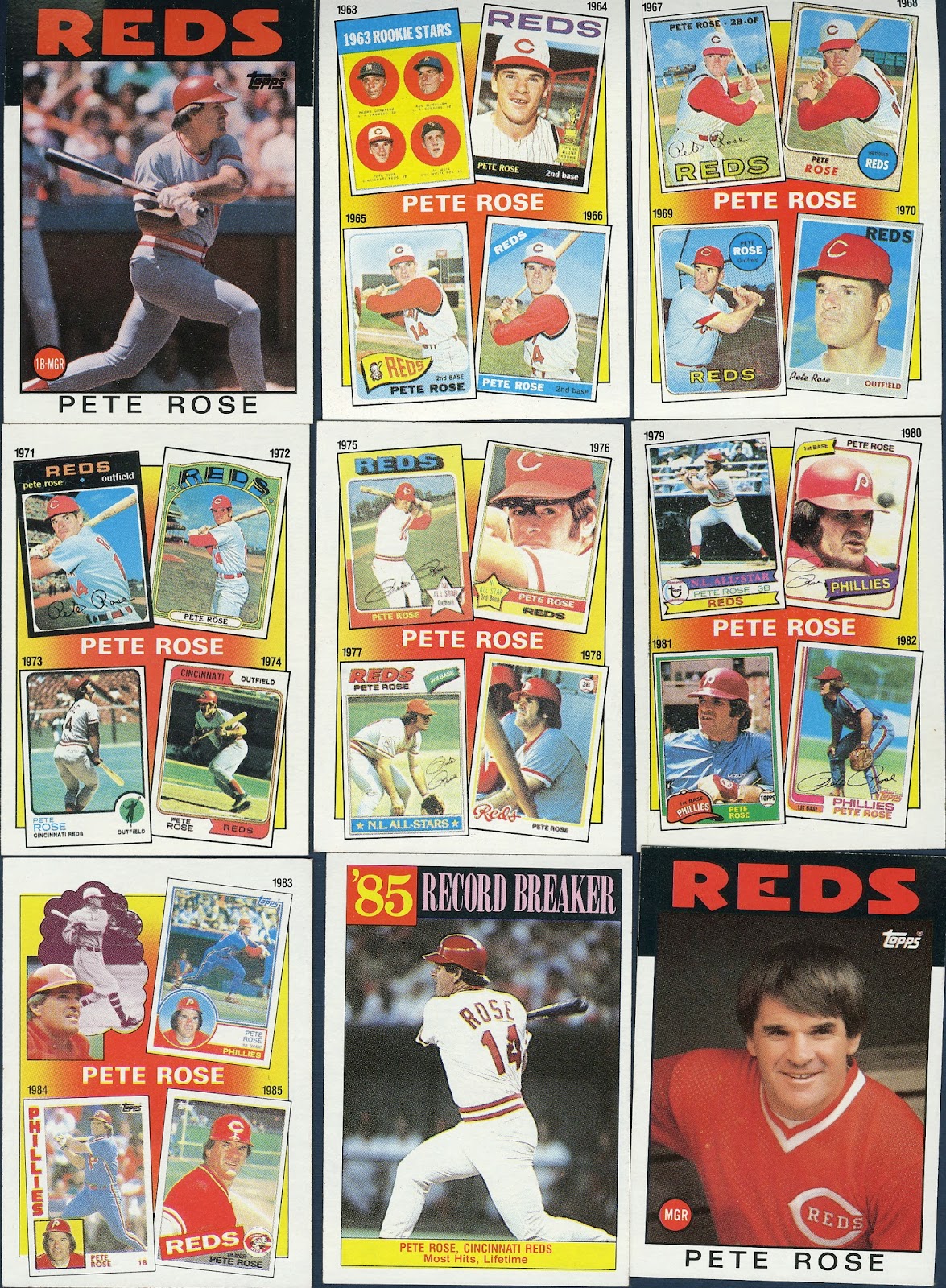
Special Topps cards from 1986 commemorating Rose passing Ty Cobb.

Pete Rose playing for the Phillies, illustrating why he was nicknamed "Charlie Hustle."

Rose during his brief stint with the Montreal Expos in 1984. He collected his 4,000th hit with the Expos.
Pete Rose is baseball’s all-time leader in hits, games, at-bats, and plate appearances. He’s 6th all-time in runs scored, 2nd in doubles, and 7th in total bases. Rose led the league in hits 7 times, doubles 5 times, runs scored 4 times, won 3 batting titles, was the 1963 NL Rookie of the Year, and the 1973 NL MVP. He was a 17-time All-Star, and made the All-Star team at 5 different positions, a record that will most likely never be broken.

Pete Rose played in his last major league game in 1986 and has been banned from major league baseball since 1989, yet he might still be baseball’s most divisive figure. Lots of ink has been spilled over Rose in the past 25 years, and Kostya Kennedy’s 2014 book Pete Rose: An American Dilemma, is the latest attempt to dissect the life and career of baseball’s all-time hit leader.  

Kennedy does a good job of analyzing the different parts of Rose’s life, with detours into the history of Cincinnati, and Pete’s relationship with his brother Dave. A highlight of the book was the section on the baseball career of Rose’s son Pete Rose Jr., who played professional baseball from 1989 until 2009, accumulating just 16 plate appearances and 2 hits in the major leagues in 1997. Like his father, Rose Jr. is a player with a tremendous work ethic. Pete Rose Jr. is now a manager in independent baseball, continuing his love affair with the game.
 
Pete Rose: An American Dilemma assumes a great deal of familiarity with Rose’s playing career, as it jumps around in chronology and doesn’t cover every year of Rose’s 24-year playing career. I was already quite familiar with Rose’s career, but I wish the book had provided more context for Rose’s remarkable accomplishments. 

Throughout the book, Kennedy never really comes down on one side or the other, for or against Rose. Does he think Pete Rose should be in the Hall of Fame? Does he think that Pete Rose should be reinstated? Kennedy never really says. Kennedy is harsh on Rose throughout the book, yet he clearly feels that the Hall of Fame’s treatment of Rose was unfair when it singled him out and changed the rules in 1991 so he wouldn’t appear on the ballot. The new rule stated that anyone on baseball’s ineligible list could not appear on the ballot for the Hall of Fame. Since Rose was the only player on the ineligible list, the rule change was obviously targeted at him. The Hall of Fame clearly didn’t want to deal with the possibility of Rose being voted into the Hall of Fame while at the same time being banned from baseball, which seems like the biggest oxymoron imaginable. 

Pete Rose’s behavior since 1989 is oftentimes incomprehensible to rational people. When it became clear during Major League Baseball’s investigation of his gambling habits that Rose would be banned, Rose and his lawyers fought for a paragraph in the document banning Rose that said he neither admitted nor denied having bet on baseball. This was a ridiculous assertion to make, and I don’t understand why then-Commissioner Bart Giamatti allowed such unclear language into the final document. If Rose wasn’t admitting that he bet on baseball, why was he being banned? If Rose hadn’t bet on baseball, why did he accept the ban? Major League Baseball should have forced Rose to admit in 1989 that he did bet on baseball. Instead, Rose lied for 15 years, not telling the truth and admitting that he bet on baseball until the release of his 2004 autobiography, My Prison Without Bars.
 
If Pete Rose were a smarter guy he might have been reinstated and be back in baseball by now. But I think he’s a dumb guy who really doesn’t understand what he did wrong. He knows that he broke the rules, but he’s never seemed ashamed that he broke the rules. As Kennedy says, Rose isn’t sorry for what he did, he’s only sorry that he got caught. Rose’s half-hearted apologies have never seemed sincere. 

In my opinion, in order to have any chance of getting back into baseball, Rose needed to do three things:

1. Come clean and tell the whole truth about betting on baseball
      2. Apologize for betting on baseball
      3. Stay as far away from gambling as possible

Rose has failed miserably at those three tasks, as he didn’t tell the truth or apologize until 2004, and he spends most of his time in Las Vegas, signing autographs at memorabilia shops. But signing his name for money has proven to be most lucrative for Rose, as according to Kennedy, Rose pulls down a guaranteed income of $70,000 a month in Las Vegas. Rose also might not have told the whole truth in 2004, when he said he bet on baseball “four or five times a week.” He amended that to saying in 2007 that he bet on baseball “every night.” Is there anything else Rose is saving for his next book?

Pete Rose is a contradiction. On one hand, he seems guileless, unflinchingly honest, and yet he lied about betting on baseball for 15 years. During his playing career, Rose was extremely savvy about cultivating his image as “Charlie Hustle,” by always running to first base on a walk, and always sliding into bases headfirst, whether it was necessary or not. But since he was banned from baseball, Rose seems tone-deaf to how he comes off to the public. 

Part of me likes Pete Rose. He was a great baseball player, someone who gave it his all out there on the field every single day he played. I met Pete Rose at a baseball card show to get his autograph, and he seemed like a nice guy in the thirty seconds I talked to him. I even watched his terrible reality show on TLC, “Hits and Mrs.” But he’s also a jerk who bet on baseball and doesn’t really seem to get why that’s such a big deal. And that’s the contradiction of Pete Rose. I think that Rose deserves to be in the Hall of Fame as a player, but I don’t think Rose should be in the Hall of Fame as long as he’s banned from baseball. I know that the Hall of Fame and Major League Baseball are different organizations, but for me, personally, if you’re banned from one, why should you be in the other?

If you’re interested in Pete Rose’s baseball career, and his post-baseball life, you should read Pete Rose: An American Dilemma. It’s a great introduction to one of baseball’s most controversial figures.