Showing posts with label cincinnati reds. Show all posts

Tuesday, October 1, 2024

Pete Rose 1941-2024

Pete Rose, sliding in headfirst, as always.

Baseball’s Hit King, Pete Rose, died yesterday at the age of 83. Pete Rose was one of the greatest players in baseball history, as well as one of the most controversial. Rose has been the MLB hit leader for 39 years, and 
it’s safe to say that his record of 4,256 hits will stand for many more years. The controversy surrounding Rose will last for many more years too, as fans and historians will debate if he belongs in the Hall of Fame after his 1989 ban for betting on baseball.
 

As a player, Pete Rose obviously belongs in the Hall of Fame. His accomplishments are amazing. Rose was a 17-time All-Star (a fun Minnesota connection—his first All-Star appearance was at Metropolitan Stadium in 1965, and his last All-Star appearance was at the Metrodome in 1985) he made the All-Star team at 5 different positions, (second base, left field, right field, third base, and first base) a record that will be impossible to break. Has anyone else even matched Rose’s accomplishment of being an All-Star at 3 different infield positions? Rose was a 3-time batting champion, and he finished in the top ten of batting average 13 times. He was the 1963 NL Rookie of the Year, and the 1973 NL MVP. Rose was a .321 hitter in the postseason, and he appeared in 6 World Series, winning the 1975 World Series MVP. Rose led the league in runs scored 4 times, in hits 7 times, and in doubles 5 times. Not known as a power hitter, Rose is second all-time in doubles, with an incredible total of 746.  

As a person, Pete Rose falls short of the Hall of Fame. Rose bet on baseball, and while no one ever accused him of throwing a game or giving less than his full effort on the field, it’s still a cardinal sin in baseball. I think it’s ridiculous that Rose didn’t just come clean in 1989 and confess that he had bet on baseball. Instead, he lied about betting on baseball for 15 years, before finally admitting the truth in a 2004 book. As a kid, that always confused me. If Rose didn’t bet on baseball, then why did he accept the ban from baseball? If he didn’t bet on baseball, then why didn’t he fight the ban? It’s a bit like Richard Nixon accepting Gerald Ford’s pardon after he resigned in 1974. I’m not going to say I did anything wrong, but I’ll accept this pardon just in case I may have done something wrong.  

But Rose fooled a lot of people for a long time, and even a baseball writer as smart as Bill James was an apologist for Pete Rose. In his 2001 book The New Bill James Historical Abstract, James spent six pages attacking the Dowd Report and casting doubt on the evidence that Rose bet on baseball. Of course, read today, it makes James sound foolish. 

You can admire Pete Rose’s grit, his tenacity, his hustle, and still find him lacking as a human being. If Rose had truly reconstituted his life in 1989 and lived the rest of his life after his ban from baseball the way, say, Stan Musial lived his life, maybe Rose would have seen the ban lifted. But he didn’t live his life that way, because he was Pete Rose. How could he do anything wrong?  

I was born in 1981, the year that Rose passed Stan Musial for the National League hit record. (Back in the day, records for each league had more importance than they do today.) Rose was an icon from the moment I became a baseball fan. To anyone slightly older than I am, Pete Rose was a huge symbol of baseball. You could argue that Pete Rose and Reggie Jackson were the two most iconic baseball players of the 1970’s. They were opposites, Reggie the powerful home run slugger, Rose the dedicated contact and average hitter. But they both captured the media’s attention and became stars.  

Back in 2015, Rose applied for reinstatement, hoping that Rob Manfred would be more receptive to his case than Bud Selig ever was. Rose was wrong. Reading Manfred’s statement is illuminating of the kind of person Pete Rose was. In true Rose fashion, he told Manfred he didn’t currently bet on baseball, and then backtracked later in his interview to say he does still bet on baseball. 

Rose still generates conversation, 35 years after his ban from baseball. When I was in Cooperstown with my family this summer, Pete Rose was there, signing autographs. We talked to a guy who had eaten breakfast at the same place Rose did. He said that one morning, Pete was facing away from the door, and he figured Rose didn’t want people to bother him, but the next morning, he was sitting facing out to the restaurant, so this guy said hi to Pete and ended up having a nice conversation with him for 10 minutes about baseball. We had breakfast at that restaurant the next morning, but we didn’t see Pete there. We did see Rose at the Safe at Home memorabilia store in Cooperstown. I didn’t pay for an autograph, but we at least saw Pete, although the store had practically blockaded him, I assume to keep people like us from just looking at Pete for free. Rose looked good when I saw him. He looked like, well, how Pete Rose always did.  

I also had a conversation about Pete Rose with a guy who was staying at the same motel. Like most people, this guy thought Rose should be in the Hall of Fame. I’m torn, because I do believe that Rose deserves to be in the Hall of Fame as a player. But I also believe that Rose bet on baseball, and he accepted the ban, and he really didn’t do much to change his ways after 1989. I do think it’s a positive sign that people wanted Pete Rose back in baseball—people were not full of hatred and retribution towards Pete Rose. And even though I might seem harsh on Rose, there’s part of me that still likes him. He was a great player. He loved playing the game, and he played all-out, every single day. Pete Rose is so close to being the perfect role model. So close, and yet so far. Maybe that’s the moral of Pete Rose, that he was so talented, so gifted, but he had fatal flaws as well. He was human.  

Friday, February 8, 2019

Frank Robinson 1935-2019

Frank Robinson, about to crush some homers for the Baltimore Orioles.

One of the very best players in baseball history passed away yesterday. The great Frank Robinson was 83 years old. Throughout his long playing career, Robinson amassed numerous awards: Rookie of the Year, NL MVP, AL MVP, Triple Crown winner, 2-time World Series champion, first ballot Hall of Famer. Robinson also became baseball’s first African American manager, leading the Cleveland Indians in 1975. Robinson hung up his spikes after the 1976 season, but he remained in baseball his entire life, later managing the Giants, Orioles, and the Expos/Nationals. 

Robinson brought an intense competitive spirit to the diamond. Sportswriter Jim Murray memorably wrote that “Robinson always went into second like a guy jumping through a skylight with a drawn Luger.” (Needless to say, if he were still playing, Robinson would have some issues with the Utley Rule.) I’ve always felt that Frank Robinson was an underrated player. I know that sounds ridiculoushow can someone hit 586 home runs and be underrated? I think Robinson was somewhat overshadowed by Hank Aaron and Willie Mays. It’s really unfair to compare anyone to Hank Aaron and Willie Mays, and while Robinson falls short in the WAR comparison, at 107.3, compared to Aaron’s 143 and Mays’ 156.4, his slash line is very similar. (All stats according to Baseball-Reference.com)

Robinson: .294/.389/.537 OPS .926 OPS+ 154
Aaron: .305/.374/.555 OPS .928 OPS+ 155
Mays: .302/.384/.557 OPS .941 OPS+ 156

The lowest OPS+ that Robinson ever put up was 104, in his final season, 1976, in which he played just 36 games. His next lowest OPS+ was 118, in 1958. Robinson had one of the greatest single-seasons ever in 1966. In December of 1965, Robinson was traded from the Cincinnati Reds to the Baltimore Orioles for Milt Pappas, Jack Baldschun, and Dick Simpson. (Side note: Milt Pappas was actually a pretty good pitcher. He won 209 games and came within a strike of pitching a perfect game in 1972.) All Robinson had done for the previous decade was obliterate National League pitching, so why were the Reds dealing him? Well, in the words of General Manager Bill Dewitt, Robinson was “an old 30.” These words no doubt added fuel to Robinson’s already substantial competitive fire. In his first year with the Orioles, Robinson won the Triple Crown, leading the American League in home runs, RBI, and batting average. Not content to merely dominate the league in three prime statistical categories, Robinson also led the league in runs scored, on base percentage, slugging percentage, OPS, OPS+, total bases, and sacrifice flies. Robinson won the AL MVP, making him the first and only player to date to win the award in both leagues. The Orioles won the American League pennant that year, and faced the heavily favored Los Angeles Dodgers in the World Series. The Dodgers had a formidable 1-2 pitching punch with Sandy Koufax and Don Drysdale. However, the Orioles swept the Dodgers in four games. The score of Game 4? 1-0. How did the Orioles score that one run? On a Frank Robinson solo homer off of Don Drysdale. For his timely hitting, Robinson was awarded the World Series MVP. 

I met Frank Robinson once, at a baseball card show in 2013. He was very nice, easy to talk to, but a little intimidating all the same. He made eye contact with me a couple of times as I was standing in lineone guy was having trouble getting his cell phone to take a picture and Frank gave me an exasperated look like “You see what I have to deal with?” I also corrected the guy in front of me when he was talking about Frank’s 573 home runs. As Frank was signing the guy’s photo he looked at it and said, “Look at those guns, wow!” When I met Frank I told him he was one of my favorite players and I wish I could have seen him play. He said “You were born too late! You should have been born 20-30 years earlier. But if you’d been born then, you’d be old now like me.” I told him, “You’re not old,” and he gave me a funny look. I guess what I meant to say was “You’re only as old as you feel,” or something like that. So that was my interaction with the great Frank Robinson. I’m just happy I never had to pitch to him.

Friday, December 19, 2014

Book Review: Pete Rose: An American Dilemma, by Kostya Kennedy (2014)


Cover of Pete Rose: An American Dilemma, by Kostya Kennedy, 2014.


Pete Rose collecting hit number 4,192, breaking Ty Cobb's all-time record, September 11, 1985.

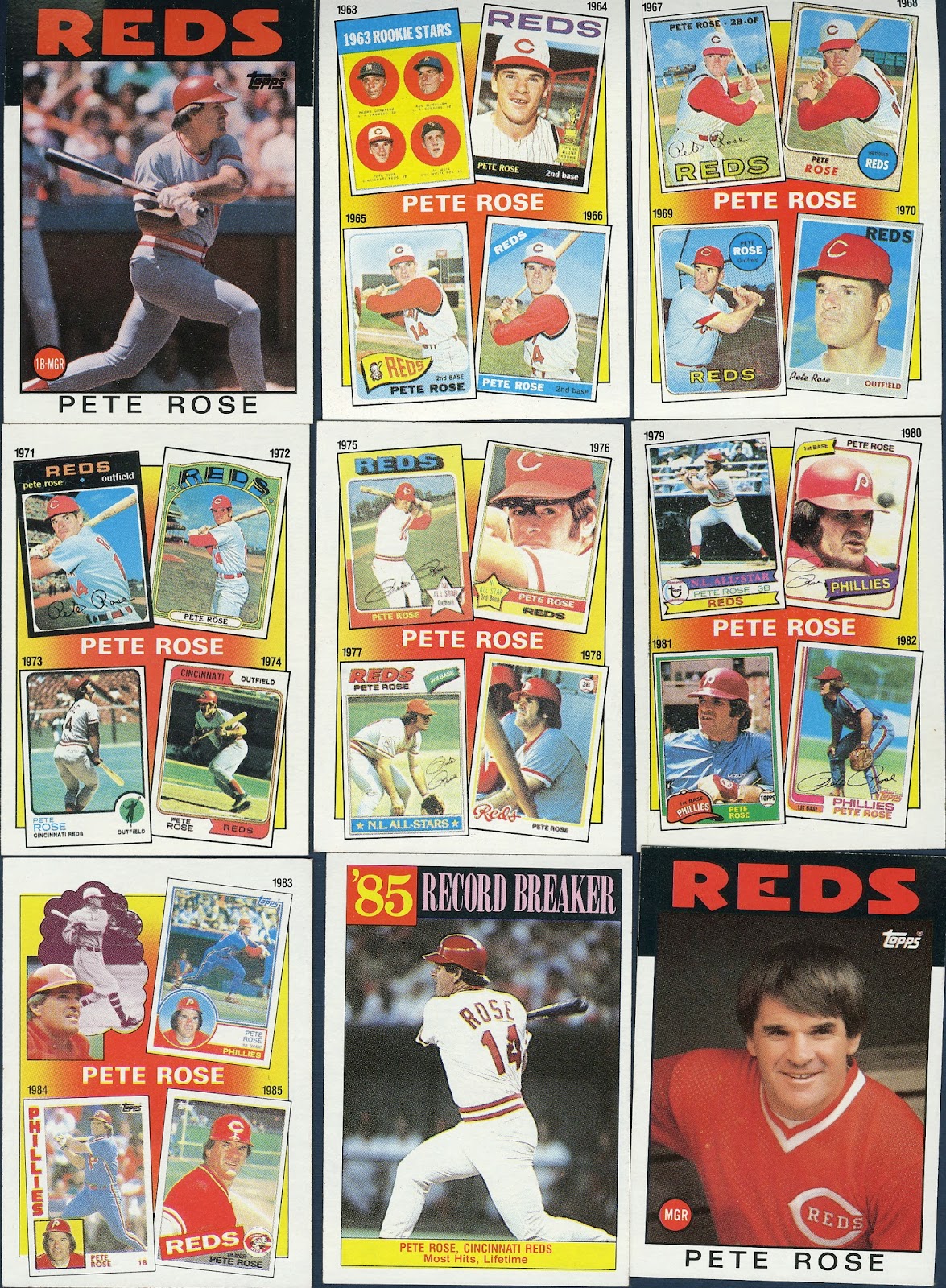
Special Topps cards from 1986 commemorating Rose passing Ty Cobb.

Pete Rose playing for the Phillies, illustrating why he was nicknamed "Charlie Hustle."

Rose during his brief stint with the Montreal Expos in 1984. He collected his 4,000th hit with the Expos.
Pete Rose is baseball’s all-time leader in hits, games, at-bats, and plate appearances. He’s 6th all-time in runs scored, 2nd in doubles, and 7th in total bases. Rose led the league in hits 7 times, doubles 5 times, runs scored 4 times, won 3 batting titles, was the 1963 NL Rookie of the Year, and the 1973 NL MVP. He was a 17-time All-Star, and made the All-Star team at 5 different positions, a record that will most likely never be broken.

Pete Rose played in his last major league game in 1986 and has been banned from major league baseball since 1989, yet he might still be baseball’s most divisive figure. Lots of ink has been spilled over Rose in the past 25 years, and Kostya Kennedy’s 2014 book Pete Rose: An American Dilemma, is the latest attempt to dissect the life and career of baseball’s all-time hit leader.  

Kennedy does a good job of analyzing the different parts of Rose’s life, with detours into the history of Cincinnati, and Pete’s relationship with his brother Dave. A highlight of the book was the section on the baseball career of Rose’s son Pete Rose Jr., who played professional baseball from 1989 until 2009, accumulating just 16 plate appearances and 2 hits in the major leagues in 1997. Like his father, Rose Jr. is a player with a tremendous work ethic. Pete Rose Jr. is now a manager in independent baseball, continuing his love affair with the game.
 
Pete Rose: An American Dilemma assumes a great deal of familiarity with Rose’s playing career, as it jumps around in chronology and doesn’t cover every year of Rose’s 24-year playing career. I was already quite familiar with Rose’s career, but I wish the book had provided more context for Rose’s remarkable accomplishments. 

Throughout the book, Kennedy never really comes down on one side or the other, for or against Rose. Does he think Pete Rose should be in the Hall of Fame? Does he think that Pete Rose should be reinstated? Kennedy never really says. Kennedy is harsh on Rose throughout the book, yet he clearly feels that the Hall of Fame’s treatment of Rose was unfair when it singled him out and changed the rules in 1991 so he wouldn’t appear on the ballot. The new rule stated that anyone on baseball’s ineligible list could not appear on the ballot for the Hall of Fame. Since Rose was the only player on the ineligible list, the rule change was obviously targeted at him. The Hall of Fame clearly didn’t want to deal with the possibility of Rose being voted into the Hall of Fame while at the same time being banned from baseball, which seems like the biggest oxymoron imaginable. 

Pete Rose’s behavior since 1989 is oftentimes incomprehensible to rational people. When it became clear during Major League Baseball’s investigation of his gambling habits that Rose would be banned, Rose and his lawyers fought for a paragraph in the document banning Rose that said he neither admitted nor denied having bet on baseball. This was a ridiculous assertion to make, and I don’t understand why then-Commissioner Bart Giamatti allowed such unclear language into the final document. If Rose wasn’t admitting that he bet on baseball, why was he being banned? If Rose hadn’t bet on baseball, why did he accept the ban? Major League Baseball should have forced Rose to admit in 1989 that he did bet on baseball. Instead, Rose lied for 15 years, not telling the truth and admitting that he bet on baseball until the release of his 2004 autobiography, My Prison Without Bars.
 
If Pete Rose were a smarter guy he might have been reinstated and be back in baseball by now. But I think he’s a dumb guy who really doesn’t understand what he did wrong. He knows that he broke the rules, but he’s never seemed ashamed that he broke the rules. As Kennedy says, Rose isn’t sorry for what he did, he’s only sorry that he got caught. Rose’s half-hearted apologies have never seemed sincere. 

In my opinion, in order to have any chance of getting back into baseball, Rose needed to do three things:

1. Come clean and tell the whole truth about betting on baseball
      2. Apologize for betting on baseball
      3. Stay as far away from gambling as possible

Rose has failed miserably at those three tasks, as he didn’t tell the truth or apologize until 2004, and he spends most of his time in Las Vegas, signing autographs at memorabilia shops. But signing his name for money has proven to be most lucrative for Rose, as according to Kennedy, Rose pulls down a guaranteed income of $70,000 a month in Las Vegas. Rose also might not have told the whole truth in 2004, when he said he bet on baseball “four or five times a week.” He amended that to saying in 2007 that he bet on baseball “every night.” Is there anything else Rose is saving for his next book?

Pete Rose is a contradiction. On one hand, he seems guileless, unflinchingly honest, and yet he lied about betting on baseball for 15 years. During his playing career, Rose was extremely savvy about cultivating his image as “Charlie Hustle,” by always running to first base on a walk, and always sliding into bases headfirst, whether it was necessary or not. But since he was banned from baseball, Rose seems tone-deaf to how he comes off to the public. 

Part of me likes Pete Rose. He was a great baseball player, someone who gave it his all out there on the field every single day he played. I met Pete Rose at a baseball card show to get his autograph, and he seemed like a nice guy in the thirty seconds I talked to him. I even watched his terrible reality show on TLC, “Hits and Mrs.” But he’s also a jerk who bet on baseball and doesn’t really seem to get why that’s such a big deal. And that’s the contradiction of Pete Rose. I think that Rose deserves to be in the Hall of Fame as a player, but I don’t think Rose should be in the Hall of Fame as long as he’s banned from baseball. I know that the Hall of Fame and Major League Baseball are different organizations, but for me, personally, if you’re banned from one, why should you be in the other?

If you’re interested in Pete Rose’s baseball career, and his post-baseball life, you should read Pete Rose: An American Dilemma. It’s a great introduction to one of baseball’s most controversial figures.

Wednesday, January 4, 2012

Vada Pinson-A Great Baseball Player


While I was thrilled that Ron Santo was finally elected to the Baseball Hall of Fame last month, I was also annoyed that Vada Pinson was not on the ballot. The Veteran’s Committee that voted Santo in examined the careers of players active during the “Golden Age,” defined by the Committee as 1947-72. Pinson’s major league career started in 1958 and ended in 1975, putting the bulk of his career within that time span. Apparently, the ballot went through a screening committee, and the committee felt that Pinson wasn’t good enough to be on the ballot. I strongly disagree with the decision of the screening committee, and I feel that Pinson should have been on the ballot. The extremely overdue election of Ron Santo proves that the writers and the Veteran’s Committee sometimes get it wrong, and it can take a long time to correct that wrong.

I don’t know if Vada Pinson should be a Hall of Famer, but he was a great player who should at least still be considered for the Hall of Fame. I’m too young to have ever seen Vada Pinson play, so I can’t sprinkle this post with anecdotes about the time I saw him make a game-winning catch in center field or hit a game-winning home run. I’ve never even seen film footage of Pinson playing. All I have are Pinson’s numbers, and they’re pretty darn good. I’m not quite sure why Pinson became a favorite player of mine. I got to know of him through his baseball cards, which I collected when I was a little kid. I always liked players with unique names, and Vada Pinson’s name was certainly unique. I also remember looking at his stats and seeing how high Pinson ranked among the all-time leaders in various categories. I thought, “Wow, he seems pretty good. Why isn’t he in the Hall of Fame?” (Pinson still ranks among the top 100 players in Games, At Bats, Runs, Hits, Total Bases, Doubles, and Triples.) I remember being saddened to read of his death in 1995, at the age of just 57. The notice of his passing that I read in the Minneapolis Star-Tribune was just a line or two. I want to shine more light on Vada Pinson and his career-he deserved much more than just a line or two.

As an adult baseball fan I look back at Pinson’s stats and I’m still very impressed. Pinson was a truly great player for the first half of his career, and an above-average player for the second half of his career. Pinson finished his career with 2,757 hits. If he could have remained a great player for just two or three more seasons he would have reached the 3,000 hit milestone and he would be a Hall of Famer for sure. (Although he would probably be the most obscure member of the 3,000 hit club.) Pinson’s career breaks almost exactly in half-from 1959 to 1967 he was a terrific player, and from 1968 to 1975 he was merely pretty good. After appearing in more than 150 games in every season from 1959-67, from 1968-75 Pinson never again appeared in 150 games in a season. Were nagging injuries the cause of his decline as a player? I’ve read online that he played with a broken leg for most of the 1969 season. I’m not quite sure how that’s possible, but that’s what I read.

Vada Pinson made his major league debut with the Cincinnati Reds in 1958, at the age of 19. Pinson began the 1958 season as the Reds’ starting right fielder. However, he quickly slumped and was sent down to the minors in May. After hitting .343 in the minors, he returned to the major leagues to stay in September of 1958. In 1959 Pinson shifted to center field, and he would go on to play 1,681 games in center field during his career. Pinson had a huge year in 1959, hitting .316, good for 4th in the National League. Pinson also cracked 20 home runs, collected 205 hits, and lead the league with 47 doubles and 131 runs scored. He might have easily been Rookie of the Year, but he had slightly too many at bats in 1958 to be considered a rookie in 1959. Pinson quickly became friends with the Reds’ other African-American superstar, Frank Robinson. Ironically, Pinson and Robinson had attended the same high school, Oakland’s McClymonds High. McClymonds also boasted Cardinals center fielder Curt Flood and NBA great Bill Russell among its alumni.

Pinson and Robinson tore up National League pitching during the early 1960’s. The Reds went to the World Series in 1961, and Pinson and Robinson both played key roles in getting the Reds to the Series. Pinson hit a career-best .343 and led the league in hits. Robinson led the league in slugging, hit 37 home runs, and was voted the MVP. Pinson floundered in the World Series against the Yankees, getting just 2 hits as the Reds lost in 5 games. His batting average for the Series was an anemic .091. This would prove to be Pinson’s only post-season experience. Robinson was traded to the Orioles after the 1965 season, just after he turned 30. The Reds’ General Manager famously pronounced Robinson to be “an old 30.” (Robinson went on to win the Triple Crown and lead the Orioles to the World Series, where they swept the Dodgers.) Pinson was traded just after he turned 30 as well, after the 1968 season. Pinson had suffered through a lackluster 1968 season, hitting just 5 home runs. He was dealt to the Cardinals, where he teamed with Lou Brock and Curt Flood to make up an awesome outfield. (The second photo posted above is of Brock, Flood, and Pinson, from left to right.) However, 1969 would prove to be another disappointing season for Pinson, as he broke his leg and slumped to a .255 batting average, the lowest he had ever hit in the majors. Pinson was sort of a victim of bad timing in his trade to the Cardinals. Had the Reds traded Pinson after the 1966 season, Pinson could have played for the pennant-winning Cardinal teams of 1967 and 1968. On the other hand, if the Reds would have kept him for his entire career, Pinson would have played for the Big Red Machine team that won pennants in 1970, ’72, and ’75. After the 1969 season, Pinson was traded to the Cleveland Indians, and he rebounded, hitting 24 home runs-the most he ever hit in a season-and hitting .286. 1970 was Pinson’s last really good year. He spent the rest of his career in the American League, playing for the Indians in 1971, the Angels in 1972 and ’73, and finishing with the Royals in 1974 and ’75. He was reunited with Frank Robinson in 1973 when they both played for the Angels. (Robinson had a better year that Pinson, as he slugged 30 home runs.) After being released by the Royals after the 1975 season, Pinson was signed by the Brewers in early 1976. However, he was released by the Brewers on April 4, 1976, just 4 days before the season began. No other teams were interested in signing Pinson, and he retired.

That’s a short summary of Pinson’s major league career. He was a good hitter who usually hit for a pretty high average and he had good power, putting up solid totals of doubles, triples, and home runs. He was fast on the base paths, stealing 305 bases. He played most of his career in center field, a very demanding defensive position. From everything I’ve read about Pinson, he was a good defender who was quick and graceful in the outfield. So why isn’t Pinson a Hall of Famer? I think there are several reasons why Pinson has been so overlooked by the baseball writers and the Veteran’s Committee. (Of course, you could simply say that Pinson clearly isn’t a Hall of Famer, but I think it’s more complicated than that.) Pinson seems to have been underrated for just about his whole life. During the best years of his career, he was overshadowed by his teammate Frank Robinson. Pinson was also overshadowed by his fellow National League outfielders. Pinson played in the All-Star games in only two seasons, 1959 and 1960. However, from 1959 to 1962 2 All-Star games were played, so Pinson is either a 2-time or 4-time All-Star, depending on how you look at it. The outfielders that Pinson was competing against for the All-Star selection were Frank Robinson, Willie Mays, Hank Aaron, Roberto Clemente, and Billy Williams, among others. Robinson, Mays, Aaron, and Clemente were some of the very best players to ever play the game, and Pinson simply wasn’t as good as they were. Pinson was also up against the same competition when it came to winning Gold Gloves for fielding excellence. Willie Mays, Hank Aaron, Curt Flood, and Roberto Clemente had virtual locks on the Gold Gloves while Pinson played. Pinson won one Gold Glove, in 1961.

Pinson is also a player without a “signature stat.” He fell short of 3,000 hits, which so far has ensured Hall of Fame election to everyone who surpassed it. Pinson had good power for his era, and he hit more than 20 home runs in a season 7 times. But his career high in a season was just 24, and he finished his career with 256 home runs, which is certainly a respectable total, but that alone won’t get you into the Hall of Fame. Pinson was also a gifted base stealer, swiping 305 bases during his career. But, like his home runs, this stat alone is not enough to get him in the Hall. In short, Pinson’s career numbers are very, very good, but he doesn’t have any stat that really stands out. And his totals have since been dwarfed by the numbers put up by players during the offense-heavy 1990’s and 2000’s.

After he retired, Pinson stayed in the game as a coach, and he coached nearly every season from 1977 until 1994. So he was at the major league level as either a player or coach for about 35 years. Oddly enough, Pinson’s visibility after his retirement did not help his Hall of Fame vote totals. Pinson got less than 5% of the vote his first 4 times on the HOF ballot, which now would get him kicked off the ballot. However, the rules were different at that time, and Pinson stayed on the ballot. After those first 4 votes, he was always above 5% of the vote, but seldom above 10%. His highest total was 15.7% in 1988, which is a long ways from the 75% of the votes required for election. I’m not sure what Pinson’s relationship with most of the press was, but he once punched Cincinnati beat writer Earl Lawson. Lawson had been riding Pinson in his columns, and they got into an argument in the locker room. Lawson said to Pinson, “If you want a piece of me Vada, come and get it.” And Vada did. Which begs the question: Why would you say something that dumb to a pro athlete? If I were a betting man, I would always put my money on the athlete to win the fight rather than the sportswriter. Judging from his baseball cards and just about every picture I’ve ever seen of him, Pinson looks like a really nice, happy guy. But if he were mad at me, I wouldn’t provoke him. Anyway, I wonder if the incident with Lawson hurt Pinson’s reputation with the press. Pinson seems to have had a quiet personality, which could be another factor in why he didn’t get much support for the Hall of Fame. He never seemed to get much attention from the press, and he never wrote an autobiography. I haven’t been able to find out much about Pinson’s life, and just about everything I know about him I’ve repeated in this post. Pinson was so quiet during his first spring training with the Reds that coach Jimmy Dykes thought Vada didn’t speak English. (Pinson was not foreign and was raised in Oakland.) Dykes attempted to communicate with Pinson using gestures and broken English until Vada said, “Mr. Dykes, if there is something you want me to do with my stance, please tell me.” Dykes was shocked.

Another reason why the baseball world is not clamoring for Vada Pinson to get into the Hall of Fame is that the new sabermetric stats don’t really help Pinson’s case very much. Sabermetric stats tend to place a great importance on drawing a walk, and that wasn’t one of Pinson’s strong points. His career OBP is .327, which is really low for someone with a lifetime batting average of .286. Pinson’s selling points for the Hall of Fame are not found in the “new stats,” they’re found in the old stats like batting average and hits. Pinson’s stats don’t get any better when you view them through the sabermetric lens. In this way, Pinson is very similar to Al Oliver, another player with over 2,700 hits who didn’t walk very much and also didn’t get much support for the Hall of Fame.

So, what’s the conclusion? Like I said at the beginning of this post, I’m not really sure if Vada Pinson is a Hall of Famer or not. I’d like to see him elected to the Hall of Fame partly because he’s one of my favorite players. I think he was a really great player who deserves to still be considered by the Veteran’s Committee. Pinson was not an “inner-ring” Hall of Fame player like Willie Mays, Hank Aaron, Roberto Clemente, and his friend Frank Robinson were. However, Vada Pinson was a better player than many players who are in the Hall of Fame. Sure, some of the players I’m thinking of are widely regarded as terrible choices for the Hall of Fame, but putting Vada Pinson in the Hall of Fame would not blemish the reputation of the Hall of Fame one bit. Hopefully Vada Pinson will be on the ballot the next time the Veteran’s Committee votes on players from the Golden Age of baseball.