Showing posts with label hit king. Show all posts

Tuesday, December 22, 2015

The Last Word on Pete Rose?


Pete Rose, baseball's all-time hits leader.

Will baseball Commissioner Rob Manfred’s decision last week to not reinstate Pete Rose finally be the last word on Rose’s case? Probably not, seeing as how Rose has become a constant media presence, but Manfred’s decision does seem to slam the door on Rose’s possible reinstatement for a very long time, if not forever.

I’ve thought about Pete Rose a lot in the last year. Last December I read Kostya Kennedy’s book Pete Rose: An American Dilemma, and I also read Michael Sokolove’s excellent biography of Rose, Hustle: The Myth, Life, and Lies of Pete Rose. I concluded my review of Hustle with these words: “he doesn’t deserve to be reinstated and let back into baseball. If and when Pete Rose ever truly changes his ways, maybe he can get back into baseball. But until then, he will remain on the outside looking in.” That has remained the case, as Manfred’s report makes it clear that Rose has not changed his ways, as he still places legal bets on baseball games. Read Manfred’s footnote for the whole story: in true Rose fashion, he said he doesn’t currently bet on baseball, and then backtracked later in his interview to say he does still bet on baseball.

I agree with everything Manfred said in his statement, I don’t think Rose truly understands the gravity of what he did. "Mr. Rose's public and private comments, including his initial admission in 2004, provide me with little confidence that he has a mature understanding of his wrongful conduct, that he has accepted full responsibility for it, or that he understands the damage he has caused," Manfred wrote. Manfred also wrote, “I am also not convinced that he has avoided the type of conduct and associations that originally led to his placement on the permanently ineligible list.” I think Manfred hits the nail on the head. Rose lives in Las Vegas and makes his living signing his autograph in stores that are attached to casinos. Not exactly the kind of environment you’d want a supposedly reformed gambler to be around. 

Pete Rose’s story is a sad one, of how one man worked extremely hard to get to the very top of his profession, and then threw it all away. Pete Rose seemed to have everything, but that wasn’t enough for him. Someday someone should write a novel or an opera about Pete Rose’s life. A work of art like that might capture the full spectrum of his life, which has been both triumphant and sad.

Saturday, December 27, 2014

Book Review: Hustle: The Myth, Life, and Lies of Pete Rose, by Michael Sokolove (1990)


Cover of Hustle, by Michael Sokolove, updated 2005 edition.


Pete Rose, after breaking Ty Cobb's all-time hit record. Padres first baseman Steve Garvey is behind him.

Pete Rose during his brief tenure as a Montreal Expo, 1984. Seeing him in an Expos uniform is just weird.
Pete Rose is a jerk who bet on baseball. That’s the conclusion I’m left with at the end of Michael Sokolove’s excellent 1990 book Hustle: The Myth, Life, and Lies of Pete Rose. Although Sokolove’s book is nearly twenty five years old, and appeared just a year after Rose was handed down a lifetime ban from baseball, it’s still an impressive piece of journalism. Sokolove did his homework, as he interviewed 112 people in the course of writing Hustle, and the book thoroughly covers Rose’s life and career. Hustle was reissued in 2005 with a new introduction, which covers Rose’s 2004 admission that he did bet on baseball.  Sokolove writes of Rose’s behavior in 2004, “In the broadcast interviews he gave to promote the book, he could barely bring himself to express what sounded like true remorse. Sometimes he complained that he just wasn’t very good at saying he was sorry-a trait common in people who actually aren’t sorry.” (p.7) 

I recently read Kostya Kennedy’s excellent 2014 book on Rose, Pete Rose: An American Dilemma, and while Kennedy’s book takes Rose’s story up to date, Sokolove’s Hustle is a more in-depth look at Rose’s gambling on baseball. Hustle is essential reading for any baseball fan. 

Sokolove is tough on Rose, but the book is by no means a hatchet job. With that being said, I don’t know how anyone could read Hustle and still be on Rose’s side. Looking back, it’s rather ridiculous that Rose kept denying he bet on baseball until finally admitting it in 2004. 

One of the best chapters in Hustle is “Playing the Press,” which details how Rose was able to keep sportswriters writing positive stories about him until the gambling scandal broke in 1989. Rose’s friendliness with sportswriters might have been a reason why sportswriters never wrote about Rose’s gambling problem until after the scandal began to break. Sportswriters loved Pete Rose, and even a baseball writer as smart as Bill James was an apologist for Pete Rose. In his 2001 book The New Bill James Historical Abstract, James spends six pages attacking the Dowd Report and casting doubt on the evidence that Rose bet on baseball. Of course, read today, it makes James sound foolish. It also makes it clear that James didn’t read Hustle.

Sokolove also details that major league baseball knew that Rose had a gambling problem long before 1989. Baseball had been investigating Rose since the early 1970’s, and while their investigation didn’t show that Rose was betting on baseball, it was clear that he was a big racetrack gambler. As Sokolove writes, “Before Rose was even halfway to Cobb’s hit record, the office of baseball commissioner Bowie Kuhn had identified him as a problem gambler-and a probable violator of the game’s rules against gambling ‘associations.’” (p.199) For whatever reason, major league baseball didn’t want to touch Pete Rose, perhaps because of his standing as one of the most popular players in the game. However, Bowie Kuhn, commissioner of baseball from 1969-1984, was very tough on star players connected to gambling, as he handed down a three month suspension to pitcher Denny McLain in 1970 for associating with gamblers. Kuhn also handed out lifetime bans to living legends Willie Mays in 1980 and Mickey Mantle in 1983 for merely being greeters at casinos. Mantle and Mays were both reinstated by new commissioner Peter Ueberroth in 1985, perhaps the most popular decision any commissioner has ever made. So why wasn’t Kuhn tougher on Rose? If baseball was willing to act against Denny McLain, who was coming off of back to back Cy Young Awards, why didn’t baseball act against Pete Rose? There’s no easy answer to that question.

Throughout Hustle, Sokolove details the many ways in which Pete Rose didn’t expect the rules of life to apply to him. Rose lived a selfish life, with little regard for what the consequences might be. When those consequences never came, Rose was further emboldened in his bad behavior. One of the most shocking revelations of Hustle was the fact that Rose would never fully repay his gambling debts. When he began losing too much, he merely moved on to another bookie. Rose was lucky he never ended up with a broken hand from an irate bookie. Sokolove writes about Rose: “Rose continues to rail against the Dowd Report and major league baseball’s treatment of him because he truly believes he was treated unfairly. He wasn’t. He was treated, for the first time, like an adult, which was so unfamiliar to him that he mistook it for unfairness.” (p.291)

 Sokolove also understands the contradiction of Pete Rose, and other athletes: that a man can be a great baseball player and at the same time be a terrible human being. Rose went to jail in 1990 for income tax evasion, and Sokolove writes in the afterword of the book, “What Pete Rose leaves to the game he loved, his legacy, is not romance but a disquieting reality: A man can belong both in the Hall of Fame and in federal prison.” (p.292) 

I used to be more ambivalent about Pete Rose. I was 8 years old when he was banned from baseball. I knew that he was a great player, but I didn’t really have an opinion on whether or not he bet on baseball. As I got older, I assumed he probably had because why else would he have accepted the lifetime ban? When I was in college, around 1999 or 2000, I remember reading an article on Sports Illustrated’s website about the Dowd Report, and wanting the evidence that Rose had bet on baseball to be more compelling. Then when Rose finally admitted in 2004 that he did bet on baseball, I was disappointed in him for lying for so long. I remember watching Rose on “The Tonight Show” in 2004 and thinking to myself, “He just doesn’t understand that he did anything wrong, he doesn’t get it.” I softened a little on Rose when I watched his stupid reality show, “Hits and Mrs.” in 2013. But reading Hustle has made up my mind firmly on Pete Rose: he doesn’t deserve to be reinstated and let back into baseball. If and when Pete Rose ever truly changes his ways, maybe he can get back into baseball. But until then, he will remain on the outside looking in.

Friday, December 19, 2014

Book Review: Pete Rose: An American Dilemma, by Kostya Kennedy (2014)


Cover of Pete Rose: An American Dilemma, by Kostya Kennedy, 2014.


Pete Rose collecting hit number 4,192, breaking Ty Cobb's all-time record, September 11, 1985.

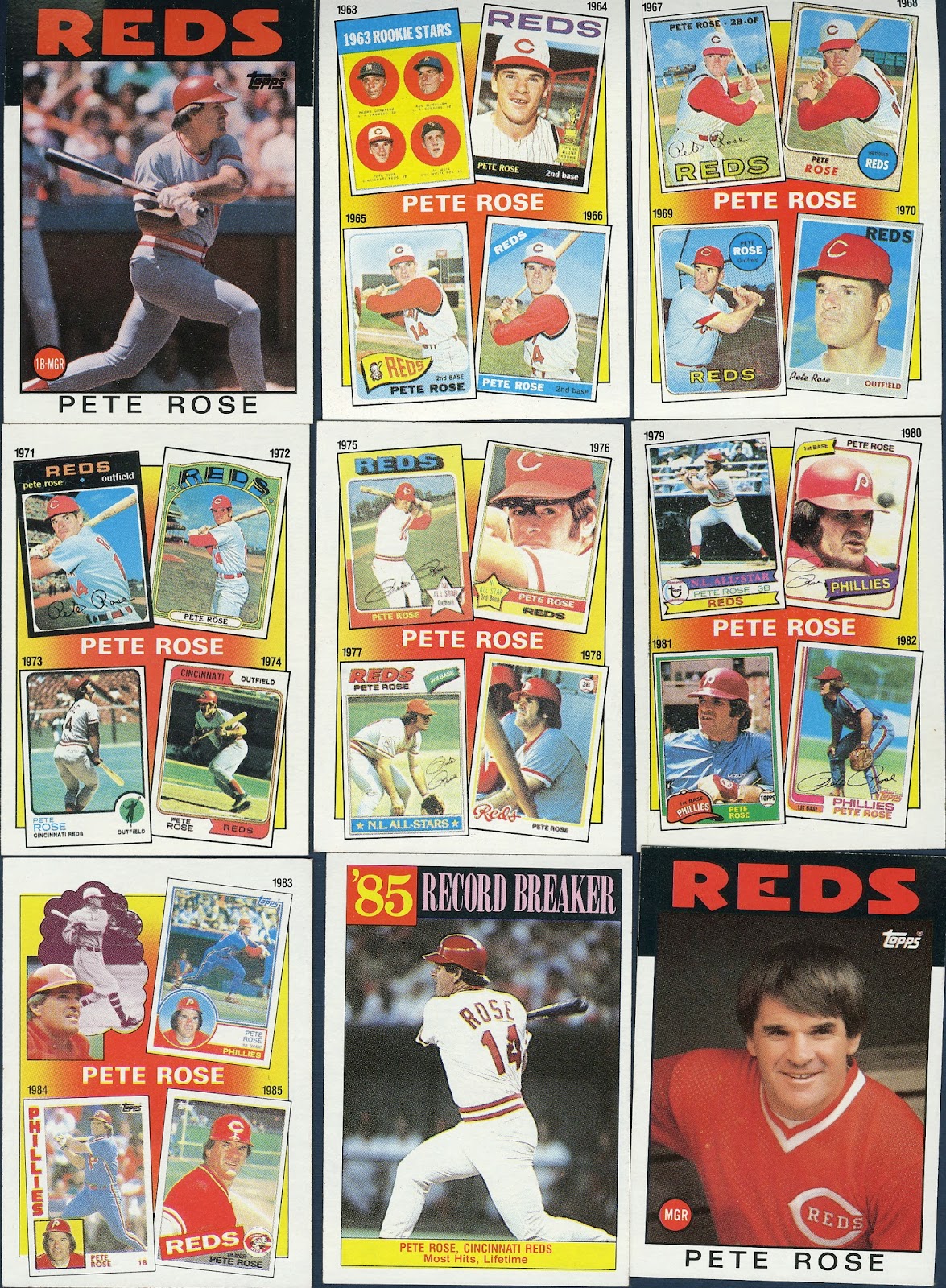
Special Topps cards from 1986 commemorating Rose passing Ty Cobb.

Pete Rose playing for the Phillies, illustrating why he was nicknamed "Charlie Hustle."

Rose during his brief stint with the Montreal Expos in 1984. He collected his 4,000th hit with the Expos.
Pete Rose is baseball’s all-time leader in hits, games, at-bats, and plate appearances. He’s 6th all-time in runs scored, 2nd in doubles, and 7th in total bases. Rose led the league in hits 7 times, doubles 5 times, runs scored 4 times, won 3 batting titles, was the 1963 NL Rookie of the Year, and the 1973 NL MVP. He was a 17-time All-Star, and made the All-Star team at 5 different positions, a record that will most likely never be broken.

Pete Rose played in his last major league game in 1986 and has been banned from major league baseball since 1989, yet he might still be baseball’s most divisive figure. Lots of ink has been spilled over Rose in the past 25 years, and Kostya Kennedy’s 2014 book Pete Rose: An American Dilemma, is the latest attempt to dissect the life and career of baseball’s all-time hit leader.  

Kennedy does a good job of analyzing the different parts of Rose’s life, with detours into the history of Cincinnati, and Pete’s relationship with his brother Dave. A highlight of the book was the section on the baseball career of Rose’s son Pete Rose Jr., who played professional baseball from 1989 until 2009, accumulating just 16 plate appearances and 2 hits in the major leagues in 1997. Like his father, Rose Jr. is a player with a tremendous work ethic. Pete Rose Jr. is now a manager in independent baseball, continuing his love affair with the game.
 
Pete Rose: An American Dilemma assumes a great deal of familiarity with Rose’s playing career, as it jumps around in chronology and doesn’t cover every year of Rose’s 24-year playing career. I was already quite familiar with Rose’s career, but I wish the book had provided more context for Rose’s remarkable accomplishments. 

Throughout the book, Kennedy never really comes down on one side or the other, for or against Rose. Does he think Pete Rose should be in the Hall of Fame? Does he think that Pete Rose should be reinstated? Kennedy never really says. Kennedy is harsh on Rose throughout the book, yet he clearly feels that the Hall of Fame’s treatment of Rose was unfair when it singled him out and changed the rules in 1991 so he wouldn’t appear on the ballot. The new rule stated that anyone on baseball’s ineligible list could not appear on the ballot for the Hall of Fame. Since Rose was the only player on the ineligible list, the rule change was obviously targeted at him. The Hall of Fame clearly didn’t want to deal with the possibility of Rose being voted into the Hall of Fame while at the same time being banned from baseball, which seems like the biggest oxymoron imaginable. 

Pete Rose’s behavior since 1989 is oftentimes incomprehensible to rational people. When it became clear during Major League Baseball’s investigation of his gambling habits that Rose would be banned, Rose and his lawyers fought for a paragraph in the document banning Rose that said he neither admitted nor denied having bet on baseball. This was a ridiculous assertion to make, and I don’t understand why then-Commissioner Bart Giamatti allowed such unclear language into the final document. If Rose wasn’t admitting that he bet on baseball, why was he being banned? If Rose hadn’t bet on baseball, why did he accept the ban? Major League Baseball should have forced Rose to admit in 1989 that he did bet on baseball. Instead, Rose lied for 15 years, not telling the truth and admitting that he bet on baseball until the release of his 2004 autobiography, My Prison Without Bars.
 
If Pete Rose were a smarter guy he might have been reinstated and be back in baseball by now. But I think he’s a dumb guy who really doesn’t understand what he did wrong. He knows that he broke the rules, but he’s never seemed ashamed that he broke the rules. As Kennedy says, Rose isn’t sorry for what he did, he’s only sorry that he got caught. Rose’s half-hearted apologies have never seemed sincere. 

In my opinion, in order to have any chance of getting back into baseball, Rose needed to do three things:

1. Come clean and tell the whole truth about betting on baseball
      2. Apologize for betting on baseball
      3. Stay as far away from gambling as possible

Rose has failed miserably at those three tasks, as he didn’t tell the truth or apologize until 2004, and he spends most of his time in Las Vegas, signing autographs at memorabilia shops. But signing his name for money has proven to be most lucrative for Rose, as according to Kennedy, Rose pulls down a guaranteed income of $70,000 a month in Las Vegas. Rose also might not have told the whole truth in 2004, when he said he bet on baseball “four or five times a week.” He amended that to saying in 2007 that he bet on baseball “every night.” Is there anything else Rose is saving for his next book?

Pete Rose is a contradiction. On one hand, he seems guileless, unflinchingly honest, and yet he lied about betting on baseball for 15 years. During his playing career, Rose was extremely savvy about cultivating his image as “Charlie Hustle,” by always running to first base on a walk, and always sliding into bases headfirst, whether it was necessary or not. But since he was banned from baseball, Rose seems tone-deaf to how he comes off to the public. 

Part of me likes Pete Rose. He was a great baseball player, someone who gave it his all out there on the field every single day he played. I met Pete Rose at a baseball card show to get his autograph, and he seemed like a nice guy in the thirty seconds I talked to him. I even watched his terrible reality show on TLC, “Hits and Mrs.” But he’s also a jerk who bet on baseball and doesn’t really seem to get why that’s such a big deal. And that’s the contradiction of Pete Rose. I think that Rose deserves to be in the Hall of Fame as a player, but I don’t think Rose should be in the Hall of Fame as long as he’s banned from baseball. I know that the Hall of Fame and Major League Baseball are different organizations, but for me, personally, if you’re banned from one, why should you be in the other?

If you’re interested in Pete Rose’s baseball career, and his post-baseball life, you should read Pete Rose: An American Dilemma. It’s a great introduction to one of baseball’s most controversial figures.